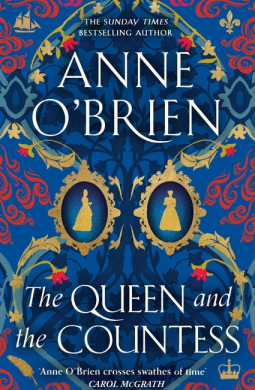
The Queen and the Countess by Anne O’Brien

I’ve been looking forward to reading Anne O’Brien’s new novel as it’s set in one of my favourite periods of history, the Wars of the Roses. O’Brien has written about this period before, from the perspectives of Anne Neville in Virgin Widow (which I haven’t read) and Cecily Neville in The Queen’s Rival, but this book is slightly different because it focuses on not just one woman but two: Margaret of Anjou, wife of Henry VI, and Anne Beauchamp, Countess of Warwick.

The two women take it in turns to narrate their story, alternating chapter by chapter throughout the book and beginning in 1458 with the Loveday Parade – a procession through London intended to promote peace between York and Lancaster, the two feuding branches of the royal House of Plantagenet. In the parade, Queen Margaret walks hand-in-hand with the powerful Duke of York, while Anne watches her husband, Richard, Earl of Warwick, walk with his rival nobleman, the Duke of Exeter. The peace is very short-lived, however, and the following year York and Lancaster are at war again.

As the mental health of the Lancastrian king, Henry VI, goes into decline and he gradually retreats from real life into a world of prayer, Margaret does her best to rule in his place, aiming to keep the throne safe for Prince Edward, their young son. When Margaret’s army is defeated in battle and Warwick helps to put the Yorkist heir, Edward IV, on the throne, it seems that her life is in ruins, but it’s not long before Warwick falls out of favour with the new king and comes to her ready to form a new alliance with Lancaster. Meanwhile, Anne stays loyal to her husband throughout all of this but, with no real influence over his decisions, she can only hope that he’s picked the right side this time…

I was intrigued by O’Brien’s decision to pair Margaret of Anjou’s story with the Countess of Warwick’s in this book. There are so many other interesting women from this period – Margaret Beaufort, the mother of Henry Tudor; Edward IV’s wife Elizabeth Woodville and her mother Jacquetta, to name a few – it seemed like a bit of an arbitrary choice to put these two together, but as I read on and saw the shape the novel was starting to take it did make sense. Margaret and Anne are at first on opposite sides of the conflict, then on the same side, but in the difficult position of never fully being able to trust each other, which is an interesting dynamic for O’Brien to explore. Although they are two very different women, there are some parallels between them which begin to emerge as the novel progresses.

This is an eventful and dramatic period of history, so there’s always something happening in the novel – a battle to be fought, a marriage to be negotiated, a plan for invasion to be put into place. Using two narrators rather than one gives O’Brien a wider scope instead of being limited to one character’s personal experiences. However, the two threads of the story come together now and then through a series of fictional letters sent between Margaret and Anne. I’ve no idea if they really corresponded or not (I don’t think there’s any evidence of it, and if they ever did, I doubt it would have been as often as depicted in the book) but it’s a nice touch and makes the lives of the two characters feel less separate and disconnected.

The narrative voices of the two women sound almost identical, so I had to pay attention to the section headings, otherwise it sometimes took me a few paragraphs to decide which of them was narrating. Margaret of Anjou never really seems to be portrayed in a very positive light and she’s not very likeable here either, but I could at least have some sympathy for her. She was in a very challenging situation, trying to hold onto the throne for Lancaster with a husband who didn’t understand what was going on and who was by now completely incapable of ruling. Anne is a much easier character to like, but then, she doesn’t have the difficult decisions to make that Margaret does. Things aren’t easy for Anne either, though, as her fate is determined by the actions of her husband, Warwick, and while she does involve herself in politics to a degree, she has very little say in the course her life will follow.

This is ultimately quite a sad story – anyone familiar with the Wars of the Roses will know what happens to Margaret, her husband and her son, and how Anne’s later life plays out (at one point she’s declared legally dead while still alive in order to settle an inheritance dispute) – but I enjoyed reading it. It was nice to see some links to O’Brien’s previous novel, A Court of Betrayal, whose heroine, Johane de Geneville, was an ancestor of Anne Beauchamp’s – something I wasn’t aware of until I started reading this book and Anne mentioned her great-great-grandmother! I’ll look forward to O’Brien’s next book, whatever it may be, but I should probably try to find time to go back and read the earlier ones that I’ve missed as well.

Thanks to Orion for providing a copy of this book for review via NetGalley.
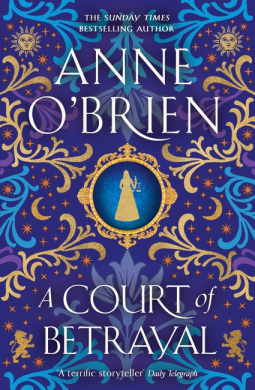
A Court of Betrayal by Anne O’Brien

I enjoyed Anne O’Brien’s last two novels, about the Pastons – one of England’s most influential families in the 15th century, who left behind a collection of correspondence known as the Paston Letters – and I wondered if she would continue to write about them in a third novel. However, with A Court of Betrayal she has chosen to tell a very different story: the story of Johane de Geneville.

Johane (or Joan) de Geneville is not a well known historical figure and most people have probably never heard of her, but as the wife of Roger Mortimer, 1st Earl of March, she played a part in an important and eventful period of English history. Having been imprisoned for leading a revolt against King Edward II, Mortimer escaped to France where he joined forces with Edward’s estranged queen, Isabella, and together they led a successful invasion of England in 1326. With Edward forced to abdicate and his young son crowned in his place, Mortimer and Isabella effectively ruled the country for several years. The Stone Rose by Carol McGrath, The She-Wolf by Maurice Druon and Isabella by Colin Falconer are just a few of the novels I’ve read that cover this period, but the focus is always firmly on Isabella, Edward and Mortimer. What was Johane doing while all of this was happening and how did she feel about it? These are the questions Anne O’Brien sets out to explore in A Court of Betrayal.

The novel is written in the first person from Johane’s perspective and I found her much more likeable and sympathetic than some of O’Brien’s other heroines. Throughout the course of the novel, as the title would suggest, she experiences and witnesses betrayal of many kinds, but the most significant for Johane personally is the betrayal she faces at the hands of her own husband. The marriage between Johane and Roger Mortimer is portrayed as a happy one at first. Although it was an arranged marriage, which was normal amongst the medieval nobility, there seems to be genuine love and affection between them and they go on to have twelve children together. This all changes when Mortimer begins an affair with Isabella and makes no real attempt to hide it, either from Johane or from the public – and even insists on Isabella being accepted as a guest in Johane’s home. I feel bad that, despite having read about the Mortimer/Isabella relationship before, I’ve never really given any thought to the fact that Roger had a wife!

With the story being told from Johane’s point of view, there’s a limit to the things she sees and experiences for herself (particularly as she spends large chunks of the novel imprisoned or under house arrest) and information often comes to her via other people. This doesn’t make the novel boring, however; there’s always something happening in Johane’s personal life and it’s still interesting to read about the political developments happening elsewhere even if we’re not seeing them at first-hand. Like most periods of history, this one has its fair share of controversies, mysteries and other matters on which historians have never been able to agree – how and when did Edward II die, for example, and what was the nature of his relationships with his favourites, Piers Gaveston and Hugh Despenser? O’Brien has her opinions on these things and incorporates them into the plot. It’s all very fascinating, whether you’ve read about this period before or not.

Although I haven’t read all of Anne O’Brien’s books yet, I have read a lot of them and I think this is one of her best. I’ve discovered that her next novel, due in 2025, is going to be set during the Wars of the Roses and will tell the stories of Margaret of Anjou and Anne, Countess of Warwick. Something to look forward to!

Thanks to Orion for providing a copy of this book for review via NetGalley.

Book 36/50 for the Historical Fiction Reading Challenge 2024

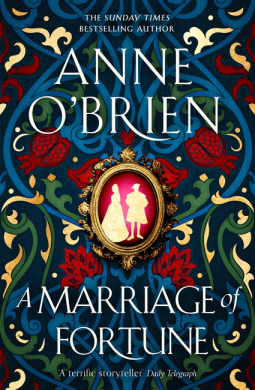
A Marriage of Fortune by Anne O’Brien

This sequel to The Royal Game continues the story of the Paston family. The Pastons were an influential Norfolk family during the 15th century and left behind a collection of private correspondence, known as the Paston Letters, which are a valuable source of information on life in England at this time. In this novel and her previous one, Anne O’Brien brings the story of the Pastons to life, using their letters to provide the outline of the plot. You could read this book as a standalone if you wanted to, but I would recommend reading both in order if you can.

A Marriage of Fortune is again narrated by several of the Paston women. First there’s Margaret Mautby Paston, now a widow with seven children. Her eldest son, Sir John, is now head of the family following the death of his father, but Margaret still takes an active part in managing the household, arranging the marriages of her younger children and continuing the ongoing feud against the Duke of Norfolk over the ownership of Caister Castle. Margaret’s priority is seeing that the Pastons continue to rise through the ranks of society, so she is furious when her eldest daughter Margery announces that she is in love with the family bailiff, Richard Calle. She refuses to allow a marriage between the two, but is unprepared for the lengths to which Margery is prepared to go.

The relationship between Margaret and Margery is very sad to read about. Margery is another of our narrators, which means we get to know exactly how she feels about her mother’s refusal to accept her love for Richard and the family estrangement that occurs as a result. Margaret believes that a daughter’s first duty should be to her parents and that Margery has no right to consider her own happiness, but there’s always a sense that she might come to regret taking this stance and we are kept wondering whether mother and daughter will be reconciled in the end.

We also hear from Margaret’s sister-in-law, Elizabeth Paston Poynings, whose husband has been killed fighting on the Yorkist side at the Second Battle of St Alban’s, leaving her a widow with a young son. Like Margaret, Elizabeth has found herself facing a struggle to hold on to her late husband’s estates, which are being claimed by the powerful Percy family. A fourth narrator is Anne Haute, cousin of Elizabeth Woodville, Edward IV’s queen. Anne is betrothed to Margaret’s son, Sir John Paston, but with the rapidly changing political situation in England – Edward IV on the throne one minute, Henry VI the next – it seems that Sir John is reluctant to either make the marriage official or release her from it. I had a lot of sympathy for poor Anne when she begins to discover that she’s wasted years of her life on a man who clearly doesn’t really love her.

I enjoyed A Marriage of Fortune; this is one of my favourite periods to read about, but I still haven’t read the original Paston Letters or Helen Castor’s non-fiction account of them, Blood and Roses, despite having had the latter on my TBR pile for several years now. This was maybe a good thing as far as this novel was concerned, as it meant that although I was familiar with the historical background – the kings and queens, the battles and rebellions – I didn’t know the personal stories of the individual Paston family members, so I never knew what was going to happen to them next. However, I do think this novel, like the first one, was slightly too long, with a lot of information packed into it. It may have been better to have focused on fewer characters; Elizabeth Poynings’ story, in particular, felt very separate from the others and could possibly have been left out.

I’m not sure whether there will be a third book on the Pastons or whether Anne O’Brien will be moving on to something else now. Either way, she always chooses interesting historical women to write about so I know it will be worth looking forward to.

Thanks to Orion for providing a copy of this book for review via NetGalley.
This is book 2/50 read for the 2023 Historical Fiction Reading Challenge.

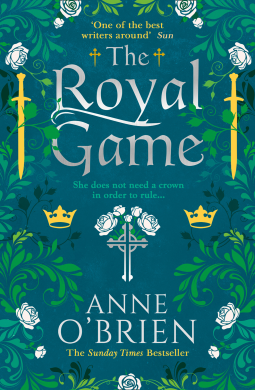
The Royal Game by Anne O’Brien

With a title like The Royal Game, you might expect this novel to be about a king or a queen; in fact, it’s the story of the Pastons, who rose from humble origins to become members of the aristocracy and one of Norfolk’s most influential families during the 15th century. Their collection of personal letters, known as the Paston Letters, is the largest archive of private correspondence surviving from the period and tells us a lot about life in England at that time.

The Pastons’ story is retold by Anne O’Brien in fictional form, using the letters as a guide. She has chosen to focus on three characters in particular: Margaret Mautby Paston, wife of John Paston, who becomes head of the family after the death of his father; John’s sister Elizabeth (known as Eliza); and Anne Haute, a cousin of Edward IV’s queen, Elizabeth Woodville. There are chapters written from the perspectives of each of these women, mainly Margaret and Eliza at first, with Anne only introduced halfway through and becoming more prominent towards the end of the book.

During the period covered in the novel, the Wars of the Roses are playing out in the background as the House of Lancaster and the House of York fight for control of England’s throne. The Pastons are an ambitious family who see the changing political situation in terms of what it will mean for them and how they can turn things to their own advantage in order to increase their wealth and power. This means that much of the story is concerned with the gaining and losing of properties and land, disputes over wills and controversies surrounding inheritances. In particular, estates left to John Paston by his patron Sir John Fastolf (the inspiration for Shakespeare’s Falstaff), become the subject of a long legal battle.

I liked this book much more than Anne O’Brien’s previous one, The Queen’s Rival, partly because this one is written in a more straightforward format – although with the alternating narrators I mentioned above. I felt that the narrative voices of Margaret and Eliza were very similar and sometimes I had to remind myself which one I was reading about, but this was less of a problem as I got further into the book. Margaret is portrayed as a strong, intelligent and resourceful woman working alongside her husband to hold on to the family property, while Eliza is being badly treated by her mother and desperately hoping for marriage as a way of escape. Eventually, both women find themselves with the same focus in life: to protect their children’s titles and inheritances from jealous rivals who are trying to claim them for themselves. Our third narrator, Anne Haute, who is depicted as another young woman with ambition and hopes of an advantageous marriage, seems unconnected to the other two at first, but quickly becomes drawn into the Pastons’ world.

The Wars of the Roses is one of my favourite historical periods to read about and it made a nice change to move away from the usual novels set at the royal court or on the battlefields and see what was going on elsewhere in the country at that time. I enjoyed this book but it’s very long and detailed and I was surprised when I reached a cliffhanger ending and discovered that there’s going to be a sequel. I will look out for it, but while I wait maybe this would be a good time to read my copy of Blood & Roses, Helen Castor’s non-fiction book about the Paston family.

Thanks to HQ for providing a copy of this book for review via NetGalley.
Book 47/50 read for the 2021 Historical Fiction Reading Challenge.

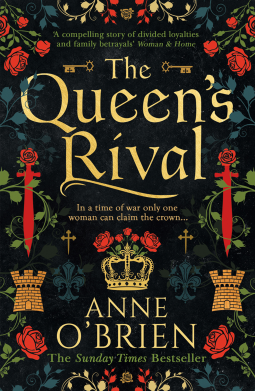
The Queen’s Rival by Anne O’Brien

Having read six of Anne O’Brien’s previous novels, I thought I knew exactly what to expect from this one, but I was wrong. It couldn’t be more different! I’m not sure that every aspect of it really worked for me, but it’s nice to see authors trying something new now and then.

The Queen’s Rival is the story of Cecily Neville, Duchess of York, mother of Edward IV and Richard III. As a prominent member of the House of York, Cecily has an important role to play in the Wars of the Roses, yet she is often just a minor character in novels set during this period. Joanna Hickson’s Red Rose, White Rose is the only other book I’ve read which focuses specifically on Cecily, so I was keen to see how O’Brien would choose to tell her story.

The way O’Brien chooses to tell her story is through a series of letters sent between Cecily and various members of her family, as well as diary entries, prayers, recipes and articles from a (fictitious) newspaper called England’s Chronicle. From Cecily’s perspective we see all of the major events of the Wars of the Roses unfold – the attempts of her husband, the Duke of York, to claim the throne of England for himself; the events that lead to the defeat of Henry VI and to Cecily’s eldest son Edward becoming king; the controversy surrounding Edward’s marriage to Elizabeth Woodville; and finally, the end of Edward’s reign and the coronation of Cecily’s youngest son, Richard.

The epistolary format gives the story a feeling of immediacy and intimacy, especially where Cecily is exchanging letters with her sisters Anne and Katherine (both of whom also see their fortunes rise and fall several times throughout the novel). However, as all of the other O’Brien novels I’ve read have been written in ordinary prose, this change in style and structure was completely unexpected and, as I’ve said, not completely to my taste. I particularly disliked the excerpts from the Chronicle, which were written in the gossipy style of a modern tabloid newspaper, but I’m sure Anne O’Brien knew that newspapers in this form didn’t exist in the 15th century, so I do appreciate that it was intended as a bit of fun, as well as a way to provide information that might not otherwise have been available to Cecily.

Still, I did find the book entertaining overall. This is such a fascinating period of history with so much still open to debate, so many mysteries and controversies, that it never fails to interest me – although sadly, the novel ends just as Richard III is coming to the throne, so the mystery of the Princes in the Tower is not explored. Cecily herself comes across as an intelligent, politically astute woman who is loyal to her family, but without being blind to their faults. I did wonder about the title: was she a ‘rival’ to Margaret of Anjou, Henry VI’s queen, or Elizabeth Woodville, Edward IV’s queen? It could refer to either or both, I think.

Despite this probably being my least favourite Anne O’Brien book so far, I will still look forward to her next novel, The Royal Game, about the 15th century Paston family, which is due to be published later this year.

Book 3/50 read for the Historical Fiction Reading Challenge.

A Tapestry of Treason by Anne O’Brien

One of the things I like about Anne O’Brien’s books is that they tend to be about women who are not usually the subjects of historical fiction. I have read five of her previous novels, all set in the 14th and 15th centuries, which told the stories of Katherine of Valois, Elizabeth of Lancaster, Joanna of Navarre, Joan of Kent and Elizabeth Mortimer. Now, in her latest novel, A Tapestry of Treason, she brings another medieval woman out of obscurity and gives her a voice. She is Constance, Lady Despenser, daughter of Edmund of Langley, Duke of York, the fourth surviving son of King Edward III of England.

The novel opens in 1399. Constance’s cousin, Richard II, has reigned for over twenty years but another cousin, Henry of Lancaster, now has his eye on the throne. The York branch of the family – Constance, her father, her brothers Edward and Dickon, and her husband Thomas Despenser – must decide with whom their loyalties lie, knowing that if they give their support to the wrong man they could lose everything, including their lives. History tells us that Henry would be successful, taking the throne as Henry IV when Richard abdicates, but of course Constance and her family don’t know how things will play out and this leaves them with some difficult choices to make.

Cold, ambitious and determined, Constance is not an easy character to like, but the fact that the story is told from her point of view allows us to have a certain amount of sympathy for her. She makes some terrible mistakes and, despite having grown up in a world of shifting politics and court intrigue, she judges the situation wrongly on several occasions and pays the price for it. It’s frustrating to see her at the heart of one plot or conspiracy after another and she never seems to learn from her mistakes, but as we get to know Constance better we understand that she is only trying to look after her family’s interests and help them to advance in any way they can. In this respect she reminded me of Elizabeth Mortimer, heroine of Queen of the North, who is actually involved in some of the same conspiracies.

Constance’s hard and emotionless exterior can probably be explained by the lack of love she has experienced throughout her life. Her parents have shown her very little affection – and although her husband, Thomas Despenser, is not a cruel man, their marriage took place at a very early age and was definitely a political match rather than one based on love. There is a chance of romance for Constance later in the novel, but she makes mistakes here too and risks having her heart broken.

There are two other relationships in this book which interested me more than the romantic one. The first is Constance’s relationship with her elder brother, Edward of York, a man who is as ambitious and ruthless as Constance herself, but unlike his sister, thinks only of himself. He shows no real loyalty to anyone and is ready to betray his family and friends if it means saving his own skin, yet Constance always gives him the benefit of the doubt and it is never quite clear whether he cares for her even a little bit or not at all. The other is the relationship between Constance and her young stepmother, Joan Holland. At first they make no secret of the fact that they dislike each other but as the story progresses they settle into an uneasy friendship.

A Tapestry of Treason is not my favourite Anne O’Brien book; although this is a fascinating period of history, I felt that for a long time Constance was plotting and scheming in the background, watching events unfold from afar rather than taking an active part in her own story. Not the author’s fault, but an indication of the limitations and constraints placed on women at that time. It’s only from the middle of the novel onwards that Constance begins to play a bigger role and becomes more directly involved in carrying out her treasonous plots.

I did still enjoy the book, though, and it was interesting to read about the origins of the conflict between the houses of Lancaster and York which would later intensify and lead to the Wars of the Roses. Now I’m wondering if there are any other fictional portrayals of Constance of York; if you know of any please let me know!

Thanks to the publisher HQ for providing a copy of this book for review via NetGalley.
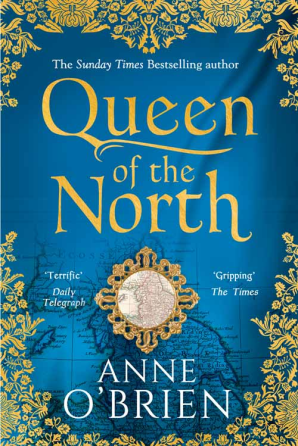
Queen of the North by Anne O’Brien

Having enjoyed some of Anne O’Brien’s previous books, I was excited to learn that her latest novel, Queen of the North, was going to tell the story of Elizabeth Mortimer, wife of the famous Harry Hotspur, heir to the Earl of Northumberland in the late 14th and early 15th centuries. So much English historical fiction concentrates on London and the south, it’s always nice to find something set in my part of the country instead.

The novel opens in 1399; King Richard II is still on the throne, but for how much longer? His power is weakening rapidly and the exiled Henry of Lancaster is preparing to return to England and reclaim his lands. Elizabeth Mortimer’s husband, Harry Percy (known as Hotspur), and his father, the Earl of Northumberland, are among the northern Lords who decide to take Lancaster’s side against the King. This worries Elizabeth, who is convinced that Lancaster’s ultimate goal is the throne of England itself – and soon she is proved right.

Although Lancaster is Elizabeth’s cousin, she is disappointed when the Percy family support him in deposing Richard and claiming the crown. She believes that her young nephew, Edmund Mortimer, has a stronger claim and she is determined to do whatever it takes to help him take his rightful place as King. This will bring Elizabeth into conflict not only with the newly crowned Henry IV but also with her husband and she will have to decide where her loyalties truly lie: with the Mortimers or with the Percys?

Elizabeth’s efforts on Edmund’s behalf eventually lead her to Wales, where Owain Glyn Dŵr is planning a rebellion and looking for support from the Mortimers and Percys. Alliances are formed and broken, friends become enemies then friends again in an instant; it’s a dangerous time, but a fascinating one to read about!

I loved Queen of the North; I think it’s my favourite of the five Anne O’Brien novels I’ve read so far. As I’ve said, I really liked the northern setting, which gave me some glimpses of places I know and have visited, such as the Percy stronghold of Warkworth Castle when it was a living, working building rather than the semi-ruin it is today. The Percys were one of the most powerful and influential families in the north of England at that time; they were wardens of the Marches (the area surrounding the border with Scotland) and virtually ruled the north on behalf of the king, but this did not mean they could not be brought down and replaced if they fell out of royal favour. Anne O’Brien does a great job of showing how precarious their position actually was, when an error of judgement, a wrong decision or an act of betrayal could mean their downfall.

The central two characters in the novel are well drawn, strong and convincing. I liked Elizabeth – although her obsession with putting her nephew on the throne becomes frustrating at times (partly because we already know from history that she wouldn’t succeed), but it’s obvious that it means a lot to her and that she is only doing what she believes is right. With her husband reluctant to help and the old Earl completely in opposition, she takes matters into her own hands and although her actions are not always sensible I did admire her courage and persistence. I also liked Harry, nicknamed Hotspur because of his brave, reckless and impulsive nature. His relationship with Elizabeth is very convincingly portrayed – their personalities clash at times and they don’t always see eye to eye, but their love is strong enough to survive these differences of opinion.

Because we are seeing things through Elizabeth’s eyes, a lot of important events – such as battles, rebellions and some of Hotspur’s meetings with Henry IV – take place ‘off the page’. However, this does not mean that Elizabeth’s personal story is boring; she has plenty of adventures of her own as she tries to navigate her way through the various plots and schemes of the shrewd old Earl of Northumberland, the Welsh hero Owain Glyn Dŵr, and her own Mortimer relatives. There’s never a dull moment and in comparison to Anne O’Brien’s last book, on Joan of Kent, I think this is a much more exciting and compelling novel. Speaking of O’Brien’s other books, there is also some overlap here with The Queen’s Choice, which tells the story of Henry IV’s wife, Joanna of Navarre.

I really enjoyed Queen of the North – and have been reminded that I never did look for the final two books in Carol Wensby-Scott’s Lion trilogy, which was my only other encounter in fiction with Elizabeth and Hotspur. Can anyone recommend any more books set in this time and place?

Thanks to the publisher HQ for providing a copy of this book for review via NetGalley.