Historical Musings #37: Reading Anya Seton

Welcome to my monthly post on all things historical fiction. Last month, I looked at the work of Elizabeth Chadwick; this month it’s the turn of another historical fiction author: Anya Seton.

Anya Seton was the pseudonym of Ann Seton Chase, an American author born in Manhattan in 1904. She died in 1990 aged eighty-six, having written twelve novels, some of which were bestsellers and some which were adapted for film.

I have read six Anya Seton novels, although she was an author I discovered years before I started my blog, so I don’t have reviews to link to for most of these books.
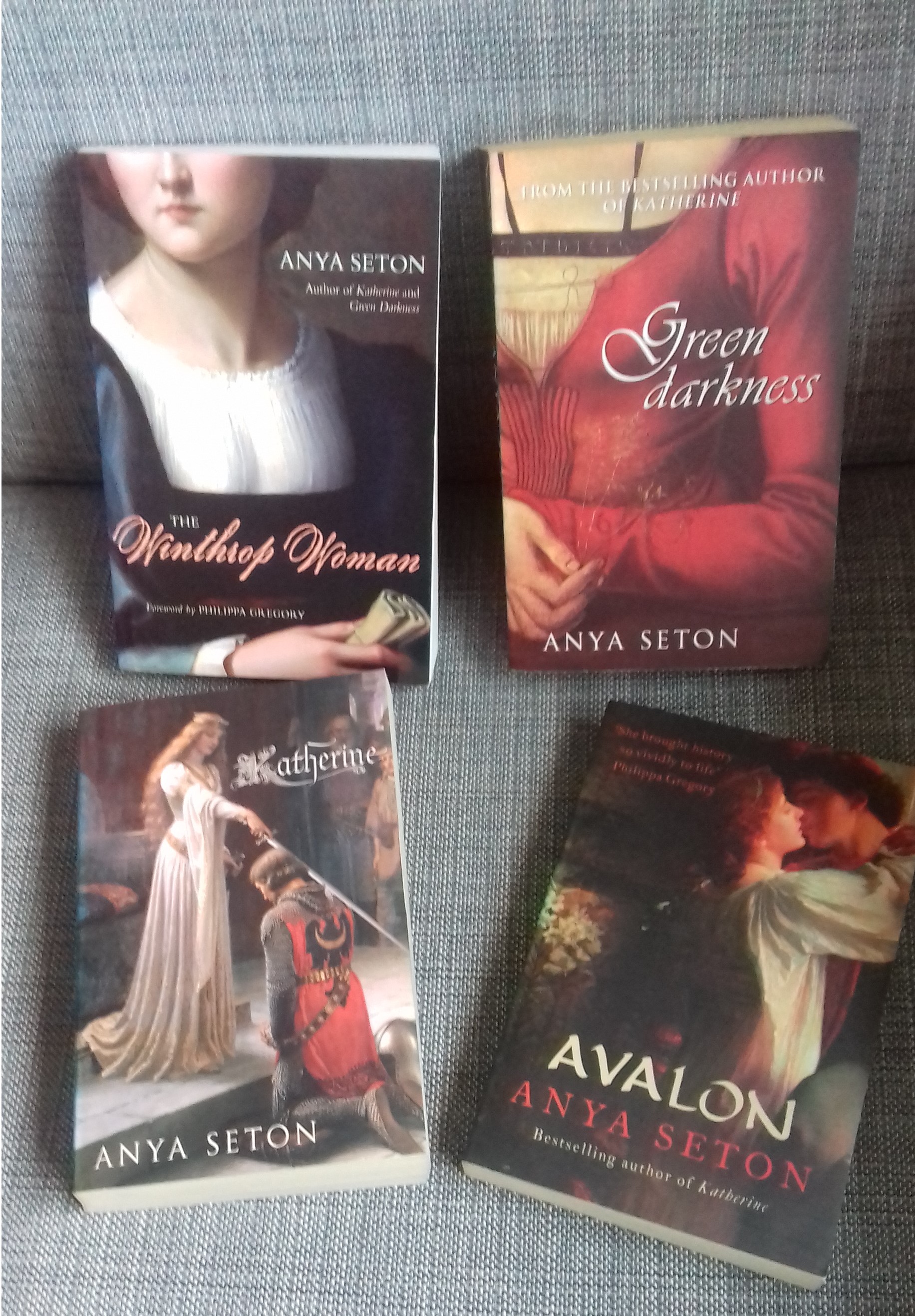
Katherine (1954)

This is probably Seton’s most famous novel. It was my first introduction to her work and, in fact, I think it was the first book I read that dealt with real historical figures rather than fictional characters in a historical setting. The Katherine of the title is Katherine Swynford, mistress of Edward III’s son John of Gaunt. The descendants of Katherine and John were the Beauforts, who included Margaret Beaufort, mother of King Henry VII. I thought it was a wonderfully moving story and a vivid portrayal of 14th century England – the world of Edward III and Richard II, the Black Death and the Peasants’ Revolt, Geoffrey Chaucer and Julian of Norwich.

Green Darkness (1972)

Green Darkness was the second Anya Seton novel I read and, although I enjoyed some aspects of it, I thought it was slightly disappointing after Katherine. It’s a reincarnation story about a present day (1960s) woman who revisits her former life in Tudor England, during which she lived with the wealthy Browne family and fell in love with the family chaplain. The 16th century romance didn’t really work for me but I did like the setting, particularly the descriptions of the manor house, Ightham Mote.

The Winthrop Woman (1958)

This was another one I loved. It tells the story of Elizabeth Fones, a young Puritan woman who, in the 17th century, marries into the family of John Winthrop, the first governor of the Massachusetts Bay Colony. I can’t remember very much else about this book now, but I did find it interesting because I had never read anything about this period of American history before.

Avalon (1965)

Avalon is my least favourite of the Anya Seton books I’ve read, although that could be because, at the time when I read it, the setting didn’t particularly interest me as I preferred reading about later periods. The story takes place in the 10th century and follows the adventures of Rumon, a nobleman from Provence who is shipwrecked off the coast of Cornwall, and Merewyn, a Cornish girl who believes she is a descendant of King Arthur. Maybe I’ll try reading this book again one day to see if my opinion of it has changed.

Devil Water (1962)

Having read the four books above, it wasn’t until years later that I picked up my fifth, Devil Water, in the library. This one centres around the Jacobite Rebellions of 1715 and 1745, focusing on two English Jacobites, James Radcliffe, the 3rd Earl of Derwentwater, and his younger brother, Charles. Later in the book, Charles’ daughter travels to America, to the plantations of colonial Virginia. Although this wasn’t a favourite, it was of particular interest to me because the first half of the novel is set in the North East of England, which is where I’m from.

Dragonwyck (1944)

This was the last Anya Seton book I read, in 2013. This one is a gothic novel about a young woman from Connecticut who becomes a governess in the home of Nicholas Van Ryn in Hudson, New York. Again, not an absolute favourite, but I did love the historical setting – the Anti-Rent War, the Astor Place Riot of 1849, steamboat races on the Hudson River and even an appearance from Edgar Allan Poe!

I still haven’t read the rest of Seton’s novels, partly because I have already read the ones which appealed to me the most. The other titles are:

My Theodosia (1941)
The Turquoise (1946)
The Hearth and Eagle (1948)
Foxfire (1950)
The Mistletoe and Sword (1955)
Smouldering Fires (1975)

I do have a copy of The Turquoise, which I will read eventually, but if you have read any of the others please let me know what you thought of them!

I will be looking at another author of historical fiction in next month’s post, but for now:
Have you read any of Anya Seton’s novels? Which are your favourites?
Dragonwyck by Anya Seton

Dragonwyck - Anya Seton Sorry for neglecting my blog recently…I’ve had a busy two weeks at work and haven’t had much time or enthusiasm for blogging. Luckily I have a week off now and will be able to catch up on telling you about all the books I’ve been reading, beginning with this one, Dragonwyck, which I read for the R.I.P challenge.

I had been looking forward to reading this book for a long time, having been a fan of Anya Seton’s for years and also being a lover of both historical fiction and gothic novels. Dragonwyck is a combination of both – it includes some typical gothic elements (mysterious deaths, a mansion with haunted rooms and an old servant who tells tales of ghosts and curses) but it also has a fascinating and thoroughly researched historical background.

One day in 1844 Abigail Wells, wife of a Connecticut farmer, receives a letter from her rich cousin, Nicholas Van Ryn, offering to take one of her daughters into his home as a governess for his own young daughter, Katrine. Eighteen-year-old Miranda is the one who is chosen and she is thrilled to be given this opportunity to improve her situation in life. Nicholas is the Patroon (landowner) of a large estate called Dragonwyck in Hudson, New York, and after growing up on her parents’ farm the naïve and romantic Miranda is immediately captivated by the handsome Nicholas, his luxurious home and his aristocratic lifestyle.

Soon she becomes aware that she is falling in love with Nicholas and is sure he feels the same way – the only problem is, Nicholas is married. When tragedy strikes at Dragonwyck, Miranda’s life is transformed again, but this time she begins to uncover some of the house’s dark secrets and to learn the truth about her mysterious cousin Nicholas. As Anya Seton explains in her author’s note introducing the story: “All Gothic magnificence and eerie manifestations were not at that time inevitably confined to English castles or Southern plantations…”

As a gothic novel I didn’t find Dragonwyck particularly creepy – although it’s certainly a very dark book, with an oppressive, unsettling atmosphere. But the real attraction of this book for me was its wonderful historical setting that gave me some fascinating insights into areas of American history I hadn’t read about before. We learn about the Patroon system, for example, which began when landholders in the Dutch colony of New Netherland were given power over large areas of land, similar to the feudal system in medieval Europe. This led to an uprising of the tenants known as the Anti-Rent War and this forms a large part of Dragonwyck’s historical backdrop. We also learn about the Astor Place Riot during William Charles Macready’s performance in Macbeth and about the steamboat captains who would race each other on the Hudson River with total disregard for the safety of their passengers, sometimes with fatal consequences.

There are also a few brief appearances by real historical figures, most notably Edgar Allan Poe, but these felt as if they had been woven naturally into the story rather than name-dropping for the sake of it (in fact, the Poe episode does have a significance to the plot which only gradually becomes apparent later in the story). The main focus though, is on the three main fictional characters – Miranda, Nicholas and the doctor, Jeff Turner – and you’ll notice I haven’t said much about any of those three, because to attempt to explain why I liked or disliked each character would risk giving away too much of the story.

I did enjoy Dragonwyck but not as much as some of Anya Seton’s other novels (and I don’t think it really comes close to the brilliance of Jane Eyre or Rebecca, two books that it has been compared with). I do love reading ‘older’ historical fiction novels like this one though, as they seem to somehow have a completely different feel from modern ones. This book was published in 1944 and there’s a film too from 1946 with Gene Tierney and Vincent Price. I haven’t seen it, so I’d be interested to know what it’s like and how faithful it is to the book.

As well as this book, I have now read Katherine (one of my favourite historical fiction novels), Green Darkness, The Winthrop Woman, Avalon and Devil Water. If there are any of her others that you think I should look out for, please let me know which ones!

Devil Water by Anya Seton

Several years ago I had the pleasure of discovering Anya Seton’s historical fiction novels. The first one I read was Katherine, the story of Katherine Swynford and John of Gaunt, quickly followed by Green Darkness, Avalon and The Winthrop Woman. After that I moved on to other authors and never got round to reading Seton’s other novels. And so I was pleased to come across one I hadn’t read, Devil Water, in the library. This book was originally published in 1962 and the story takes place during the Jacobite Rebellions of 1715 and 1745.

Devil’s Water is the name of the river that flows past Dilston, a village in Northumberland in the north east of England. In the early 18th century, when Anya Seton’s novel begins, Dilston is home to the Radcliffe family. James Radcliffe, the 3rd Earl of Derwentwater, and his younger brother, Charles, are descendants of King Charles II and were both real historical figures.

The first half of the book concentrates on the life of Charles Radcliffe and his secret marriage to a working-class Northumberland girl, Meg Snowdon, with whom he has a daughter, Jenny. Both Charles and his brother, the Earl, are Catholics and Jacobites (supporters of the Catholic James Stuart who is living in exile in France while his half-sister, the Protestant Queen Anne, reigns in his place). In 1715 the Radcliffes join the Jacobite Rising in an attempt to put James, who they consider their rightful king, on the throne. When the rebellion ends in defeat, Charles escapes to France and leaves Jenny to be raised in London by his friend, Lady Betty Lee. Throughout the second half of the book the focus is on Jenny’s adventures which take her across the Atlantic to the plantations of colonial Virginia in search of Rob Wilson, the man she loves.

This book was particularly interesting to me as I’m from the north east of England myself. There are very few novels set in this part of the country so it was nice to read about places that I’m familiar with. I appreciated the effort Seton made to reproduce various local dialects, depending on whether a character comes from Northumberland, London, Scotland, Ireland, Virginia or elsewhere. Although the northern dialects didn’t always seem quite right to me, it wasn’t a bad attempt and it gave the book a more authentic feel. And the characters never sounded too modern or used language that felt out of place either.

Although I knew absolutely nothing about the Radcliffes before reading Devil Water, you can always trust that an Anya Seton novel would have been well researched and as historically accurate as she could make it, while bearing in mind that it’s still fiction and not everything that happens in the book will be completely factual. This book includes two author’s notes at the beginning and end in which she details the research she carried out and explains which parts of the story are likely to be true. There are also some useful maps and family trees which I found myself referring to occasionally. Don’t worry though, because the book is easy enough to read and doesn’t feel like a history lesson at all.

So, I loved the settings and the time period (I’ve read historical fiction about the Jacobites before and it always makes me feel sad, knowing what the outcome will be) but I did have one or two problems with the book. I thought it was much longer than it needed to be and seemed to take forever to read; the pacing didn’t feel right either – some parts of the book dragged and there were some big jumps forward in time, often leaving gaps of ten years. But the main thing that prevented me from really loving this book was that some of the characters were very difficult to like. I never managed to feel any connection to Charles and was more interested in his brother, the Earl of Derwentwater. And another character, who I had just started to warm to, does something really unforgivable that completely changed my impression of them. I did like Jenny (and a few of the minor characters, such as Betty Lee) but because the people around her were so unlikeable, the story didn’t have the emotional impact on me that it might otherwise have done.

Have you read any other Anya Seton books that I haven’t read yet? Which ones would you recommend?