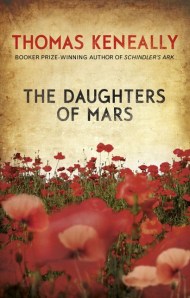
The Daughters of Mars by Thomas Keneally

The Daughters of Mars Until I picked up The Daughters of Mars in the library I was only really aware of Thomas Keneally as the author of Schindler’s Ark (which I haven’t read), the book on which the film Schindler’s List was based. I was surprised to find that he has written more than forty other books (both fiction and non-fiction) and I’m pleased that I’ve finally read one. The Daughters of Mars is the story of two Australian sisters, Naomi and Sally Durance, who serve as nurses with the Australian Army Nursing Service during the First World War. I had a few problems with the book, mainly due to the unusual writing style, but it gave me lots of fascinating insights into the challenges facing wartime nurses.

When we first meet the Durance sisters, they are leading very different lives: Naomi has left home and has gone to work at a hospital in Sydney, while Sally has remained on the family dairy farm in the Macleay Valley and is caring for their sick mother. The two girls have little in common other than a love of nursing but an unwelcome bond is formed between them when their mother dies under tragic circumstances. Deciding to get away for a while from Australia and the memories it holds, they enlist on the hospital ship Archimedes. Sailing first to Egypt and then to the Dardanelles, the sisters are kept busy treating casualties of the Gallipoli Campaign and as the war progresses, they find themselves in separate hospitals on the Western Front where they face the horrors of trench warfare and gas attacks.

The work is demanding, dangerous and emotionally draining, but also very rewarding. As well as learning new skills, both girls find new friends among the other young nurses and meet the men they hope to spend the rest of their lives with. Of course, nothing is certain in times of war and there’s no guarantee that either they or the men they love will survive long enough for marriage to become a possibility. And the most important relationship of all – the one between Naomi and Sally – will remain tense and strained until the sisters can find a way to put the past behind them.

I can’t say that I particularly enjoyed reading The Daughters of Mars, but I did find it interesting to learn about the work of the Australian nurses, which is something I haven’t read about before. Most of what we hear about the Great War involves stories of men fighting on the front lines, but it’s important to remember the important contribution of these brave women who also played their part in helping the war effort. While I have read British author Vera Brittain’s first-hand account of life as a wartime nurse, Testament of Youth (which I highly recommend), this is the first time I’ve read about the same subject from an Australian perspective. It was fascinating, although if you’re squeamish I should warn you that Sally and Naomi are faced with all kinds of gruesome battle wounds, injuries and illnesses – and they are described in a lot of detail, along with the medical procedures and surgical operations that are used to treat them.

Now I need to explain what I didn’t like about this book and it’s something that’s really a matter of personal taste. In his author’s note, Keneally tells us that if the use of punctuation in the novel sometimes seems unusual it’s because he has taken inspiration from ‘the forgotten private journals of the Great War, written by men and women who frequently favoured dashes rather than commas’. The dashes didn’t bother me, but the lack of quotation marks did! We use punctuation to indicate speech for a reason and because it wasn’t there I found that the text didn’t flow properly, which made it unnecessarily difficult to read. I felt that I was viewing the events of the story from a distance and never fully engaged with either Durance sister. In fact, I found most of the characters quite bland and difficult to tell apart. There was none of the passion and emotion that I would have expected from a book like this.

I can’t comment on the accuracy of the book (as I said, wartime nursing is not a subject I know much about) but it does seem to have been very well researched and covers almost every aspect of the war you can think of from conscription and conscientious objectors to shell shock and the Spanish flu. Despite the problems I had with Keneally’s writing, I found the story interesting enough to keep reading until I reached the end. And what an intriguing ending it was! Unfortunately I can’t tell you what was so special about it, but it was completely unexpected and I’m still not sure whether I liked it or not – it’s the sort of ending that will leave you wondering why the author chose to end the book in that way and what message he wanted us to take from it.

If anyone has read any other Thomas Keneally books, let me know if you think I should try another one. Are his other books written in a more conventional style?

The Light Between Oceans by M.L. Stedman

The Light Between Oceans is the story of Tom and Isabel Sherbourne, a young couple living on the remote island of Janus Rock, off the coast of Australia. Tom, who has recently returned physically unharmed from fighting in the Great War, has taken a job as lighthouse keeper on the island.

One day in 1926, a boat is washed up on the shore of Janus, with a baby girl and a dead man inside. Isabel, who has just suffered the latest in a series of miscarriages and stillbirths, sees this as a second chance and is determined to keep the baby. Tom is not so sure, but he loves his wife and she convinces him that it’s the right thing to do. Raising Lucy as their own child, it’s not long before Tom and Isabel can’t imagine life without her, but their decision to keep her leads to other important choices that have to be made and could have heartbreaking consequences for everybody involved. What if the baby’s real mother is still alive somewhere, wondering what has happened to her daughter? And how will Tom cope with his feelings of guilt over what they’ve done?

The Light Between Oceans is a very impressive debut novel from M.L. Stedman. I loved the island setting and I was given a real sense of the isolation of Tom and Isabel’s lives. The Sherbournes are completely alone on Janus Rock, apart from a few times a year when supplies are brought by boat from the mainland. It sounded like a beautiful place to live but also a very lonely, solitary existence not without its difficulties and hardships. There are a few occasions when they visit Partageuse, the closest mainland town, and this setting is also brought to life through characters such as Isabel’s parents, Bill and Violet Graysmark, and the businessman Septimus Potts. Reading this book made me aware of how few novels I have actually read that are set in Australia, which is something I would like to change.

The First World War, the long term effects on the men who fought in it and the experiences of the many people who lost their loved ones forms a small but very important part of this novel. I don’t think I’ve ever read anything about Australia’s involvement in the war and so I really liked this aspect of the book. I also found it interesting to read about the role of a lighthouse keeper and what it involved. There are some quite detailed descriptions of the various parts of the job, but none of it was too difficult to understand.

But what I loved most about this book was the way the author allowed us to sympathise with all of the main characters; it wasn’t a case of one person being entirely in the right and another in the wrong. I could see why Isabel wanted so desperately to keep Lucy but I could also understand why Tom was struggling with his conscience and how the baby’s biological mother might have felt. The novel raises so many questions…If you know that you’ve done something wrong should you try to put it right even if doing so could cause even more heartbreak? Will trying to make amends actually make things better or worse? And most importantly, what will be best for Lucy herself? These questions are difficult to answer but they are what made this book such an interesting and thought-provoking read.

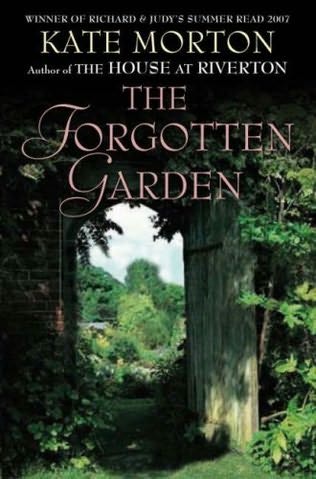
The Forgotten Garden by Kate Morton

Kate Morton’s latest book, The Distant Hours, is getting a lot of attention at the moment but I thought that before I decided whether to buy it I should really read the previous two books of hers that have been sitting on my shelf unread for a long time. I’m so glad I finally decided to pick up The Forgotten Garden because, although it wasn’t perfect, I loved it overall.

In 1913, just before the beginning of World War I, a port master finds a little girl with a suitcase sitting alone on the docks at Maryborough, Australia. With no sign of the child’s parents and no clue to her identity, he takes the girl home with him, where he and his wife name her Nell and raise her as their own daughter. But what was Nell doing in Australia? Who were her real parents? And what is her connection with the mysterious Eliza Makepeace, writer of fairy tales?

When Nell dies in 2005, she leaves everything to her granddaughter, Cassandra – including a cottage in Cornwall, England. When Cassandra travels to Cornwall to investigate, she begins to uncover some secrets about her grandmother’s identity and attempts to solve the mystery of Cliff Cottage.

At first I thought I was going to have a problem with Kate Morton’s writing style. She has quite a flowery, descriptive style which you’ll either love or hate. For example:

Was it always this way? Did those with passage booked on death’s silent ship always scan the dock for faces of the long-departed?

As the book went on though, the writing bothered me less, because I was becoming so absorbed in the story. It had a wonderful atmosphere and was very reminiscent of The Secret Garden in places (the manor house, the invalid cousin, the walled garden – and Frances Hodgson Burnett even makes a brief appearance!) It also felt a bit like a Daphne du Maurier book in places (particularly the Cornwall scenes) and the Swindell family whom Eliza lives with in turn-of-the-century London could have come straight from a Dickens novel. Some of Eliza’s fairy tales are even included in the book which I thought was a nice touch although I wasn’t too impressed with the stories themselves.

The biggest problem I had with this book was the constant jumping around in time and place. One chapter would be set in London in 1900, the next in Brisbane in 2005 and the next in Cornwall in 1975, which disrupted the flow of the story and made it difficult to follow. We also switch narrator with every chapter, which made me even more confused, particularly as there was almost nothing to differentiate between the voices of Cassandra, Nell and Eliza. It was too easy to forget who I was reading about. Eliza’s storyline was by far the most interesting of the three though and I think it would probably have worked on its own as a straight historical fiction novel.

The solution to the mystery was made very obvious to the reader from early on in the book, so when it was finally revealed it came as an anti-climax. This didn’t really spoil the story for me but it was slightly frustrating to watch Cassandra trying to solve the mystery and knowing that she was getting it completely wrong. I would have appreciated it if some of the clues could have been kept from the reader until nearer the end.

Other than those few points, I loved this book, which was great because I really hadn’t expected to. For such a long and complex book it was surprisingly quick to read.

Those of you who have read all of Kate Morton’s books, how does this one compare to The House at Riverton or The Distant Hours?

Short Story Reviews: Arthur Conan Doyle and Henry Lawson

One of my personal challenges for 2010 was to read more short stories. So far I haven’t been making much progress, but I made up for it this week by reading two very different short stories: The Brazilian Cat by Arthur Conan Doyle and The Drover’s Wife by Henry Lawson.

The Brazilian Cat by Sir Arthur Conan Doyle

I don’t use any real method in choosing which short stories to read.  At the rate I’m reading them (only six so far in 2010!) there are enough available online to keep me busy for years, so I’ve just been selecting one or two pretty much randomly.  As I’ve never read any of Conan Doyle’s works other than some of the Sherlock Holmes books, I decided to try one of his stories from Tales of Terror and Mystery (published 1922).

The Brazilian Cat, one of the “tales of terror”, is a quick, easy read. Marshall King, heir to Lord Southerton, has been invited to stay at the home of his cousin Everard, who has recently returned to England from Brazil. Everard has brought a menagerie of animals and birds back to England with him, including a peccary, an armadillo, an oriole…and a Brazilian cat.

“I am about to show you the jewel of my collection,” said he. “There is only one other specimen in Europe, now that the Rotterdam cub is dead. It is a Brazilian cat.”
“But how does that differ from any other cat?”
“You will soon see that,” said he, laughing. “Will you kindly draw that shutter and look through?”

What exactly is a Brazilian cat? Why does Everard’s wife seem so desperate for Marshall to leave Greylands Court? And why is Everard receiving so many mysterious telegrams? You’ll have to read the story to find out.

As a short horror story I wouldn’t say it was terrifying, but it was suspenseful with the tension building at a steady pace throughout the story.  There’s nothing very deep or profound about The Brazilian Cat, nothing complex or thought-provoking, but it’s entertaining and worth reading if you have a few minutes to spare.

Read it online here

The Drover’s Wife by Henry Lawson

Henry Lawson has been described as one of Australia’s greatest writers but until now I had never read any of his work.

The Drover’s Wife (1892) is the story of an unnamed woman who lives in the Australian bush with her husband and four young children. Her husband is a drover and spends very little time at home; at the time of our story he has been away for six months. When the children spot a snake slithering into the house, their mother makes a bed for them on the kitchen table and sits up all night watching over them. During the long hours of darkness she reflects on her life “for there is little else to think about”.

Although the story is very short and contains very little action, it manages to leave a lasting impression of the hardships, obstacles and overwhelming loneliness faced by a woman living an isolated life in rural 19th century Australia. The drover’s wife’s lifestyle has made it necessary for her to become independent, brave and resourceful. As she sits in the kitchen waiting for the snake to emerge, she remembers all the times in the past when her husband has been absent – on one occasion she had to fight a bush fire on her own; on another she fought a flood. She has also had to defend herself and her home from “suspicious-looking strangers” and “crows and eagles that had designs on her chickens”.

And yet the drover’s wife has grown accustomed to being on her own and is making the best of her lot in life:

“All days are much the same for her; but on Sunday afternoon she dresses herself, tidies the children, smartens up baby, and goes for a lonely walk along the bush-track, pushing an old perambulator in front of her. She does this every Sunday. She takes as much care to make herself and the children look smart as she would if she were going to do the block in the city. There is nothing to see, however, and not a soul to meet… But this bushwoman is used to the loneliness of it. As a girl-wife she hated it, but now she would feel strange away from it.”

I recommend reading this story as it’s an important piece of Australian literature. Having read some of the essays and analysis online however, it seems there’s more than one way to interpret the story. Some people consider it to be anti-feminist because it implies that all of the drover’s wife’s pain and suffering is caused by the absence of her husband. This is interesting because on my first reading I had seen it as a straightforward portrayal of a woman’s courage and bravery; yes, it would have made things easier if her husband had been around to help her, but she was doing the best she could to take care of herself and her children – husband or no husband. I can see I’ll have to give it some more thought. Have you read the story? What was your interpretation of it?

You can read The Drover’s Wife online here

I’ll try to make more progress with this personal challenge and post my thoughts on some more short stories soon!

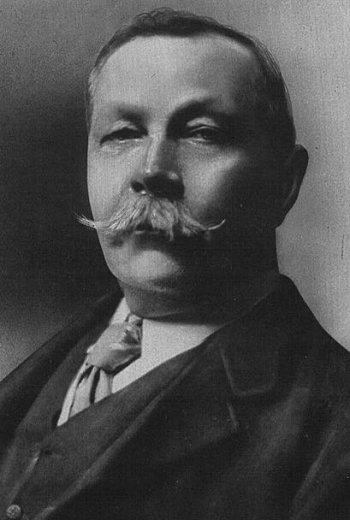
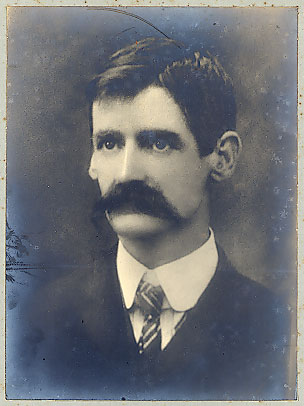
Pictures of Sir Arthur Conan Doyle and Henry Lawson both in the public domain