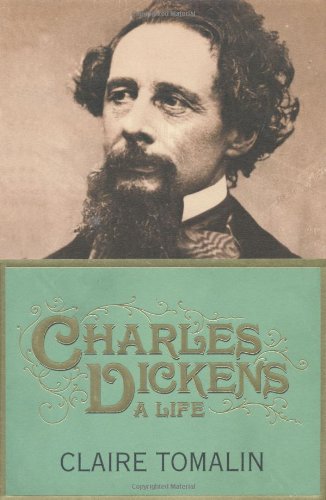
 I’ve only read one of Claire Tomalin’s other biographies (Samuel Pepys: The Unequalled Self) but having read that one, Charles Dickens: A Life was everything I was expecting: well researched, thorough and very readable. It took me a long time to finish it but that’s just because I was reading other books at the same time and is no reflection on how much I was enjoying it. Charles Dickens is an ideal subject for a biography as he had such an eventful life and career. One of the things I liked about Tomalin’s Samuel Pepys book was the way she attempted to give us a balanced view of Pepys, looking at both his good points and his bad points, and she does the same here with Dickens.
There are plenty of positive things about Dickens that we can take away from this biography: his incredible energy, his literary talent and the amount of hard work and effort he was prepared to put in to achieve his ambitions. But Tomalin also shows us Dickens’ flaws, particularly the insensitive and cruel way he treated his wife Catherine Hogarth and sometimes his children too. And of course, she discusses his affair with the actress Nelly Ternan (this is the subject of one of Tomalin’s other biographies, The Invisible Woman: The Story of Nelly Ternan and Charles Dickens, which I haven’t read).
It was interesting to read about the progress of Dickens’ career as a writer, and how he went from writing character sketches of the people around him to developing longer stories and eventually producing his famous novels. I enjoyed reading what Tomalin had to say about the Dickens novels that I’ve read – it seems that she admires most of his work though not all of it – but be aware that if you haven’t read all of his books she does include some spoilers. I can understand this, as many of the plot points and characters in Dickens’ novels give us insights into the mind of Dickens himself, and it would be hard to discuss the man without discussing his work. However, I’m sure there will be a lot of people like myself who will read this biography without having read Dickens’ complete works first, so I thought I should warn you that you might come across things you would prefer not to know!
Overall I was left with a negative impression of Dickens rather than a positive one. I can admire the motivation, ambition and talent of someone who worked his way up from a job in a boot blacking factory to become first a journalist and then one of the most famous and successful writers in the world. But the way he treated people in his personal life, as well as the high opinion he seemed to have of himself, makes it hard for me to like him.
I’m not sure how this book compares with other Dickens biographies as this is the only one I’ve ever read, but I enjoyed it, learned a lot from it and was left with a much better understanding of the complex person Dickens was. And as well as the huge amount of information this book contains about the life and work of Dickens himself, as someone who loves reading about the Victorian period in general I was fascinated by all the little details of 19th century life! The book also comes with plenty of additional material including maps, illustrations, a bibliography and a list of the important people in Dickens’ life.
Finally, this has nothing to do with this biography but I was surprised to find how much of Dickens’ life story was already familiar to me through reading novels like Drood and The Last Dickens. This shows that although historical fiction may not always be completely accurate it’s often a good way to absorb historical facts while being entertained at the same time!