This week’s Nonfiction November topic is Nonfiction Journeys, hosted by Frances of Volatile Rune, who has set the following challenge:
This week choose a book that reflects a journey for its author/protagonist or for the reader or both. This can be a physical journey, an emotional, psychological or spiritual journey or a combination of these. Any nonfiction title that leaves its author/protagonist and/or reader in a different place at the end from the start point is good for this challenge.
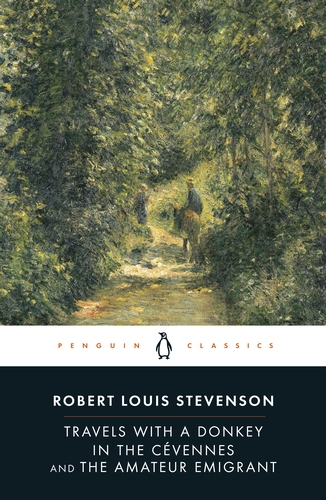 I’ve just finished reading a nonfiction book which fits this theme perfectly – and this seems the appropriate day to post my review, as today is RLS Day, an annual celebration of Robert Louis Stevenson’s life and work which takes place on the anniversary of his birth. It’s also a title from my current Classics Club list, it’s a short book so counts for Novellas in November (short nonfiction is allowed, as well as fiction), and Stevenson is a Scottish author which also makes it ideal for Reading Scotland Month!
Travels with a Donkey in the Cévennes was published in 1879 and describes Stevenson’s twelve day journey through the Cévennes mountains in southern France. Stevenson was in his twenties at the time and still financially dependent on his parents, so planned the trip hoping to gather material for a book that would establish him as an author and enable him to earn his own living. He also wanted the money so he could pursue his relationship with Fanny Van de Grift Osbourne, an American woman of whom his parents disapproved (and who would later become his wife).
Stevenson undertakes the journey alone, with only a donkey for company. Her name is Modestine and he purchases her to carry his hiking equipment, which includes a very large and cumbersome sleeping bag. Modestine proves to be stubborn and temperamental, often walking very slowly, going round in circles or refusing to move at all, which is a constant source of frustration for Stevenson. Although he finds that by the end of the journey he’s sorry to part with her, there are times when he and others don’t treat her very well, so it’s worth being aware of that before you start.
As you would expect from a travel book, there are lots of descriptions of the beautiful scenery – the hills, rivers, forests, small villages and ruined castles – as he makes his way through the Cévennes. I’ve never been to that part of France but enjoyed looking up pictures online of the places Stevenson visits. Apparently you can recreate his journey by following the 140 mile footpath known as the Robert Louis Stevenson Trail, starting in Le Monastier-sur-Gazeille and ending in Saint-Jean-du-Gard.
 Finding somewhere to sleep each night is one of the challenges Stevenson faces on his journey. In one of my favourite parts of the book, he describes camping outdoors in a glade surrounded by pine trees:
Night is a dead monotonous period under a roof; but in the open world it passes lightly, with its stars and dews and perfumes, and the hours are marked by changes in the face of Nature. What seems a kind of temporal death to people choked between walls and curtains, is only a light and living slumber to the man who sleeps afield.
Stevenson finds spending the night in the pine glade such a moving experience, he leaves some money behind the next day to thank the natural landscape for its hospitality. On other occasions, he stays overnight at a village inn and once at a Trappist monastery, Our Lady of the Snows. Religion forms an important part of the book – as well as the monastery chapters, Stevenson also passes through villages which are either Catholic or Protestant, and spends some time reflecting on the differences.
Stevenson wrote several other travel books. I would like to try some of them after finding this one so interesting!
Book 10/50 from my third Classics Club list.