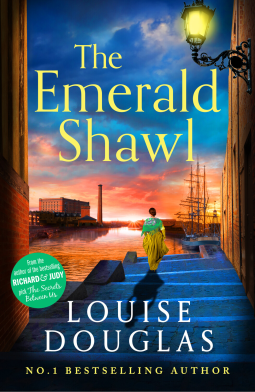
The Emerald Shawl by Louise Douglas

I’d forgotten how much I love reading Louise Douglas! I’ve read four of her books and particularly enjoyed the du Maurier-inspired The Secrets Between Us, but then I seemed to lose track and missed all of her more recent ones. The Emerald Shawl, published this week, turned out to be the perfect choice for my return to her work.

The novel opens in Bristol in 1864, with journalist Nelly Brooks meeting a woman in a green shawl by the docks. Nelly’s ‘journalism’ amounts to writing a women’s column for the Courier, giving advice on cooking, cleaning and decorating, which is all her editor will allow her to do. She hasn’t given up on her dream of becoming a serious news reporter like her male colleagues, however, and when Eliza Morgan, the woman in the shawl, tells her of the murder of the wife and newborn child of an important man, Nelly is sure she’s found the story she’s been hoping for. When Eliza herself is found floating lifeless in the river the next day, Nelly doesn’t believe the verdict that it was an accidental drowning. She’s convinced that Eliza was murdered and that she is the only person who may be able to find out who killed her.

The mystery is the main focus of the book, but Nelly’s personal life is also interesting. Having become pregnant at the age of fifteen, she spent several years in an asylum, sent there by her parents who found it preferable to admitting that she’d had an illegitimate child. Nelly has had no contact with her daughter – or her parents – since the baby was removed from her after the birth, but she has now discovered that twelve-year-old Hannah is attending a school near Nelly’s place of work. As well as investigating Eliza’s death, Nelly also sets out to find a way to bring Hannah back into her life.

The characters in the book range from the very wealthy, such as the politician Sir Edward Fairfield and his wife, for whom Eliza Morgan worked as a seamstress, to the working class Skinners, who are drawn into the mystery when their daughter’s body is stolen from the morgue. Although both families live in Bristol, they may as well be in different worlds and Nelly has to navigate between the two.

I found it interesting to learn after finishing the book that Douglas based Nelly’s character on the American journalist Nellie Bly, who went undercover to report on conditions inside a mental institution. The fictional Nelly’s own experience of mental institutions allows Douglas to explore issues around mental health and how ‘insanity’ could be used as a convenient way of dealing with people seen as problematic. I also loved the Victorian Bristol setting, which made a nice change from the usual Victorian London settings! The building of the Clifton Suspension Bridge is completed during the course of the novel, an important event in Bristol’s history which helps set the story in a wider historical context.

I hope Louise Douglas will return to Nelly Brooks in a future book as I think there’s a lot of scope to do more with the character. If not, I still have plenty of her earlier novels to enjoy!

Thanks to Boldwood Books for providing a copy of this book for review via NetGalley.
The Drowned City by KJ Maitland

I had already been drawn to The Drowned City, the first in a new series of historical mysteries set in the 17th century, before it dawned on me that KJ Maitland was Karen Maitland, an author whose books I’ve enjoyed in the past. All the more reason to want to read it, then!

In January 1606, exactly a year after the execution of the conspirators who tried to blow up Parliament in the failed Gunpowder Plot, a towering wave sweeps up the Bristol Channel, leaving a scene of devastation. Whole families are drowned, buildings are swept away and farmland is destroyed. As the survivors try to come to terms with what has happened, rumours begin to arise. Some say the wave was summoned by witches, others that it was God’s way of taking revenge for the executions. The King’s most trusted adviser, Charles FitzAlan, fears that it’s all part of another Catholic conspiracy and decides to send someone to Bristol to investigate. Luckily, he knows just the man for the job…

That man is Daniel Pursglove, currently languishing in Newgate Prison awaiting what seems to be certain death. Daniel’s particular background and skills have brought him to FitzAlan’s attention and when he is offered his freedom in return for carrying out some investigations in Bristol, he jumps at the chance. Arriving in the city, Daniel begins his search for the missing Catholic conspirator known as Spero Pettingar, but almost immediately finds himself caught up in another mystery – a series of murders. Are they all part of the same plot or is something else going on in the flooded city?

Like Maitland’s earlier novels, this is a dark and atmospheric story with an interesting historical setting. I’ve never read anything about the Bristol Channel Floods of 1607 (or 1606; Maitland uses the old Julian calendar rather than the Gregorian), so that was something completely new for me. The descriptions of the devastated city in the aftermath of the wave are vivid and even quite eerie and almost otherworldly. It’s always refreshing to read historical novels with a setting other than London, and the flooded Bristol, in a superstitious age when natural disasters were often attributed to witchcraft or messages from heaven, was the perfect choice for this particular story.

Although there a few real historical characters in the book, notably Robert Cecil, most are fictional. Daniel Pursglove, the central character in this and presumably the rest of the series, intrigued me as we know so little about him at first. What is his background? How did he come to be a prisoner? What are the special talents that make him so suitable for this task? As the story unfolds, so does our understanding of Daniel and gradually some of our questions are answered. I’m sure we’ll be learning more about him in future books.

Where this book was less successful, in my opinion, was with the mystery element; once Daniel arrives in Bristol the plot takes off in so many different directions I kept forgetting what his original purpose was in going there. Had it been shorter and more tightly focused, I think I would have enjoyed it much more; instead, I found myself struggling to keep track of what was happening at times. Still, this is a promising start to a new series and I’m definitely interested in reading the second book.

Thanks to Headline for providing a review copy of this book via NetGalley.

Book 16/50 read for the 2021 Historical Fiction Reading Challenge

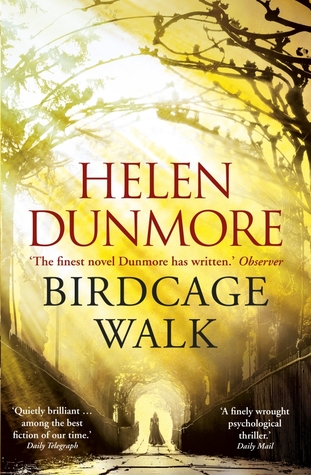
Birdcage Walk by Helen Dunmore

Helen Dunmore’s Exposure was one of my favourite books of 2016, so when I saw that she had a new one coming out last year, I knew I wanted to read it. The early reviews seemed to be very mixed, though, so I didn’t rush to get hold of a copy and it wasn’t until the days between Christmas and New Year that I finally got round to reading it.

I mustn’t have read those reviews very closely because I had the impression that this was a book about the French Revolution – but that’s not really true. The story is set in England and although events taking place across the Channel do have an effect on the lives of our characters, all of this is happening at a distance and is not the focus of the novel. The main theme of Birdcage Walk, according to Helen Dunmore herself and hinted at in the opening chapters, is the temporary nature of human life and the way so many of us leave behind very little evidence of our existence when we die. Dunmore states in her Afterword that she wanted to show that everyone has shaped the future in some way, by influencing those around them, even if they then disappear without trace. This is particularly poignant when you consider that while she was writing this novel she was already seriously ill with the cancer that would soon take her life.

But back to the plot of Birdcage Walk. The main part of the story is set in Bristol in 1792. Lizzie Fawkes’ husband, John Diner Tredevant (known simply as Diner) is a property developer who has started to build a terrace of houses with magnificent views of the Avon Gorge. With war against France on the horizon, however, this is a bad time to be trying to sell houses. Lizzie can see that her husband is troubled but is he just worried about the failure of his building project or is there something else on his mind?

Dunmore’s portrayal of Diner is excellent; he is a jealous, possessive and controlling husband who resents Lizzie having relationships with any other friends or family members apart from himself – but it is clear that something terrible has happened in his past, leaving him unhappy and disturbed. We find out very early in the novel what that something probably is, which takes away part of the suspense, but I think there is still plenty of tension in waiting to see when and how Lizzie will learn the truth.

The characterisation in general is very good; I found Lizzie’s mother, the writer Julia Fawkes and her husband Augustus particularly interesting to read about. Julia’s role in the story is brief, but she is one of the characters Dunmore uses to illustrate her point about a person’s influence living on after their words have faded away. Augustus, with his strong political views but lack of insight when it comes to the everyday things going on around him, also feels believable and real.

As I’ve said, the French Revolution is played out in the background with news reaching our characters mainly in the form of letters and newspaper reports. This means we don’t have the excitement of being thrown directly into the events of the Revolution, but it is still interesting to see things from the perspective of people who were less directly involved. Most of the novel, though, is concerned with more domestic issues: Lizzie’s personal relationship with Diner and her efforts to care for her baby brother Thomas despite Diner’s opposition.

I didn’t like Birdcage Walk quite as much as Exposure, but I still found it atmospheric and beautifully written. It’s so sad that there won’t be any more books from Helen Dunmore, but as I have only read three of them so far (The Lie is the other) I can still look forward to reading her others.