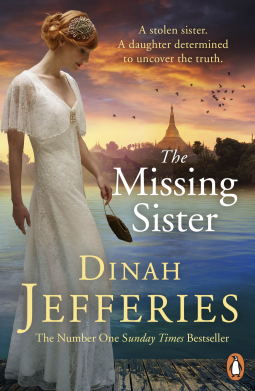
 So far, the novels of Dinah Jefferies have taken me to India, Malaya, Ceylon and French Indochina. Now, with The Missing Sister, I have had the opportunity to visit Burma. Known as Myanmar today, the novel is set in 1936 when Burma is still a British colony – although unrest is growing and there are signs that independence might not be far away. It is to Burma that Belle Hatton has come in search of answers to a mystery that has haunted her family for more than twenty years.
Taking a job as a singer in a luxury hotel in the capital city of Rangoon, Belle uses her spare time to hunt for clues that may explain the disappearance of her parents’ baby daughter, Elvira, in January 1911. Belle herself has grown up in England, unaware that her elder sister ever existed, but now that both of her parents are dead, she has discovered a newspaper clipping describing the day Elvira, only three weeks old, vanished from the Hattons’ garden in Rangoon. Although it was all so long ago, Belle is determined to find out what really happened and whether Elvira could possibly still be alive.
As with all of Dinah Jefferies’ novels, the location is beautifully described and although I’ve never been to Burma/Myanmar it was easy to picture the lively, bustling streets of Rangoon (now Yangon), the opulent temples and pagodas, and the scenery Belle sees when, later in the book, she travels upriver to Mandalay. Another common feature of Jefferies’ books tends to be a portrayal of different cultures existing, often uneasily, side by side in the final years of the British Empire (or in the case of The Silk Merchant’s Daughter, the French Empire). This book contains a vivid description of a violent riot between the Burmese and the Burmese Indians, but otherwise I was a bit disappointed that Belle has little involvement with the local people and their struggles, sticking mainly to the British community and focusing on her search for Elvira.
The mystery element of the novel is slightly predictable and although I didn’t guess exactly what had happened to Belle’s sister, I wasn’t at all surprised by the ending of the book. Along the way, Belle is offered help from two very different men – Edward, a British government official, and Oliver, an American journalist – but when she starts to receive anonymous warnings, she is unsure which, if either of them, she can trust. This time, I did guess correctly – but I did have a few doubts as it wasn’t completely obvious.
There was one other aspect of the book that interested me: a storyline set several years earlier and following the story of Belle’s mother, Diana, and how she copes with the tragic disappearance of Elvira. When suspicion falls on Diana herself, she and her husband leave Burma and return to England where, sadly, their marriage starts to break down under the stress of their ordeal. Diana doesn’t receive the support she deserves and decisions are made that will affect not only her own future but also her youngest daughter Belle’s. Diana’s story is told in the form of short chapters interspersed with Belle’s, which means we don’t spend a lot of time with her, but the little glimpses we are given of her life and the way she is treated by her husband are very sad.
This isn’t one of my favourite Dinah Jefferies novels, but I’m looking forward to her next one The Tuscan Contessa, which is out later this year and will be the first she has written not to be set in Asia.
 She Reads Novels