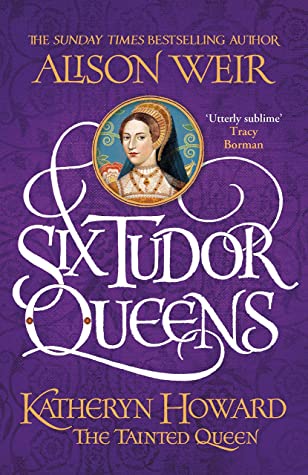
 Alison Weir’s Six Tudor Queens series aims to retell, in fictional form, the stories of all six of Henry VIII’s wives. This is the fifth book in the series so, as you would expect, the focus is on the fifth wife, Katheryn Howard. Having enjoyed the first three – on Katherine of Aragon, Anne Boleyn and Jane Seymour – I had been slightly disappointed by the one on Anne of Cleves, but I’m pleased to say that I thought this latest book was a return to form.
When Henry VIII sets aside Anne of Cleves and takes nineteen-year-old Katheryn Howard as his next wife, he believes her to be pure, innocent and virtuous, qualities he values highly in a woman. Telling her she is his ‘rose without a thorn’, he is delighted with his young bride and looks forward to her producing another son to secure his lineage. But what Henry doesn’t know is that Katheryn has had more experience with men than he has been led to believe.
Katheryn is surprised to find that, despite the age difference, she is becoming genuinely fond of her obese and ailing husband. The man she really loves, however, is Thomas Culpeper, one of the King’s courtiers, whom she continues to meet in secret even knowing that if they are discovered both of their lives could be in danger. Then there’s Francis Dereham, with whom she was sexually involved before her marriage to the King; Francis won’t leave her alone, insisting that she had been pre-contracted to marry him before she ever met Henry, and Katheryn lives in fear of the King hearing of their relationship.
Of course, history tells us that Katheryn (as Alison Weir chooses to spell her name) will fail to keep her past a secret, that her love affairs with Dereham and Culpeper will become public knowledge and that she will face the same fate as her cousin, Anne Boleyn – but that doesn’t mean there is no tension in this retelling of her story. We know from the start that Katheryn is doomed and we have to watch her make one mistake after another, choose the wrong people to trust and head irreversibly down a path which will lead her to the scaffold. Despite knowing what will eventually happen, though, we are kept in suspense waiting for the moment when she will be betrayed and her secrets will be revealed to Henry.
The novel sticks closely to the known facts of Katheryn Howard’s life; although obviously there are some areas where Weir has to use her imagination or make decisions as to how certain things should be interpreted, she doesn’t seem to invent large chunks of the story as she did in Anna of Kleve, Queen of Secrets. I suppose Katheryn’s life is more well documented than Anne of Cleves’ and already dramatic enough without the need for too much invention.
Although Katheryn is frustratingly naive and reckless, I did have a lot of sympathy for her. A lot of time is spent discussing her early life before her marriage to Henry, when she lived in the household of her father’s stepmother, the Dowager Duchess of Norfolk. The household included several other young women who were also wards of the Duchess and it seems that there was very little supervision and discipline; Katheryn appears to have been easily influenced and sometimes even encouraged by the other girls to behave in a way that would have been seen as promiscuous in the 16th century. Because of the nature of Katheryn’s story, there is a lot of focus on her sex life and her liaisons with various men and this does become a little bit repetitive and tedious at times, but I still found it a more compelling read than the previous book in the series.
I am looking forward to the final novel, which isn’t available yet, but which I’m assuming will be about Katherine Parr, the sixth and final wife.
Thanks to Headline for providing a copy of this book for review via NetGalley.
This is book 8/20 from my 20 Books of Summer list.
 She Reads Novels