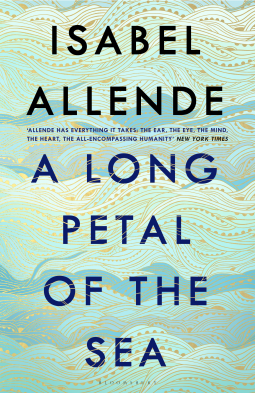
 “The long petal of sea and wine and snow” is how the poet Pablo Neruda once described Chile, the country in which most of Isabel Allende’s latest novel is set, and Neruda himself plays a small but very important role in this epic story, based on true historical events.
Beginning in Spain in 1938, we meet Victor Dalmau, a young medical student from Barcelona, and Roser Bruguera, an orphan who has been taken in and raised by the Dalmau family. Roser is in love with Victor’s brother Guillem and is pregnant with his child, but like many others, they have their plans for the future destroyed by the civil war which is currently tearing Spain apart. Victor and Roser are Republicans, but when it becomes clear that General Franco and his Nationalists have won the war, they join half a million other refugees crossing the border into France in search of safety. It is here that they learn of Pablo Neruda’s plan to commission a ship, the Winnipeg, to transport two thousand of the refugees to Chile, where they will have a chance to build a new life. The only problem is, while Victor is offered a place on the ship due to his medical training, Roser’s skills are less in demand and she will only be allowed to join him if she can prove she is his wife…
A Long Petal of the Sea is the second book I’ve read by Isabel Allende. My first was The Japanese Lover and although I was disappointed by that one, I wanted to give her another chance to impress me. Sadly, I felt very much the same about this book and am coming to the conclusion that, despite her popularity, Allende is just not an author for me.
The story itself is fascinating. I have read very little about the Spanish Civil War and knew nothing about what happened in the aftermath, with Spanish refugees being placed in concentration camps on their arrival in France. I knew even less about the political history of Chile, which is the focus of the second half of the novel. I think My Beautiful Imperial by Rhiannon Lewis is the only other book I’ve read set in that country – but that story took place in a much earlier period than this one. It’s sad to think that refugees like Victor and Roser, who had already been through so much, would settle in Chile thinking they had found peace and safety, only to face more upheaval with the 1973 military coup and then years of dictatorship under General Pinochet.
My problem with this book was the style in which it was written. As with The Japanese Lover, I felt as though I was reading a long list of facts rather than a compelling story. I found it impossible to care about or engage with the characters because the author was just telling me how people thought and felt instead of showing me through their words and actions. This should have been a moving and emotional novel but instead I thought it was dry and impersonal and seemed much more like non-fiction than fiction.
I’m aware that Isabel Allende has a large and loyal fan base and other reviews of this book are overwhelmingly positive, so it’s obvious that I’m just not the right reader for Allende’s books. I’ve tried two now and I don’t think I need to try any more, but if you think this book sounds interesting don’t let me put you off reading it – you might be able to connect with it in a way that for some reason I just couldn’t.
Thanks to Bloomsbury for providing a copy of this book for review via NetGalley.

 She Reads Novels