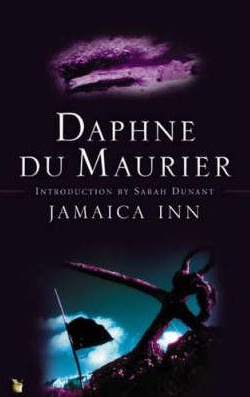
Jamaica Inn by Daphne du Maurier (re-read)

After her mother’s death, Mary Yellan goes to live with her Aunt Patience and Uncle Joss at their inn on Bodmin Moor in Cornwall. But during the coach journey to her new home, Mary hears some disturbing things about Jamaica Inn and its landlord. Soon Mary makes her own shocking discoveries about Joss Merlyn’s activities and finds herself drawn into his villainous schemes while trying to protect her frightened, nervous Aunt Patience. And when Mary is befriended by two very different men – one of them her uncle’s horse thief brother, Jem Merlyn, and the other Francis Davey, the albino vicar of Altarnun – she must decide which, if either, she can trust.

This was actually a re-read for me, although it’s been so long since I first read it that all the details of the plot had completely faded from my mind. What I did remember was being disappointed. When I read it for the first time it was immediately after finishing Rebecca (which I loved – and which is still one of my favourite books ever) and Jamaica Inn just wasn’t as good. This was more than ten years ago though, so I recently decided to give it a second chance. And I did enjoy the book much more this time than I did the first time, maybe because now that I’ve read so many of du Maurier’s other novels it meant I could consider Jamaica Inn in the context of a wider body of work rather than solely in comparison with Rebecca.

Like many of du Maurier’s other books, this one is dark, gothic and atmospheric. Published in 1936 but set in the early 1800s, it has a lot of the traditional elements you would expect to find in a gothic novel (stormy weather, smugglers, locked rooms, shipwrecks, desolate moors, a remote, lonely inn). There are also some memorable characters – Mary herself is an intelligent and courageous heroine, and I know I said that I couldn’t remember much from my previous read, but I certainly hadn’t forgotten the character of her violent, brutal Uncle Joss!

So, Jamaica Inn is not one of my favourite du Maurier novels but not my least favourite either. It does not have the depth and complexity of Rebecca or some of her later novels, but then this one was written near the beginning of her career and is a good early example of her work. The plot is not particularly complicated and I found it quite predictable but du Maurier’s skill at creating tension and suspense meant that I still enjoyed reading it.
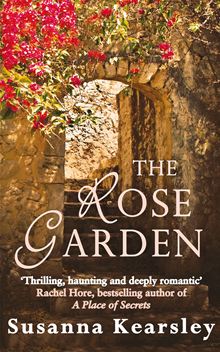
The Rose Garden by Susanna Kearsley

Following the death of her sister Katrina, Eva Ward leaves her home in Los Angeles and travels to England to scatter Katrina’s ashes. Eva knows that of everywhere in the world the place that held the most special memories for her sister was Cornwall, where the two of them had spent many happy days visiting Trelowarth, the home of their childhood friends, the Halletts. As well as scattering the ashes, Eva is looking forward to spending time with Mark and Susan Hallett again and helping them think of ways to attract tourists to the new tea room at Trelowarth. What she hasn’t expected is to find herself slipping back and forth in time between the present day and the eighteenth century, a world of Jacobites, smugglers – and a man called Daniel Butler.

I had never read anything by Susanna Kearsley until now, but she was one of those authors I was sure I would like – and now that I’ve read The Rose Garden I’m pleased to have been proved right! I love novels where time travel forms part of the plot and it’s always interesting to see the different methods authors come up with to explain how and why it happens. In this book I thought the author handled the transitions between past and present very well, in a way that reminded me of Daphne du Maurier’s The House on the Strand (which is also set in Cornwall). I also couldn’t help thinking of Diana Gabaldon’s time travel novels, due to the idea of a modern day woman finding herself in the eighteenth century and in the middle of a Jacobite rebellion. But it wouldn’t be fair to describe The Rose Garden as a copy of any other novel because it’s different enough from anything else that I’ve read to be a great book in its own right.

Eva meets some interesting characters in both time periods, though the most memorable are probably the ones she gets to know in the eighteenth century: Daniel Butler, his brother Jack, and their Irish friend, Fergal. It would have been nice to have seen more of Eva’s conversations with Daniel and Fergal though, as this would have helped make their characters feel more fully developed. And in the present day, I would have liked to have spent more time with Claire (Mark and Susan’s stepmother). I suppose there was a limit to how much the author could include, but I did feel there was the potential for this book to be even better than it already was.

I also loved the Cornish setting – it provided the perfect backdrop for both the historical and contemporary periods of the story. I enjoyed reading about Eva’s adventures in both periods and because the two threads of the story were woven together so closely I found them equally interesting. And later in the book the plot took a turn that I hadn’t expected, which was a nice surprise.

I’m sure I’ll be reading more books by Susanna Kearsley soon – I just need to decide which one to try next!

The Loving Spirit by Daphne du Maurier

If you’ve been following my blog for a while you’ll know that Daphne du Maurier is one of my favourite authors, so when I saw that Simon of Savidge Reads and Polly of Novel Insights were hosting a Discovering Daphne event throughout October I knew I’d have to read at least one du Maurier book this month. There are still plenty of her books that I haven’t read yet, but I decided I wanted to go back to the start of her career and read her first novel from 1931, The Loving Spirit.

The Loving Spirit is a family saga spanning four generations of the Coombe family. It begins in 1830 with the story of Janet Coombe, a passionate young woman who is forced to abandon her dreams of going to sea when she marries and settles down to start a family with her husband, a boat builder. We then move forward through the decades, ending one hundred years later in the 1930s. Along the way we meet Janet’s son, Joseph, her grandson, Christopher, and finally her great-granddaughter, Jennifer. The book is divided into four parts, one devoted to each of the main characters, but I won’t go into any plot details here as each story has its own set of dramas and surprises which I’ll leave you to discover for yourself.

Although this is a family story and doesn’t have the gothic feel of some of du Maurier’s other books, there are hints of the supernatural in the way the stories of the four Coombes are connected, particularly Janet’s and Joseph’s. The link between the four sections of the novel is the ‘loving spirit’ of Janet Coombe which seems to be watching over each successive generation. And this is probably a good place to mention the Emily Brontë poem, Self-Interrogation, which inspired the title of this novel:

“Alas! The countless links are strong
That bind us to our clay;
The loving spirit lingers long,
And would not pass away!”

Du Maurier had a real talent for giving her novels atmosphere and a strong sense of place, and this book is no exception. The Coombe family live in Plyn, a fictional shipbuilding town on the coast of Cornwall, and you can expect some beautiful, vivid descriptions of the Cornish coastline, the sea and Plyn itself. I’m really not a fan of books about boats and sailing, but luckily the actual seafaring action and terminology is kept to a minimum here. Instead, the focus is on the passion Janet, Joseph and other members of the Coombe family feel for the sea – and the ways in which sailing and the shipping industry become an intrinsic part of their lives.

There are some interesting supporting characters too, including one of my favourites, Jennifer’s grandmother. Du Maurier’s wonderful sense of humour comes through here in some of the dialogue in which the grandmother, who is starting to lose her hearing, constantly misinterprets what Jennifer is saying. For this reason, and also because Jennifer was the character who felt the most real to me, this final section of the novel was probably my favourite.

The Loving Spirit is not one of the better du Maurier novels I’ve read, but as a debut novel published when she was only twenty-four years old I did still find it quite impressive. It’s interesting to be able to compare it with her later novels and see how her writing developed throughout her career.

Rule Britannia by Daphne du Maurier

I love Daphne du Maurier; whenever I pick up one of her books I know I’m guaranteed a good read. Although this one was not as good as some and I can certainly understand why it’s one of her less popular books, it still kept me gripped for all 300+ pages. I’m pleased I can say that because, having read other opinions on this book, I was concerned that it might be the first du Maurier novel that I wouldn’t like.

Published in 1972 her final novel, Rule Britannia, imagines that the UK has broken away from Europe to form an alliance with the US. This new nation will be known as USUK. The first twenty-year-old Emma knows about this is when she wakes up one morning to find that the tranquil corner of Cornwall where she lives is now under American occupation – there’s an American warship in the harbour, American marines stationed in the area and roadblocks on the routes leading in and out of the town. Already the Queen is visiting the White House and the President is preparing to come to Buckingham Palace. Despite reassurances from the government that the formation of USUK is essential for Britain’s economic and military stability, Emma’s family, friends and neighbours begin to grow increasingly concerned about the exact nature of the alliance and the effect it will have on their previously peaceful lives.

It can’t happen here, thought Emma, it can’t happen here, that’s what people in England have always said, even in wartime when they were bombed, because they were all together on their own ground. Not any more.

Although the story unfolds from Emma’s perspective, the real heroine of the story is her seventy-nine-year-old grandmother, Mad (short for Madam – unless I missed it, we aren’t told her real name), who is a retired actress. Mad and Emma live together with Mad’s six adopted boys whose ages range from three to nineteen, all of whom have suffered some form of tragedy in their early lives. Mad, even in her old age, is a strong-minded, independent woman who is determined to defend her home and family no matter what, and she plays an important part in Cornwall’s resistance to the occupying forces. But although Mad and her family believe they have been invaded, I should point out that we’re told the majority of British people are very happy with the alliance and that it’s only a small percentage of the population who are rebelling against it.

As with most Daphne du Maurier novels, this one does have some suspenseful and unsettling moments. I know from my past experience of her work that nothing is ever quite as it seems and I was wondering what surprises and twists she might have in store for the reader – but unfortunately I found the way the book ended slightly disappointing because I felt there was a lot more she could have done with the story. Another thing I didn’t like was the fact that one of Mad’s adopted sons, three-year-old Ben who happens to be black, appeared to have been included simply as an excuse to make racist jokes. The book was a product of the 1970s I suppose, but these comments are offensive rather than funny. These negative points, along with the overall strangeness of the book, stopped me from enjoying it as much as I’ve enjoyed her other books. It doesn’t compare to her best work and if you’re new to Daphne du Maurier I would suggest starting somewhere else.

The House on the Strand by Daphne du Maurier

Dick Young is at a turning point in his life. He has recently left his job at a London publishing firm and needs to decide what he wants from his future. He’s been offered another job in New York and his American wife Vita wants him to accept it, but Dick’s not so sure. When his friend Professor Magnus Lane invites him to stay at his farmhouse in Cornwall for the summer, he agrees, looking forward to a few days of peace before Vita and his two stepsons join him. But when Dick arrives at Kilmarth, Magnus convinces him to take part in a secret experiment: he has developed a new drug which allows the user to travel back in time – and he wants Dick to test it for him…

Choosing to begin 2011 with a book by one of my favourite authors was the right decision. The House on the Strand is a strange and unusual book which blends historical fiction, science fiction, time travel and psychology. I loved it! In fact, it might even make my best of 2011 list at the end of the year. Although Rebecca is still my favourite Daphne du Maurier book, this one ties with The Scapegoat as my second favourite. It actually has a very similar mood and feel to The Scapegoat even though the plots of the two books are entirely different. Both books have a male narrator and both have themes of identity and escaping from reality.

I enjoy reading about time travel and this book took a slightly different approach to the question of time travel than any other book I’ve read. Rather than physically going back in time, it’s only Dick’s mind that travels while his body stays in the present – and as you can imagine, this has some disastrous and embarrassing results. The 14th century world that Dick witnesses when under the influence of the drug seems completely vivid and real to him, yet he’s unable to interact with any of the people he meets. He feels a special connection with Roger Kylmerth, steward to the Champernoune family, and also with the beautiful Isolda Carminowe. As Dick’s fascination with Roger and Isolda grows, he spends more and more time in the past and becomes increasingly dependent on the drug.

Du Maurier wrote this book in the late 1960s when psychedelic drugs such as LSD were at the height of their popularity and the drug which Magnus invents seems to be very similar to what I’ve read about LSD. As Dick becomes psychologically addicted to the drug, he gradually grows more distant and withdrawn and his relationships with his family start to suffer. His life in the present is portrayed as dull and boring in comparison to the vivid events of the 14th century and when seen through Dick’s eyes, Vita and her two sons are unlikeable and obnoxious. To me though, they were normal, reasonable people who were trying to make sense of their husband and stepfather’s bizarre behaviour.

Despite my own interest in history and historical fiction, I didn’t find the 14th century subplot particularly compelling. The story wasn’t very strong and there were too many characters with similar names who all seemed to be married to their cousins, which made it very difficult to keep all the relationships straight. I was constantly turning to the family tree at the front of the book and still couldn’t remember who was who. My advice to anyone reading The House on the Strand would be not to worry too much about following the 14th century story. By far the most interesting part of the book is the part which takes place in the present.

There were only one or two other negative points. First of all, I was disappointed that we didn’t get to know Magnus better, as I thought he was potentially the most interesting character in the book. Secondly, du Maurier made a point of describing the landscape and the locations of the various 14th century farmsteads and manor houses in great detail. I know this was supposed to show us how the appearance of the landscape had changed over the centuries (which is quite important to the plot), but I found it confusing and even by referring to the map at the front of the book, I couldn’t seem to build a picture in my mind of what the area looked like. Apart from these minor complaints though, I loved this book.

I’ve now read around half of du Maurier’s books. The good news is that I still have the other half to look forward to!

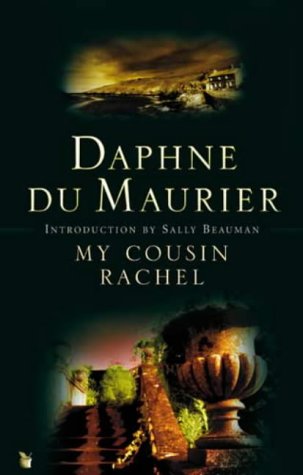
Review: My Cousin Rachel by Daphne du Maurier


This is the second Daphne du Maurier book I have read this month.  I hope eventually I’ll have time to read all of them because so far none of her books have disappointed me.

Like I’ll Never Be Young Again, which I read at the beginning of May, My Cousin Rachel is written in the first person from a male perspective. Also as in I’ll Never Be Young Again, the male narrator is a naïve, immature man who I found it difficult to sympathise with. His name is Philip Ashley, a twenty-four year old Englishman who has been raised by an older cousin, having lost both his parents at an early age. Philip and his cousin Ambrose have a very close relationship and Philip is left confused and jealous when Ambrose suddenly marries a woman he meets in Italy. This woman happens to be another cousin of theirs – their cousin Rachel.

Early in the novel, Ambrose dies and Rachel returns alone to the Ashley estate in England. At first, Philip is convinced his cousin Rachel was responsible for Ambrose’s death, but after meeting her he’s not so sure…

My Cousin Rachel is often compared with Daphne du Maurier’s most famous book, Rebecca, and although the two books are very different in many ways, I can see the reasons for the comparisons. The books share some common elements, including the estate in Cornwall (based on du Maurier’s own home, Menabilly) and the mysterious, secretive woman, but the biggest resemblance is in the atmosphere the writing conveys. Daphne du Maurier is one of the most atmospheric writers I know of. Whether she’s writing about the streets of Florence or the coast of Cornwall she always manages to convey a mood perfectly suited to the location and draws you completely into the world she has created. My Cousin Rachel has a strong feeling of foreboding, where from the beginning you know something bad is going to happen and you’re just waiting to see what it is.

Throughout the book, my opinion of Rachel was constantly changing. It was hard to form an accurate idea of what Rachel was like, as we only really saw her through Philip’s eyes and he was not a reliable narrator. Another thing that added to the vagueness and uncertainty of the story was that we were never told exactly when it was taking place. It was obvious that the book was set in the 19th century, but which decade? And what was the name of the Ashley estate? Unless I missed it, we weren’t told that either. It seems to be quite typical of Daphne du Maurier to withhold information from us in this way – after all, in Rebecca we aren’t even told the narrator’s name!

There are a lot of loose ends and questions left unanswered at the end of the book, which is something that often bothers me, but in this case I didn’t mind. I liked the way there were aspects of the story that could be interpreted in several different ways. I expect it would have been a good book to read with a group, as the ambiguity would lead to some interesting discussions and theories.

Recommended

Pages: 304/Publisher: Virago Press (Virago Modern Classics 491)/Year: 2008 (originally published 1951)/Source: Library book