Monstrous Tales: Haunting Encounters with Britain’s Mythical Beasts

This is a great new collection of short stories inspired by British folklore. I was drawn to it because it included several authors whose work I’ve previously enjoyed, but I was pleased to find that the stories by authors who were new to me were just as strong. The book has also given me the opportunity to learn about lots of creatures from British myth that I’d never come across before; only one or two of them were familiar to me.

I’ll start with the three stories by authors I hadn’t tried before. I particularly enjoyed Jenn Ashworth’s Old Trash, set in the Pendle area of Lancashire where a mother has taken her troubled teenage daughter camping for the weekend, hoping to keep her away from the bad influence of an older boyfriend. Ashworth does a wonderful job of creating a creepy atmosphere as darkness falls over the hills and Rachael and Mae listen to tales of the gytrash, a huge black dog thought to be an omen of death. Abir Mukherjee’s The Doctor’s Wife is another highlight, following a doctor and his wife who move to a small village in the Highlands of Scotland. Once there, the doctor becomes obsessed with the fate of his predecessor and a mysterious woman dressed in red. This story combines a British setting with elements of Hindu mythology, which is fascinating and adds some diversity to the book.

Sunyi Dean’s Eynhallow Free didn’t work for me quite as well as the others, which I think is due to the story being written in second person (addressing the reader directly as ‘you’, putting us in the position of the protagonist, a style I never really get on with). I did love the Orkney setting, though; it’s a very eerie story, incorporating figures from Orkney folklore such as the Goodman of Thorodale and the Finfolk. There’s one more story also set in Scotland: These Things Happen by Dan Jones. I’ve read some of Jones’ history books, but this is my first experience of his fiction. I disliked the main character which put me off the story a little bit, but I was fascinated by the descriptions of the Cat Sith, the large black cat of Scottish mythology that walks around on its hind legs.

Welsh folklore is represented by the Fad Felen, or yellow plague, which appears in Rosie Andrews’ story, The Yellow Death. The story is set at the end of the First World War and the Fad Felen can be seen as a metaphor for the yellow of mustard gas. This is one of only two stories in the book with historical settings. The other is Rebecca Netley’s Mr Mischief, in which ten-year-old Bessie moves to a big house on the Yorkshire moors with her Uncle Kit who has a job as gamekeeper. Here she learns about a mysterious being known only as Mr Mischief and the lengths the superstitious locals go to in order to keep him happy.

I think my favourite story in the book was probably Boneless by Janice Hallett, about a writer investigating reports of a giant slug in Derbyshire. Written in Hallett’s usual style incorporating emails, articles, texts etc, it explores issues such as climate and habitat change and how animals are forced to adapt and evolve. The ending is great – I hadn’t expected the story to go in that direction at all. I also liked The Beast of Bodmin by Jane Johnson, which is set, like a lot of Johnson’s work, in Cornwall. Gina moves into a cottage on the edge of Bodmin Moor, hoping to make a new start in life, and almost immediately her black cat, Roxy, goes missing.

The collection is completed by Stuart Turton’s Deaths in the Family. It follows the story of Ben and his family, who gather together for Christmas every year, barricading themselves indoors while an army of grotesque and murderous Redcaps amasses outside. I wasn’t sure what to make of this story as it was so strange and felt different in tone from the others in the book, but it was certainly entertaining!

Nine stories in this collection, then, and although I inevitably enjoyed some more than others, there wasn’t a single bad one here. I’m looking forward to exploring more of Ashworth, Mukherjee and Dean’s work now, so if you can recommend anything please let me know.

Thanks to Raven Books for providing a copy of this book for review via NetGalley.

Powers and Thrones by Dan Jones

I actually started Dan Jones’ Powers and Thrones for last year’s Nonfiction November but found it so long and intensely detailed I could only read it in small doses. Although it’s a fascinating book and I’ve been learning a lot from it, 736 pages covering more than a thousand years of history is not something I could read quickly. I confess that I kept putting it aside and getting distracted by other books…so here I am, finishing it a year after I began and conveniently just in time for Nonfiction November again!

In Powers and Thrones, Jones explores the long period of history known as the Middle Ages. Starting in 410 AD, just before the fall of the Roman Empire, and ending in 1527 during the Renaissance, he looks at some of the ‘powers’ that helped to build the world we know today – not just ‘thrones’, but also powers such as money, trade, religion and exploration. He moves forward chronologically throughout the book while choosing a different topic to focus on in each chapter; Monks, Knights, Scholars, Crusaders, Merchants and Builders are just a few of the chapter titles.

As well as putting key events into the context of their own time, Jones also draws lots of parallels with modern life. It’s impossible to read about the first recorded global pandemic – a form of bubonic plague thought to have killed millions of people worldwide during the middle of the 6th century – without thinking of the similarities and differences with our own recent Covid-19 pandemic. Again, when he discusses the later outbreak of plague in the 14th century known as the Black Death, he looks at the economic impact on prices and wages, something as relevant now as it was then. It was also interesting to read about the effects of climate change and extreme weather such as droughts on the mass migration of people in the 4th and 5th centuries that led to ‘barbarian’ tribes pushing across the Roman frontiers and contributing to the fall of Rome.

Although the book concentrates on broad themes like these, Jones does pick out individual historical figures to write about in more detail. These range from ancient leaders such as Attila the Hun and Theodoric, king of the Ostrogoths to Henry the Navigator, Marco Polo, and Dick Whittington – a real-life merchant and politician before he became a British pantomime character! The book is quite Eurocentric, but Jones doesn’t ignore things that were taking place in other parts of the world, particularly where they affect European life and culture. For example, he includes sections on Genghis Khan and the Mongols and on the caliphates of the Arab world.

The problem with Powers and Thrones is that there’s just too much information here for one book. Any of the chapters could have been expanded into an entire book in itself; trying to condense it all into one volume was a bit overwhelming. I’m still glad I read it, though, and am pleased I made it all the way through to the end – I finished it with a real sense of achievement!

Thanks to Head of Zeus for providing a copy of this book for review via NetGalley.

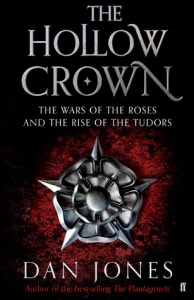
The Hollow Crown by Dan Jones

The Hollow Crown A rare non-fiction review here today! Having loved Dan Jones’ book on the Plantagenets, I was curious to see how he would approach the Wars of the Roses, which is one of my favourite periods of English history. I was looking forward to another well written, thoroughly researched book that would make a complex subject accessible and easy to understand – and that’s what I got, although there were one or two problems which prevented me from enjoying this book as much as the previous one.

The Hollow Crown: The Wars of the Roses and the Rise of the Tudors begins with the marriage of Henry V and Catherine of Valois, laying the foundation for the years of conflict that would follow. Best known for his victory over the French at Agincourt, Henry V was considered one of England’s great medieval kings, but when he died in 1422 of a sudden illness with his only heir still a baby, the scene was set for decades of uncertainty and instability. As Henry’s son, Henry VI, grew into an adult it became obvious that he was unfit to rule. Suffering from an unspecified mental illness, he was a weak and ineffectual king, and this paved the way for rival claimants to the throne – Richard of York and his son, the future Edward IV.

From the 1450s to the 1480s a series of battles were fought between the two rival branches of the royal house – York and Lancaster. This book takes us through the entire period in chronological order, detailing each battle and its outcome and examining the reigns of Henry VI, Edward IV, Richard III and finally Henry VII, who defeated Richard at the Battle of Bosworth and founded a new royal dynasty – the Tudors. Naturally a lot of the focus is on the male figures of the period – the kings and dukes and earls – but Jones shows understanding and sympathy for some of the women too: Margaret Beaufort who gave birth to Henry Tudor at the age of thirteen and according to Jones may have been left physically and mentally traumatised by the experience, and Henry VI’s wife, Margaret of Anjou, who found herself with the responsibility of trying to maintain some sort of control of the kingdom during her husband’s long spells of illness.

This is a shorter book than The Plantagenets (and focuses more intensely on a shorter period of history) and, like the previous volume, it’s very readable and even quite gripping in places. There was one area, though, where I felt that this book was not as good as the first one. In The Plantagenets I felt that Jones had given a fair and balanced account of the historical people and events concerned but The Hollow Crown feels very biased towards the Lancastrian/Tudor point of view. The bias is most noticeable, maybe not surprisingly, in the sections dealing with Richard III where Jones makes it clear where he stands on the questions of what happened to the Princes in the Tower and how Henry VI met his death. Now, I know Richard is a controversial figure and it would be difficult for any historian not to have an opinion of him one way or the other, but it would have been nice if some alternative theories could have been explored here as well instead of just being dismissed in one or two sentences!

I did enjoy The Hollow Crown, though. Dan Jones’ writing style is lively and entertaining, which means his books are good choices for someone like myself who prefers fiction to non-fiction. I feel that I’m starting to have quite a good knowledge of the Wars of the Roses now but there was still some information here that was new to me (particularly near the end of the book, where he looks at the fate of the de la Poles, the final Yorkist claimants). This book could also be a good place to start if you know nothing about the Wars of the Roses – it’s a very complex and confusing period but Jones does a good job of making it as easy to understand as possible…I hope you’ll find it as fascinating as I do!

I received a copy of The Hollow Crown for review via NetGalley.

The Plantagenets by Dan Jones

The Plantagenets As someone who has always read mainly fiction, I have been making an effort to read more non-fiction. The type of non-fiction books I find myself drawn to tend to be books about history or biographies of historical figures; I’ve read a few of these recently and The Plantagenets by Dan Jones is one of the best I’ve read. It’s a very long book at almost 700 pages but as the book covers two centuries of history that’s not surprising!

The book begins in the year 1120 with the wreck of the White Ship in which King Henry I lost his only son and heir. This led to the period of English history known as The Anarchy, a civil war with the country divided between supporters of Henry’s daughter, Matilda, and of his nephew, Stephen. It was the son of Matilda and her husband, Geoffrey of Anjou, the future Henry II, who was England’s first Plantagenet king. Dan Jones tells the story of not only Henry II’s reign, but the reigns of all the Plantagenets who followed, up to and including Richard II who was deposed in 1399. Of course there were several more Plantagenet kings after Richard II, but Jones does explain why he chose to end the book at this point.

I love reading about the Plantagenets and find them far more interesting than the Tudors. However, I have to admit that most of my knowledge of them comes from reading historical fiction and while I certainly think it’s possible to learn through fiction, it was good to have the opportunity to read a factual account of the period. Actually, I found this book almost as entertaining and compelling as a novel anyway; Dan Jones does a great job of making the historical figures he’s writing about come to life and conveying the drama of some of the most important events of their reigns. Instead of just telling us that Henry I’s son died in a shipwreck, for example, he describes the sails of the ship billowing in the wind, the shouts of the crew and the freezing water pouring into the ship. This makes the book very readable, though despite it not being too academic it still feels thoroughly researched and I never had any reason to doubt the accuracy.

Before beginning this book, there were some Plantagenet kings whose lives I was more familiar with than others. I found that I already had quite a good knowledge of Henry II and his relationships with his wife, Eleanor of Aquitaine, his sons and daughters, the knight William Marshal and the Archbishop of Canterbury, Thomas Becket. And I knew the basic facts about Richard I (the Lionheart) and his crusades, and about his brother, King John. The story of the final king featured in the book, Richard II, was also familiar to me, but I had less knowledge of the others in between – Henry III and the three Edwards (I, II and III). I enjoyed learning about Simon de Montfort’s rebellion during the reign of Henry III, the 1326 invasion of England by Queen Isabella and Roger Mortimer, and the possible fate of Edward II, all subjects I had previously known very little about.

The Plantagenets would be a great choice for any history lover looking for an accessible introduction to a fascinating time period. I’m hoping for a second volume covering the 15th century and the Wars of the Roses.

I received a copy of this book from Netgalley for review.