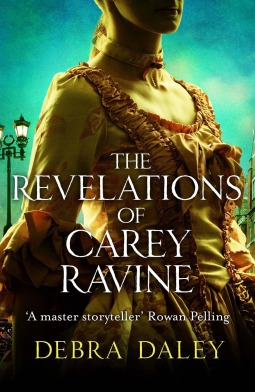
 There was always a good chance that I was going to love The Revelations of Carey Ravine. A book which has been compared with “Sarah Waters, Amitav Ghosh’s The Sea of Poppies, and Jamaica Inn” sounded perfect for me…and it was. Set in 1770s London, this is a dark tale of deception and betrayal in which nothing is as it seems. Our guide through all of this is Carey Ravine, an intelligent and spirited woman with an interesting past.
On the surface, Carey and her husband, Oliver Nash, appear to be the perfect couple: rich, good-looking, charming and leading a life of glamour and luxury. In reality, their lavish lifestyle is funded by Carey’s dwindling savings – and as their finances become stretched to the limits, cracks in their marriage begin to appear. When Carey finds a dossier in Nash’s desk describing the death by poisoning of a young man during a medical experiment in India, she confronts her husband and asks for an explanation. It’s obvious, though, that Nash doesn’t want to talk about it, so Carey is left to investigate on her own…
Towards the end of the novel, revelation follows upon revelation as the mystery surrounding the poisoning starts to unfold…but Carey also makes some important discoveries about herself and the sort of person she really wants to be. The novel is narrated by Carey herself, which means the reader can only know as much as Carey does – and it quickly becomes obvious that there are some big gaps in our heroine’s knowledge. The fate of her father, the horticulturalist Daniel Ravine, for example, is unknown to Carey. The last she heard of him was when he wrote to her from India ten years earlier to tell her of her mother’s death in Calcutta. Having had no further news, Carey has given up hope of ever seeing or hearing from him again. Eventually, though, the truth about Daniel Ravine begins to emerge, and as we learn more about Carey’s family and her past, some light is shed on her present circumstances.
Carey is a wonderful character – she’s strong and resourceful but she’s still convincing as a woman of her time and her actions never fall outside of the realms of plausibility. Through her eyes we see what it was like to be female in the 18th century, facing a range of challenges, some of which were unique to the time period and others which we can still identify with today. Carey’s relationship with Nash is particularly interesting; she’s in love with her husband and wants to please him, but not at the expense of losing her own identity. Although her freedom is restricted as a married woman, she still does what she can to support herself independently and finds work translating scientific texts.
The setting for this novel is one that I always enjoy – Georgian England – and Debra Daley does a wonderful job of bringing the time period to life with descriptions of flamboyant clothing of silk, velvet and lace, popular dances (the cotillion, for example), and entertainment (masquerade balls and card games such as faro). But it’s the lesser-known details of Georgian life and culture that I like reading about the most; I love the idea that pineapples were seen as such a status symbol in the 1770s that it was possible to hire one to use as a table decoration for your dinner party!
Too many good novels are let down by a poor ending which leaves the reader wondering what was the point of it all. Carey Ravine, though, feels like a complete novel with a beginning, a middle and a satisfying ending. I was also happy, on reaching the end of the book, with the level of character development throughout the story – Carey changes and grows as a person as the novel progresses and by the time we come to the final page she is a rather different woman than she was at the beginning.
This is the second novel by New Zealand author Debra Daley; her first, Turning the Stones, was published in 2014. I will certainly be going back to read that one, as well as looking forward to any future books from Daley.




 She Reads Novels