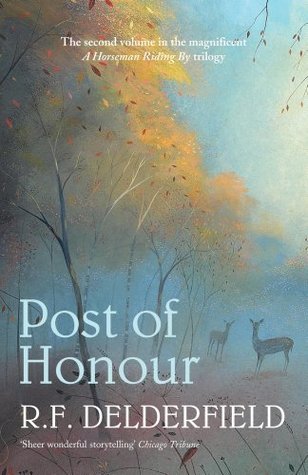
Post of Honour by RF Delderfield

Post of Honour is the second book in RF Delderfield’s A Horseman Riding By trilogy which begins with Long Summer Day, one of my favourite reads of last year. For me, this second novel is not as good as the first, but still very readable.

As this book and the first one were originally published in 1966 as one very long volume, Post of Honour picks up the story just after Long Summer Day ends in 1911, dropping us straight back into the daily lives of the people of the Sorrel Valley. A few years go by with small dramas taking place – weddings, funerals, births, deaths, new friendships being formed and new romances beginning to blossom. And then, in 1914, war breaks out in Europe and life in the Valley will never be the same again.

Although I had allowed a whole year to pass between finishing the first book and picking up this one, I found that I had no problem remembering the characters and storylines. It was lovely to be reacquainted with old friends like the former street-urchin Ikey Palfrey, the wild, untameable Hazel Potter, suffragette Grace Lovell and, of course, our hero Paul Craddock, the squire of Shallowford. The first part of the book is devoted to the First World War, showing us how these characters and many others are affected, either directly or indirectly. One of the Valley men becomes a conscientious objector while others fight in the trenches and those left at home wait for news of their loved ones. It would be unrealistic for all of our much-loved characters to return from war unscathed – so, inevitably, there are some deaths and the next section of the novel looks at how the inhabitants of Shallowford and the Sorrel Valley recover from their losses and try to move on over the next two decades.

This book covers a much longer time span than the previous one and this, in addition to the number of deaths during the wartime chapters, means the introduction of lots of new characters from the second and third generations. One of the things I remember loving about Long Summer Day was the way Delderfield brought each character, even the minor ones, fully to life. However, I don’t think he does that quite as successfully in Post of Honour and I felt that many of the new characters were little more than names on the page. With the exceptions of two of Paul’s children – Simon and Mary – and Ikey’s son, the strangely named Rumble Patrick, I simply wasn’t very interested in any of the others.

By the end of the book, another world war has begun, and I do want to see how Paul and his friends and family will fare. I will be reading the third book in the trilogy, The Green Gauntlet, but after that I’m looking forward to leaving the Sorrel Valley behind and trying some of Delderfield’s other novels – probably beginning with the one I already have on my shelf, Farewell the Tranquil Mind.

This is book 9/20 of my 20 Books of Summer.

Gentian Hill by Elizabeth Goudge

For the last few years Lory of The Emerald City Book Review has been hosting a celebration of Elizabeth Goudge’s work on the author’s birthday and as a result I have read three wonderful novels, one every April since 2015 – The Child from the Sea, The White Witch and Towers in the Mist. This year Lory has taken a break from hosting this event, but I was pleased to find that it has a new home at Howling Frog Books and Jorie Loves a Story. Even before I knew that there would be an Elizabeth Goudge Day 2018, I had already decided to mark the day myself by reading another of her books. I still had plenty of unread Goudge novels to choose from, but Gentian Hill was the one I felt most drawn to this year.

Gentian Hill, first published in 1949, is set in Devon during the Napoleonic Wars. It opens on a peaceful August evening with a Royal Navy fleet arriving at Torbay during a glorious sunset. On board one of the frigates is fifteen-year-old Midshipman Anthony Louis Mary O’Connell, who has been in the Navy for eight weeks and has had all he can take of the seasickness, the brutal treatment, the punishments, and the taunts of the older, more experienced sailors. Escaping from the ship during the night, he deserts and disappears into the countryside where, taking the name of Zachary, he wanders from place to place looking for work until, eventually, fate takes him to Weekaborough Farm near Gentian Hill.

Weekaborough Farm is home to the Spriggs and their ten-year-old adopted daughter Stella. Stella is a gentle, sensitive girl whose time is divided between caring for the animals on the farm and attending lessons with Dr Crane, the village doctor, a man who values the importance of a thorough education for girls as well as boys:

Reading, writing, and elementary arithmetic were all the child needed to learn of the doctor, Mother Sprigg maintained. This, combined with the arts of housewifery that she herself could teach her, was all the education required by a farmer’s daughter. Doctor Crane disagreed; the education required by any individual, he maintained, was just exactly all the knowledge the individual could possibly assimilate.

When Zachary arrives in Stella’s life, an instant connection forms between the two of them which quickly blossoms into love, but soon Zachary must go to sea again…and there is no guarantee that they will be reunited.

I enjoyed Gentian Hill; as with all the other Goudge novels I’ve read, the writing is beautiful and there are some truly lovely descriptions of the Devon countryside. Here are the words she uses to bring Torbay to life:

The last light of the sun was streaming over the rampart of green hills to the west, brimming the leafy valleys with liquid gold, then emptying itself in a sort of abandonment of glory into the vast domed space of sky and sea beyond. There were ripples on the water, and a fragile pattern of cirrus clouds above, and these caught the light in vivid points of fire that were delicate as filigree upon the fine metal of the gold-washed sea and sky.

However, this is probably my least favourite of the four books I’ve read so far. With the hero and heroine being ten and fifteen (and they only age slightly over the course of the novel), I couldn’t really believe in the romance between them – it felt more like the love between a brother and a sister. I also found the characters a little bit too good and too pure, even for a Goudge novel; I feel sure there were characters in her other books who were more complex – unless I was just in the wrong mood this time.

I did find plenty of things to love, though. I particularly liked the way Goudge weaves local legends into the story, such as the legend of St Michael’s Chapel in Torquay, as well as all the customs and traditions that formed part of 18th century rural life: Christmas wassailing, the Ploughing Chant, harvesting, corn dollies, and the ancient instrument known as the bull-roarer. I also enjoyed following the story of the Abbe de Colbert, chaplain of Torre Abbey, who lived and suffered through the recent French Revolution. And although the plot is predictable, what I was hoping would happen is exactly what did happen, so I was happy with that!

Gentian Hill is a lovely story, but if you have never tried one of Elizabeth Goudge’s historical novels before I would recommend starting with either Towers in the Mist or The Witch Witch. She also wrote several contemporary novels including The Scent of Waterdon’t forget to enter my giveaway if you would like to win a copy of that one!

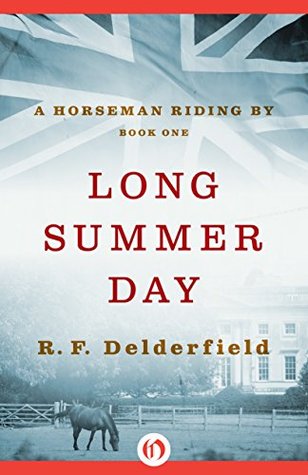
Long Summer Day by RF Delderfield

Long Summer Day was a long summer read, but I enjoyed every minute of it! First published in 1966, this is the first part of RF Delderfield’s A Horseman Riding By trilogy (originally just two books rather than three, as this one and Post of Honour were intended to form one huge volume; the final book, The Green Gauntlet, came a few years later).

Long Summer Day begins in 1902, early in the reign of King Edward VII, and ends in 1911, shortly after the coronation of his successor, George V. The novel takes its title from the fact that this period of history, coming just before the horrors of the First World War, came to be looked back on with nostalgia and described as the ‘Long Edwardian Summer’. Set in rural Devon, it follows the story of Paul Craddock, a young man who is injured during the Boer War and, with his military career at an end, decides to use his inheritance from his father to buy an estate in the countryside.

At first the inhabitants of the Sorrel Valley are suspicious of their new Squire, but through his efforts to befriend and understand them, Paul quickly earns their respect and acceptance. As he gets to know each of the families who live in and around the valley, we, the reader, have a chance to get to know them all too. It’s a very large cast and at first it’s hard to keep track of who’s who, but eventually each character, however minor, becomes a fully formed human being and is given a storyline of his or her own.

I can’t mention all of the characters here, but some that I found particularly memorable include Ikey Palfrey, the stableboy Paul informally adopts and sends to school; Will Codsall and Elinor Willoughby, a young couple whose marriage forms one of the novel’s first small dramas; the agent John Rudd who manages the estate and provides Paul with both advice and friendship; and Hazel Potter, the wild youngest daughter of one of the valley’s most notorious families. In such a tight-knit community, the stories of each of these characters and many more are closely intertwined so that the actions of one may have repercussions on the lives of the others.

As an eligible young bachelor, Paul attracts the attention of several of his female neighbours almost from the moment he arrives in Devon, but only two come to play an important role in his life. One of them is Claire Derwent, daughter of one of his tenant farmers, and the other is Grace Lovell, a cousin of the family who previously owned Shallowford, Paul’s estate. Grace is a fiercely independent person, a feminist who believes passionately in women’s suffrage. I felt that I should like her, but although I did admire her strength and courage, her prickly nature made it difficult for me to warm to her. Claire, though, I loved from the start – and my opinion of her never changed. Although she has little interest in politics and keeps herself busy with more domestic tasks, it’s clear that she is happy with this and that it’s her choice. I found her sensible, down-to-earth, kind-hearted and a strong person too, although not in the same way as Grace. To discover which of these women Paul chooses, you’ll have to read the book for yourself!

The personal stories of the characters are played out against a backdrop of events from Edwardian history: Edward VII’s illness and delayed coronation, the political conflict between the Conservative and Liberal parties (it’s plain to see where the author’s own political sympathies lie) and the beginnings of the suffragette movement. We also find out how the characters react when change and progress finally makes its way to the Devon countryside and they see their first ‘horseless carriage’.

Long Summer Day is one of my books of the year so far, without a doubt. It’s written in the sort of warm, comforting, old-fashioned style that I love, and despite its length I felt that the pages were going by very quickly because I was so absorbed in the lives of Paul and his friends – it’s one of those books where you truly feel as though you’ve escaped into another world for a little while!

A Horseman Riding By was adapted by the BBC in the 1970s, with Nigel Havers as Paul Craddock. Has anyone seen it?

This is book 6/20 for my 20 Books of Summer challenge.