The Sapphire Widow by Dinah Jefferies

I love Dinah Jefferies’ books; they always have such interesting settings. So far they have taken me to 1950s French Indochina (The Silk Merchant’s Daughter), Malaya during the Emergency of 1955 (The Separation) and 1920s Ceylon (The Tea Planter’s Wife). Her new novel, The Sapphire Widow, takes us back to Ceylon again but the story this time is quite different.

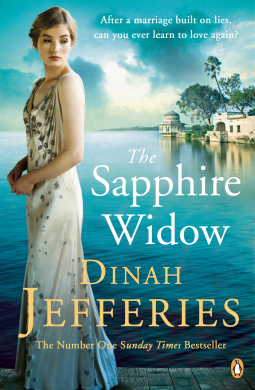
It’s 1935 and Louisa Reeve is grieving for her stillborn daughter, one of several miscarriages and stillbirths she has suffered over the years. She should be able to rely on her husband Elliot for support, but Elliot has become withdrawn and distant, spending more and more of his time visiting a nearby cinnamon plantation in which he says he has bought shares. When he tells her about his latest business venture – converting an old Print House into a shop trading in jewels and spices – Louisa feels more optimistic. It will be something they can work on together – and if they could only have another child, surely their marriage will survive.

Sadly, Louisa will never know what the future might have held for the two of them, because Elliot is killed in a tragic accident. Before she has even begun to come to terms with losing him, she makes a series of shocking discoveries that leave her questioning whether she ever really knew her husband at all. Hoping to find answers at Cinnamon Hills, she only uncovers more lies and secrets, but when she meets Leo, the plantation owner, and a little boy called Conor, she begins to find the strength to move on.

I think The Sapphire Widow could be my favourite of the four Dinah Jefferies novels I’ve read. It was lovely to return to Sri Lanka (or Ceylon, as it was then) and a nice surprise to be reacquainted with characters from The Tea Planter’s Wife, which I hadn’t expected! Although this book doesn’t explore the history and politics of 1920s/30s Ceylon in the way that the earlier book did, it doesn’t really need to because this is a different type of story. Unlike Gwen in The Tea Planter’s Wife, Louisa doesn’t have the same level of interaction with people of different backgrounds and beliefs; her story revolves around Elliot’s lies, her constant battles with her mother-in-law Irene, and the relationships that are beginning to form with Leo and with Conor.

This doesn’t mean that the setting is any less wonderful, of course! Dinah Jefferies writes so beautifully about Ceylon, bringing each location to life as the action moves between the coastal city of Galle, the capital Colombo and the cinnamon plantation where Leo lives. The characters are great too. I loved Louisa and really admired her patience with the interfering Irene, for whom Elliot can do no wrong and Louisa can do no right. I was glad that Louisa had a good friend in her sister-in-law Margo, who helps her through this difficult time despite the problems she is experiencing in her own personal life.

I really enjoyed The Sapphire Widow and will look forward to whatever Dinah Jefferies writes next. Meanwhile, I need to go back and read Before the Rains, her novel set in India in the 1930s. I’m not sure how I still haven’t read that one!

Thanks to Penguin for providing a copy of this book for review via NetGalley.
The Silk Merchant’s Daughter by Dinah Jefferies

After reading and loving Dinah Jefferies’ The Tea Planter’s Wife last month, I immediately added another of her books, The Silk Merchant’s Daughter, to my 20 Books of Summer list, hoping for another great read.

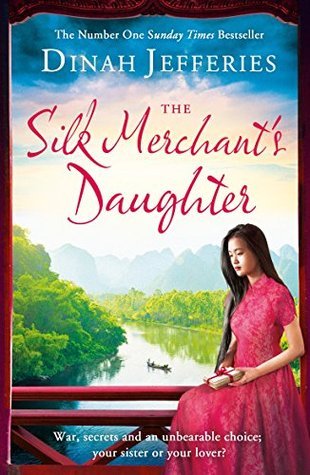
The Silk Merchant’s Daughter is set in French Indochina, the name formerly given to the group of French colonial territories which included Vietnam, Cambodia and Laos. The title character – and our heroine – is Nicole Duval, the eighteen-year-old daughter of a French silk merchant based in Hanoi, the capital city. The period during which the story takes place is a turbulent time in the history of the region and Jefferies provides a useful timeline at the front of the book for those of us who need some help in understanding the sequence of events.

As the novel opens in 1952, Nicole learns that her father is planning to hand over the running of the entire silk business to her older sister, Sylvie, leaving Nicole with only one small, neglected silk shop in the Vietnamese quarter of the city. Nicole is disappointed and resentful; her relationship with Sylvie has been difficult from childhood and yet again, Nicole has been made to feel inferior. To make matters worse, the man she loves – Mark, an American trader who is in Hanoi on mysterious government business – has previously been in a relationship with her sister, and Nicole is not at all sure that he and Sylvie no longer have feelings for each other.

Determined to make the best of things, Nicole opens up the little silk shop and it is here, living and working among the Vietnamese people, that she begins to understand their discontent with French rule. With the help of Tran, a militant with the revolutionary group the Viet Minh, Nicole’s mind is opened to new ideas and views. Being half Vietnamese herself – she has inherited her looks from her late Vietnamese mother, whereas Sylvie resembles their French father – Nicole has a certain amount of sympathy for Tran and his friends. But Mark and the Duvals will be on the opposite site of the coming conflict, so Nicole needs to decide where and with whom her loyalties lie.

The Silk Merchant’s Daughter is another enjoyable and engaging novel from Dinah Jefferies, bringing to life the history of a place about which I previously knew very little. Having learned about the Malayan Emergency in The Separation and 1920s Ceylon in The Tea Planter’s Wife, it was good to have the opportunity this time to add to my knowledge of Vietnam. I haven’t read much about the Vietnam War and nothing at all – until now – about the years immediately preceding it, encompassing the rise of the Viet Minh and the First Indochina War. It was also interesting to read about French colonialism, which made a change from reading about British colonialism!

Writing the novel from the perspective of Nicole was a good decision by Jefferies, as she is in the unusual position of being both French and Vietnamese. However, I never really felt that she was truly torn between the two and it seemed fairly obvious to me which side, and which man, she would eventually choose, and that took some of the tension and emotion out of the story. There are some wonderful descriptions of Vietnam, from the sights, sounds and smells of the streets of Hanoi to the colours and textures of Nicole’s silks, but on the whole I found this book slightly disappointing after the very high standards set by The Tea Planter’s Wife.

Although this is not my favourite Dinah Jefferies book, I am still looking forward to reading Before the Rains, her new novel set in India.

This is book 2/20 for my 20 Books of Summer challenge.

The Tea Planter’s Wife by Dinah Jefferies

I’ve been falling behind with Dinah Jefferies’ novels; after reading her first, The Separation, back in 2014, she has since had another three books published, none of which I had read until picking up The Tea Planter’s Wife a few weeks ago.  I regret not reading it sooner, because I loved it and am now desperate to read her other two, The Silk Merchant’s Daughter and Before the Rains.    

The Tea Planter’s Wife is set in Ceylon (the former name for Sri Lanka) in the 1920s and 30s, and begins with the arrival of newly married Gwendolyn Hooper who has come from England to join her husband, Laurence, on his tea plantation. Gwen is only nineteen years old and barely really knows her husband, a widower much older than herself.  Settling into married life proves to be more difficult than she’d expected, particularly as she also has to get used to a whole new culture and climate.  It doesn’t help that Laurence’s sister Verity comes to live with them and makes it obvious that she resents Gwen marrying her brother.  To make matters worse, Gwen is convinced that Laurence is trying to hide the truth surrounding the death of his first wife, Caroline.   

Feeling lonely and neglected, Gwen is grateful for the friendship of Savi Ravasinghe, a Sinhalese portrait painter, and is mystified as to why Laurence seems to disapprove of him so much.  Then something happens which makes Gwen think that Laurence was right to distrust Savi – and which throws her already troubled life into even more turmoil. 

With its evocative setting and aura of mystery and secrecy, this is a wonderfully atmospheric novel with an almost gothic feel at times.  Throughout the first half of the novel, in particular, I was constantly reminded of one of my favourite books, Daphne du Maurier’s Rebecca: the naive, inexperienced young woman; the mysterious older husband who becomes increasingly distant as soon as the wedding is over; the first wife who, even in death, still casts a shadow over the household.  The similarities lessened as the story continued, though, and more themes and elements were introduced.

Ceylon, as it was known then, is a country I know very little about, so I found it interesting to read of the racial and political tensions between the various groups of people who live on the island – the Sinhalese, the Tamils and the British planters.  With Gwen being a newcomer and unfamiliar with the way of life, we see things through her eyes and share her experiences as she tries to adapt to her new home.  Gwen finds the living standards of the plantation workers particularly difficult to accept and her well-meaning attempts to improve things for them often get her into trouble.  And yet this doesn’t feel to me like an author simply projecting her own modern views onto a character from a bygone time, as often happens in historical fiction, but more a way of showing that Gwen was a decent person who wanted to help in any small way she could, with a natural sympathy for children, the sick and the vulnerable, whatever their colour or status in society.

The setting plays an important part in the story, but so do the people, the decisions they make and the ways in which they communicate – or fail to communicate – with each other.  This is the sort of book where you find yourself becoming frustrated with the characters because they just won’t tell each other the truth…but at the same time you understand why they feel they can’t! 

Having enjoyed The Tea Planter’s Wife so much I’m pleased that I still have two more books by Dinah Jefferies to read.  I just need to decide which one to read next!

The Separation by Dinah Jefferies

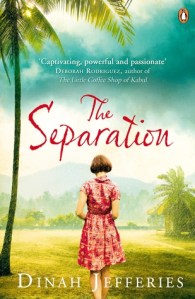
The Separation Imagine that you’ve returned home from visiting a friend to find that your house is empty – your husband and children have disappeared, the servants have vanished and when you pick up the phone the line is dead. You set out in search of your family, determined to find them no matter what, but it’s not going to be an easy task because this is Malaya in 1955: a country at war.

This is what happens to Lydia Cartwright in this wonderful debut novel by Dinah Jefferies. As Lydia leaves the family home in Malacca and heads north to Ipoh believing that her husband (who works for the British Administration) may have been posted there, we discover that Alec and the two girls – Emma, aged eleven, and Fleur, eight – have gone somewhere else entirely. Will Lydia ever see her daughters again?

The Separation is divided into two distinct storylines told in alternating chapters. In one we follow Lydia as she makes the discovery that her children are missing. As she embarks on her nightmarish journey through the dangerous Malayan jungle, she faces terrorist attacks, gunfire and overcrowded buses and trains, as well as the possibility that she has been betrayed and deceived. In the other thread of the story we join Emma as she and Fleur try to settle into their new lives while coming to terms with the loss of their mother. Things are not easy for Emma and she too is forced to go through some terrible ordeals, all the while clinging to the hope that her mother is still alive and one day they will be reunited.

I thought the structure of the novel worked well; I enjoyed reading both Lydia’s chapters and Emma’s and never felt that we were spending too much time on one character at the expense of the other. Lydia’s story is more dramatic (and full of beautiful, exotic descriptions of Malaya) but of the two I think I preferred Emma’s. That could just be due to the fact that I felt closer to Emma as she narrates in the first person while Lydia’s chapters are written in the third person – or maybe it’s because although I’m not a mother I am a daughter so it was easier for me to identify with Emma. I did like and sympathise with both main characters, though, and desperately wanted them to be together again. Of course, I’m not going to tell you whether that happens or not!

I have never read anything about the history of Malaya (as it was still known in the 1950s before becoming Malaysia) so that was another aspect of the book I found interesting. The story isn’t weighed down with too much historical detail but by the time I’d finished the book I felt that I’d learned a little bit about The Emergency (the name given to the war) and what it was like to be a woman and a European living in Malaya during that period. I was interested to read that Dinah Jefferies was born in Malaya and lived there until the age of nine, which means she was able to draw on some of her own experiences and memories.

This was a very impressive first novel and I’m already looking forward to the second book from Dinah Jefferies, The Tea Planter’s Wife, which is going to be set in Sri Lanka.

Thanks to the author for sending me a copy of this book for review.