The Pharmacist’s Wife by Vanessa Tait

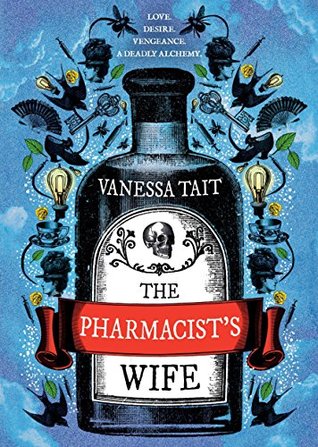
Vanessa Tait is a new author for me, although it seems she has written one previous novel, The Looking Glass House – a book inspired by Alice in Wonderland, which sounds particularly intriguing as Tait is the great-granddaughter of ‘the real Alice’, Alice Liddell. I was drawn to her latest novel, The Pharmacist’s Wife, by the eye-catching cover and then by the promise of “A dark and thrilling tale of Victorian addiction, vengeance and self-discovery, perfect for fans of Sarah Waters, Jessie Burton’s The Miniaturist and Sarah Perry’s The Essex Serpent.”

The Pharmacist’s Wife is set in Victorian Edinburgh, a setting which interested me immediately. There are so many novels set in Victorian London, it always makes a nice change to find one set somewhere else! Although I felt that the sense of place could have been strengthened by the use of more Scottish dialect, I did like the contrasting descriptions of the Old Town and the New Town.

North Bridge, the road linking Old to New, is the location Rebecca Palmer’s husband Alexander has chosen for his new pharmacy, the Grand Opening of which is celebrated with a brass band and a performing monkey. These are exciting times for Rebecca who, as a spinster of twenty-eight, had given up hope of ever marrying anyone, let alone such a clever and distinguished man as Alexander. Almost as soon as they move into their new home, however, Rebecca is forced to question whether her husband really is the man he appears to be. She suspects him of having an affair with Evangeline, a woman from the Old Town, and when she finds a ladies’ red shoe on his desk she’s sure her suspicions have been confirmed.

Alexander doesn’t like a wife who asks questions or has too many ideas of her own and, with this in mind, he has been developing a new medicine in his laboratory above the pharmacy – a medicine which he hopes can be used to control women and which he persuades Rebecca to try by telling her it will make her happy and content. Soon Rebecca is dependent on her medicine, taking it more and more often and relying on her husband to provide it for her. It is, of course, heroin – and it seems that Rebecca is not the only woman on whom Alexander has been testing his new invention…

This is certainly a dark novel but I didn’t find it a particularly thrilling one and it wasn’t until near the end that I started to feel gripped by the story. I suppose I was expecting more from the plot; there are lots of good ideas and plenty of interesting topics are touched on, but it’s only when (without wanting to spoil too much) things begin to go less smoothly for Alexander that it becomes really compelling, in my opinion. What this book does do, very well, is explore the inequalities between men and women in 19th century society. Although Alexander is not a real person and his discovery of heroin is fictitious, he uses the drug to keep his wife quiet and submissive and to take away whatever small amount of independence and freedom she may have had. Rebecca’s situation is oppressive and frightening and as her addiction to the drug deepens it becomes difficult to see how she is going to break out of the cycle in which she has found herself.

I liked Rebecca as a character and was pleased to see that she does develop as a person as the novel progresses, but I thought the villains, Alexander and his friend Mr Badcock, were too obviously ‘villainous’ and could have been given more depth. As well as the drugs, it seems that there’s no type of cruelty or depravity of which they’re not capable! Thankfully, there are two decent male characters to balance things out slightly – Lionel, the apprentice who helps Alexander in the pharmacy, and Gabriel, Rebecca’s first love.

The Pharmacist’s Wife is an interesting novel and, as I’ve said, a very dark one. I couldn’t love it, but I would be happy to read more books by Vanessa Tait. Has anyone read The Looking Glass House? What did you think of it?

Thanks to Atlantic Books for providing a review copy via NetGalley.

The Heart of Midlothian by Sir Walter Scott

The Heart of Midlothian In 2012 I read my first Walter Scott novel, Ivanhoe, and was surprised by how much I enjoyed it. Having found Scott less difficult to read than I’d expected, I decided to add another of his books to my Classics Club list and something drew me to this one – possibly memories of the Scottish football results being announced on the television on a Saturday afternoon (Heart of Midlothian is the name of an Edinburgh team).

The novel – which predates the football team, being published in 1818 – takes its title from the Old Tolbooth Prison in Edinburgh, which was in the heart of the county of Midlothian. Scott based his plot on two real historical events: the Porteous Riots of 1736 and the story of a young woman who walked all the way to London to obtain a royal pardon for her sister who had been wrongly charged with infanticide. In Scott’s version, the young woman’s name is Jeanie Deans and she lives on a dairy farm at St Leonard’s Crags with her father, Davie, a strict Cameronian (a Presbyterian faction).

Jeanie’s younger sister, Euphemia – known as Effie – is in the Tolbooth facing the death penalty, having been accused of giving birth in secret and murdering her newborn child. Jeanie is sure Effie is innocent, but with no witnesses to the pregnancy or the birth and no way to prove what happened to the baby, she is guilty in the eyes of the law. If Jeanie would only tell the court that she had known her sister was pregnant, Effie could be freed, but she is unwilling to tell a lie and instead she decides to go to London to ask Queen Caroline for a pardon. Armed with a letter of introduction to the Duke of Argyll and some money borrowed from an admirer, the Laird of Dumbiedikes, Jeanie sets off on foot to save her sister’s life.

The first half of the novel sets the scene, describing a riot that breaks out in Edinburgh during a protest over the hanging of two smugglers. When Captain John Porteous orders the city guard to fire into the crowd, causing the deaths of several people, he himself is imprisoned in the Tolbooth. The prison is then stormed by a mob and Porteous is lynched and killed. These events become entwined with Effie’s story and provide the historical backdrop for the novel. The second half of the book concentrates on Jeanie’s journey to London, which includes encounters with some characters we previously met in Scotland: George Robertson, the father of Effie’s child; and Meg Murdockson and her mentally ill daughter, Madge Wildfire, two women who could hold the key to the mystery of the missing baby.

Well, The Heart of Midlothian was not the relatively easy read that Ivanhoe was! I found it much more challenging, for several reasons. First, as the novel is set mainly in Scotland, the dialogue is written almost entirely in Scots. I wouldn’t normally have a problem with this, but added to the fact that the book was written in the early 1800s, it did slow down the pace of my reading quite a lot. I find that whenever a book uses a large amount of dialect – even one you’re familiar with – a little more effort is required to read it and that was definitely the case here. If you think you might struggle with the dialect, I would recommend choosing an edition of the book with a good glossary!

Also, unlike Ivanhoe, which is a medieval adventure story packed with sword fights, sieges, villainous knights and feuding noblemen, this is a very different type of novel. While Jeanie’s personal story was gripping, I have to admit I had very little interest in the long passages describing the religious situation in eighteenth century Scotland and the discussions between Jeanie’s father, Davie Deans, and his neighbours on their different moral beliefs. I also thought the plot relied too heavily on coincidence, with Jeanie meeting people from her own small community in Scotland hundreds of miles away in England – and I felt that the final few chapters of the book were unnecessary as the story had already reached a more natural ending point.

I did enjoy parts of The Heart of Midlothian, though. Jeanie is a strong heroine who behaves with honesty and integrity throughout the novel, and although some of her choices were frustrating, I did like her. There is a romantic interest for Jeanie too – the schoolmaster, Reuben Butler – but this only forms a small part of the story. I was also interested in the descriptions of eighteenth century life and the relationship between Scotland and England in the years following the union of 1707. And there are plenty of memorable scenes, from the storming of the Tolbooth near the beginning to Jeanie’s meeting with Queen Caroline, wife of George II, towards the end.

I certainly didn’t love this book the way I loved Ivanhoe, but I’ll still read more of Scott’s novels and will hope that the next one I pick up is more to my taste than this one was!

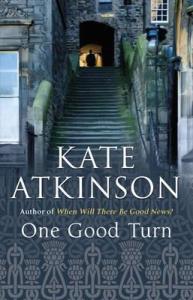
One Good Turn by Kate Atkinson

One Good Turn After reading Case Histories, the first of Kate Atkinson’s Jackson Brodie novels just before New Year, I was desperate to continue with the series. Luckily, I saw a copy of the second book, One Good Turn (subtitled A Jolly Murder Mystery), on the shelf on my next visit to the library so I didn’t have too long to wait!

Following the events of Case Histories, Jackson Brodie has given up his private investigating, taken his inheritance and is leading a quiet life in the French countryside. At the beginning of One Good Turn, he is visiting Scotland for the Edinburgh Fringe Festival where his girlfriend, Julia, is acting in a new play. On Tuesday, as he waits to enter a comedy venue, Jackson witnesses a road rage incident in which one man attacks another with a baseball bat. Jackson doesn’t want to get involved but it seems that he may have no choice.

Another bystander is crime writer Martin Canning, who intervenes by throwing his laptop at the assailant – and then begins to wish he hadn’t when he is asked to accompany the victim to hospital and stay with him overnight. They say that one good turn deserves another, but Martin’s good turn leads to a chain of bizarre incidents that could almost have come straight out of the pages of one of his own Nina Riley crime novels.

Over the next four days, a complex plot unfolds involving a fraudulent businessman, a mysterious cleaning company, a knife-wielding Russian girl, two teenage shoplifters, an unwelcome guest and an aggressive dog. Jackson can’t help being drawn into the investigations, but as the mystery deepens he finds that he has become both a victim and a suspect.

I had enjoyed Case Histories but I thought this one was even better. It was good to meet Jackson again and to see how his relationship with Julia has developed, but I also think it’s good that Jackson is only one of a large cast of eccentric, colourful characters, each of whom becomes caught up in the whirlwind of events. Atkinson puts so much detail and so much humour into her characterisation that each one feels like a real person – we can laugh at them and with them, but we can understand them and have sympathy for them as well.

In this book, we get to know Gloria Hatter, the bored and disillusioned wife of an unscrupulous businessman in trouble for fraud; police detective Louise Monroe, who is trying to investigate the case while struggling to cope with the behaviour of her teenage son; and my favourite, Martin the crime novelist, a shy, reclusive man still haunted by memories of a disastrous trip to Russia several years earlier. Martin’s Nina Riley mysteries sounded so much fun I kept wishing they really existed!

The one criticism I had of Case Histories – the fact that it dealt with three separate storylines that never really came together – was not a problem with this book, as it’s more of a conventional crime novel in that respect. Characters and events that seemed unrelated at the beginning do eventually begin to overlap and things start to fall into place (comparisons are made throughout the novel to a set of Russian dolls, with one fitting inside the other). I loved the ending too; there was a surprise on the final page that left me questioning everything I’d read about one of the characters!

Now I’m looking forward to reading the third book in the series, When Will There Be Good News?