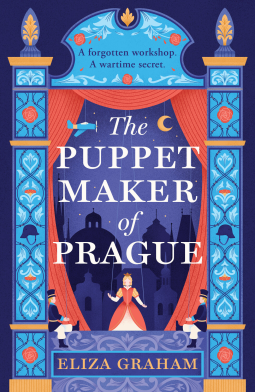
 One of the things I remember from my visit to Prague, more than twenty years ago now, is seeing so many places selling traditional Czech puppets, so I was drawn to this book as soon as I saw the title.
The novel follows the story of a family torn apart during the Nazi occupation of Prague, which begins in March 1939. Petr Doubek is the puppet maker of the title and has been making a name for himself in Prague with his clever, entertaining puppet shows featuring his own beautifully made marionettes. Since the Nazis marched into the Sudetenland the previous year, Petr’s shows have become increasingly satirical, mocking Hitler and his politics, something Petr greatly regrets when the rest of Czechoslovakia, including Prague, also falls under Nazi control. He flees to Poland, leaving behind his wife, three-year-old daughter Jana and nineteen-year-old stepdaughter, Elsa. When their mother makes the difficult decision to join her husband in exile, it is left to Elsa to raise her little sister alone in the occupied city.
In 2016, we meet Christa, an elderly woman who has found a princess marionette in the attic of her London home. Although Christa grew up in Germany, an antiques dealer tells her that the puppet appears to have Czech origins. Deciding to investigate further, her search leads her to Prague and the old Doubek puppetry workshop. But what is Christa’s connection with the Doubek family and why did the princess puppet end up in her attic?
The Puppet Maker of Prague is yet another dual timeline novel, which seem so popular these days. However, it’s an example of the format working very well, with both narratives forming an important part of the overall story. The present day timeline is directly linked to the historical one, without bringing in extra subplots or unnecessary characters. Obviously, though, most of the action takes place in the wartime sections of the novel – and I have to confess, I knew very little about what happened in Prague during the war, so I found these parts of the book particularly interesting. Lots of key events are covered, including the student protests of 1939, the assassination of Reinhard Heydrich (the senior Nazi in charge of Prague), the Nazi retaliation on the village of Lidice (Graham uses a fictional village in its place), and the eventual liberation of Prague in 1945.
Although there’s a romantic interest for Elsa, when she falls in love with a member of the Czechoslovak Resistance (ÚVOD), the most important relationship in the book is the one between the two sisters. As an older sister myself, I found myself identifying with Elsa as she tries her best to protect Jana and keep her safe. It’s a lot of responsibility, with their parents gone and the city under Nazi control, and some of the decisions Elsa makes are questionable, but there’s never any doubt that she’s doing what she thinks is the right thing to do.
This is a very emotional book – wartime stories often are, of course, but I found this one particularly moving and had tears in my eyes on more than one occasion (always a sign that the author has done a good job of getting me invested in the characters and the story). I’ll have to try more of Eliza Graham’s novels. She seems to have written a lot of them!
Thanks to Boldwood Books for providing a copy of this book for review via NetGalley.

