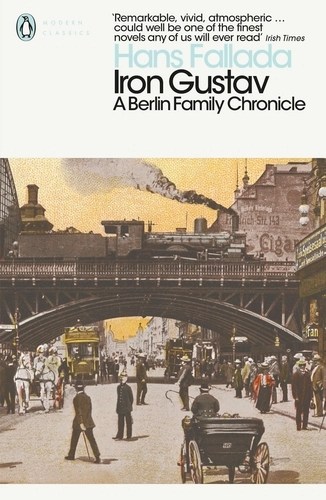
 Translated by Philip Owens and completed by Nicholas Jacobs and Gardis Cramer von Laue
This month Caroline of Beauty is a Sleeping Cat and Tony of Tony’s Reading List are hosting German Literature Month XVI and I’ve turned to a novel by my favourite German author, Hans Fallada. I had been putting off reading this one because of the length (over 600 pages), but once I started I found it so compelling I didn’t really care how long it was!
Iron Gustav has an interesting history. It was first published in 1938, but Fallada was forced to rewrite parts of it by the Nazi propaganda chief Joseph Goebbels, extending the timeline to include the rise of the Nazi regime and changing the political views of some of the characters. Then, when the first English translation by Philip Owens appeared in 1940, it was heavily abridged with about 200 pages cut out. The current Penguin edition from 2014 is the first time Fallada’s original uncensored, unabridged novel has been published in English, with the pro-Nazi passages removed and the missing text restored.
Iron Gustav is the nickname of Gustav Hackendahl, a former sergeant major who rules his household and his employees with harsh, inflexible discipline. As a father of five and the owner of a successful cab business with thirty-two horse-drawn carriages, he proudly refers to himself as a man of iron, a man whose life is in order with everyone and everything under his control. With the outbreak of war in 1914, however, Gustav’s world begins to fall apart. He is forced to sell most of his horses to the army for less than they’re worth, leaving him unable to run his business and struggling financially – and then, in their different ways, his children rebel against him, seeking their own lives away from the family home.
The eldest son, the quiet, sensitive Otto, enlists in the army and is sent to the Front, vowing that when he returns he’ll marry the seamstress Gertrud Gudde, a woman of whom he knows his father disapproves. I loved Gertrud – although she goes through personal tragedy of her own, she proves to be a tower of strength for various other members of the family. The eldest daughter, Sophie, becomes a nurse (also against Gustav’s wishes) and later a hospital matron. We see less of her than the other siblings, but I found her an intriguing character; she has a cold, hard exterior – iron like her father – but she seems to be the only one of the five who knows exactly what she wants from life and goes out to get it.
Her younger sister Eva, on the other hand, is a troubled young woman who becomes trapped in an abusive relationship and estranged from her family. Her story is unpleasant and disturbing, but also sadly believable as Fallada shows how an abuser can control and manipulate their victim until they find it almost impossible to walk away. Erich, the middle son, is originally one of Gustav’s favourite children, but early in the book he steals money from his father, a sign of his true nature. He proves himself to be a selfish, greedy, dishonest person in many ways, getting involved in lots of self-serving money-making schemes, some of which are successful while others fail disastrously.
The most likeable of the Hackendahl siblings is Heinz, the lively, carefree youngest son. Although he struggles with unemployment and romantic entanglements, he remains optimistic and does his best to be a decent person. Yet even he disappoints his father, who is resentful that none of his children followed the path he had planned for them. He considers them all to be ungrateful and disrespectful, not giving their parents the attention they deserve. But Gustav is his own worst enemy because it’s clear that he loves his children and can’t see that it’s his own actions that have pushed them away and destroyed his relationships with them.
No father’s heart can be completely made of iron. It is soil forever newly ploughed, some of whose furrows never disappear.
The story of the Hackendahl family plays out against a backdrop of the history of Germany from 1914 to 1928. We are taken through the First World War and its aftermath, the 1919 Spartacist Uprising, the Ruhr occupation of 1923, and the hyperinflation and mass unemployment during the Weimar Republic. What comes across very strongly is that this is a period of huge change for Germany, in terms of politics, social structure and also technology. Fallada apparently based the character of Gustav Hackendahl on a real life horse-drawn cab driver, Gustav Hartmann, famous for driving his carriage from Berlin to Paris and back in protest against the decline of his industry and the increasing popularity of cars.
This is a very enjoyable novel with a fascinating setting and despite the length I found it genuinely difficult to put down at times. One of my favourites by Fallada, after Little Man, What Now? and Alone in Berlin.
This is also book 11/50 from my current Classics Club list.

