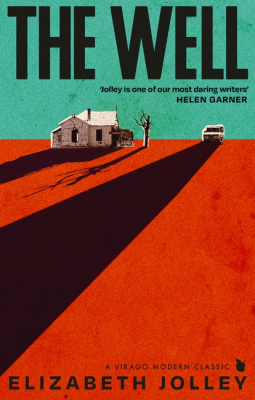
 Elizabeth Jolley is not an author I’ve ever come across before, but when I saw The Well on NetGalley I decided to give it a try. It sounded intriguing and suitably dark for the RIP XXI challenge. Originally published in 1986, the book has recently been reissued by Virago with a new introduction by Alice Slater. I saved the introduction until the end in case of spoilers, but it’s definitely worth going back and reading it.
The novel opens late at night with two women driving home from a party. One is Miss Hester Harper; the other is her adopted daughter, Katherine. As Katherine is almost ready to take her driving test, Hester allows her to get behind the wheel for practice. Due to a combination of inexperience and recklessness, Katherine hits an object on a bend in the road. Hester gets out to investigate and, although she doesn’t say exactly who or what the car has hit, the implication is that it’s a person. Acting impulsively and out of desperation, Hester urges Katherine to continue driving home so they can throw the body down the well in their yard and pretend nothing has happened.
Home for Hester and Katherine is a wheat and sheep farm in rural Western Australia. The two women have lived there alone since Hester inherited the farm from her father and because it’s so isolated, they are able to successfully dispose of the body without anyone knowing what they’ve done. Hester hopes they can put the incident behind them and move on, but Katherine is haunted by what happened and begins to spend more and more time alone at the well…
The drive home, the accident and the decision to hide the body all happen within the first ten pages of the book; we then go back to an earlier period in time with Hester remembering how the teenage, orphaned Katherine first came to live with her and how their relationship developed. We also get some glimpses of Hester’s childhood and her infatuation with her German governess, Hilde Herzfeld.
When we meet Hester as an adult in the book’s present day, it’s not stated exactly how old she is but she describes herself as middle-aged and of ‘advancing years’. Her feelings for the much younger Katherine seem to mirror her obsession with Hilde all those years ago. Her love for Katherine is intense and possessive, she’s jealous of Katherine’s friendship with a girl from the orphanage, and she’s afraid that Katherine will go away and leave her. It seems likely that she’s a lesbian, but like a lot of things in the book it’s left open to interpretation.
Later in the novel we return to the story of the body in the well and the atmosphere becomes darker as Katherine, consumed by guilt, begins to have fantasies about what is really down there. Although there were times in the first half of the book when I felt bored, I found the second half more gripping and quite unsettling. I was a bit disappointed by the ending, though, as it’s very abrupt and, again, difficult to interpret. The only other problem I had with the book was Katherine’s way of speaking, which feels unrealistic and unnatural; it’s partially explained by Hester’s observation that Katherine likes to mimic the American celebrities she admires, but I was still irritated by it!
The story has a timeless feel; I’m not sure if we’re told exactly when the story takes place – Katherine’s favourite actor is John Travolta, so it’s presumably set around the time it was published in the 1980s, but otherwise it could easily have been much earlier in the 20th century. Overall, despite my criticisms, I found The Well a fascinating and unusual novel.
Thanks to Virago for providing a copy of this book for review via NetGalley.
Reviewed for RIPXXI hosted by @perilreaders

