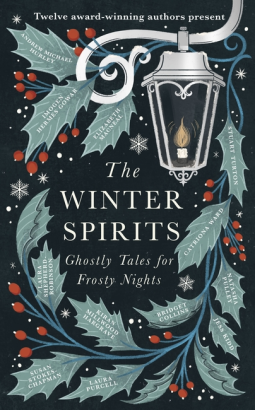
The Winter Spirits: Ghostly Tales for Frosty Nights

The Winter Spirits: Ghostly Tales for Frosty Nights is a collection of twelve new ghost stories written by popular authors of historical and Gothic fiction, all with a Christmas or Advent theme. It’s a follow-up to The Haunting Season, which I haven’t read but which includes eight of the same authors. This is the perfect time of year for ghost stories, so maybe I’ll look for the previous book next winter.

Back to The Winter Spirits and most of the stories are set in the 19th or early 20th centuries, giving them a traditional feel. More variety would have been nice – not just in the time periods, but also in the geographical settings, as the majority take place in Britain, with one or two in America or elsewhere in Europe – but otherwise I really enjoyed this collection. I’ve previously read full-length novels by most of the featured authors, but three of them were new to me: Andrew Michael Hurley, Catriona Ward and Susan Stokes-Chapman. I felt that Hurley’s The Old Play and Stokes-Chapman’s Widow’s Walk were two of the weaker stories, but looking at other reviews, some readers have singled them out as favourites, so I think it’s just a case of different stories appealing to different people! Ward’s contribution, Jenkin, was completely bizarre but added some diversity as it felt quite unlike any of the others.

The biggest surprise, for me, was Natasha Pulley’s The Salt Miracles; I really didn’t get on with her writing style in her novel The Bedlam Stacks, so I wasn’t expecting too much from this tale of disappearing pilgrims on a remote Scottish island (based on St Kilda). However, I ended up loving it – it’s such an unusual and chilling story! Inferno by Laura Shepherd-Robinson, one of my current favourite historical fiction authors, is another I particularly enjoyed – a wonderfully eerie story set in 18th century Italy, where a man is forced to confront his sins. Even better than both of these is Stuart Turton’s creepy and imaginative The Master of the House, in which a young boy who is being neglected by his father makes a deal with the devil. This one feels almost like a very dark fairytale and is one of the highlights of the book.

Of the twelve authors, Laura Purcell is probably the most well established as a writer of horror fiction and she doesn’t disappoint here with Carol of the Bells and Chains, in which a governess trying to deal with two unruly children tells them the story of the Krampus, with unintended consequences. Imogen Hermes Gowar’s A Double Thread, where a woman gets her comeuppance after badly treating her hardworking seamstress, is another I really enjoyed – it made me long for another novel by Gowar, as it’s been a few years since The Mermaid and Mrs Hancock!

The remaining stories are by Elizabeth Macneal, Bridget Collins, Jess Kidd and Kiran Millwood Hargrave. With a range of different styles and subjects, unless you just don’t like ghost stories I think this collection should contain something to please almost every reader.

Thanks to Sphere for providing a copy of this book for review via NetGalley.
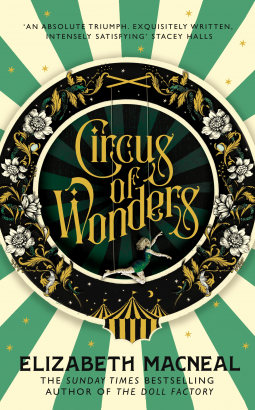
Circus of Wonders by Elizabeth Macneal

I enjoyed Elizabeth Macneal’s first novel, The Doll Factory, so was looking forward to reading her new one, Circus of Wonders.

Beginning in the year 1866, Circus of Wonders tells the story of Nell, a young woman who has always been made to feel like an outsider in her small village on the south coast of England. The unusual birthmarks which cover her skin set her apart from the rest of the community and although her brother does his best to protect her, Nell knows she will never fit in. When Jasper Jupiter’s travelling circus arrives in the village, Nell is horrified to learn that her father has sold her to Jasper, who is looking for a new ‘curiosity’ to draw in the crowds. Once she settles into her new life, however, she begins to think that joining Jasper’s show is the best thing that could have happened to her. Her performance as ‘the Queen of the Moon and Stars’ proves to be a huge success, but how will Jasper feel if she becomes a bigger star than he is himself?

Nell’s story alternates with chapters written from the perspectives of two other characters, Jasper and his brother Toby. There’s a strong bond between the brothers, but they are two very different men. Jasper is very much the leader, an ambitious and ruthless businessman who sees the exploitation of other people as his way to fame and fortune. Toby, who helps him to run the circus, is a gentle, compassionate man desperate to find a way out from his brother’s shadow, but still haunted by his experiences as a photographer in the recent Crimean War. As the novel progresses we learn more about all three main characters as each of them tries to find their place in the world.

Although this is not always a very comfortable book to read, I think Macneal handles a sensitive topic very well. Nell and the other ‘circus attractions’ are treated as commodities to be bought and sold by collectors and showmen, but they are all presented as fully developed characters who, despite their unusual appearances, are normal human beings like anyone else. I have read a few other novels that deal with the same subject, so I was pleased to come across references to Charles Stratton, who appears in The Autobiography of Mrs Tom Thumb by Melanie Benjamin and Julia Pastrana from Orphans of the Carnival by Carol Birch. Unlike Stratton and Pastrana, who both really existed, Nell is a fictional character but her story is no less moving and believable. I was also interested in the flashbacks to the Crimean War, where we gradually find out what really happened to Jasper and Toby, shaping them into the men they are when we meet them at the beginning of the novel.

Of Elizabeth Macneal’s two books, I think I preferred The Doll Factory, but I enjoyed both and will be looking out for whatever she writes next.

Thanks to Picador for providing a copy of this book for review via NetGalley.
Book 25/50 read for the 2021 Historical Fiction Reading Challenge.

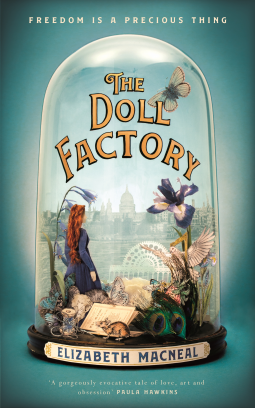
The Doll Factory by Elizabeth Macneal

The Doll Factory was one of the books on my 20 Books of Summer list that I never got round to reading, so I added it to my Autumn TBR list instead, hoping that would give me a push into picking it up sooner rather than later. Now that I’ve finally read it, I can say that it was worth waiting for – and it was actually a perfect October read.

The Doll Factory is set in Victorian London and follows three main characters whose stories become more and more closely entwined as the novel progresses. First, we meet Silas Reed, a lonely and eccentric man of thirty-eight whose ‘shop of curiosities’ houses stuffed animals, jars of specimens and cabinets of butterflies. He dreams of one day opening his own museum and hopes he will get his chance to make a name for himself at London’s upcoming Great Exhibition, but a chance encounter with Iris Whittle proves to be a distraction.

Iris – like her sister, Rose – works at Mrs Salter’s Doll Emporium, painting faces on china dolls. What Iris really wants is to develop her skills as an artist and be taken seriously as a painter in her own right, so when she is approached by Louis Frost, a member of the Pre-Raphaelite Brotherhood who asks her to model for him, she jumps at the opportunity…on the condition that Louis teaches her to paint. As she and Louis begin to spend time together, Iris discovers that she is falling in love – but she is being watched by Silas Reed, who has already decided that Iris is the woman he has been waiting for all his life.

Ten-year-old Albie has links with both Silas and Iris, providing dead animals for the curiosity shop and running errands for the doll factory. Albie is a bright and observant boy, but has grown up in poverty; he needs all the money he can get if he is ever going to help his sister out of prostitution and achieve his dream of buying a new set of teeth for himself. Albie can see that Silas is becoming dangerously obsessed with Iris, but will he be able to help her before it’s too late?

There are so many things to admire about The Doll Factory. I loved the Victorian setting, which in Elizabeth Macneal’s hands feels vivid and convincing, and I loved the way she blends her fictional characters and storylines together with real history. I enjoyed reading about the art world of the 1850s; although we do meet some of the real Pre-Raphaelites such as Rossetti and Millais, they are just minor characters while the focus is on Iris’s relationship with the fictional Louis Frost (and his wombat, Guinevere). As a woman trying to find her way into this world, Iris knows she faces huge challenges and obstacles but she knows she has talent as an artist and is determined to find a way to express herself.

Because of the Pre-Raphaelite element of the novel, I kept being reminded of Crimson and Bone by Marina Fiorato, another book in which a young woman becomes an artist’s model, although I think this is the stronger and better written of the two. It’s also quite a dark novel; the signs are there from the beginning with the descriptions of taxidermy, the collection of dead creatures and some of the macabre paintings Iris and her sister create for mourning parents in the doll factory, but it becomes much darker and more disturbing in the second half of the book as Silas becomes increasingly obsessed with possessing Iris. The ending wasn’t perfect – the climax of the story seemed to go on for far too long and was the one part of the book that, for me, felt contrived and over the top – but other than that, I really enjoyed The Doll Factory. It’s an impressive first novel and I will be hoping for more from Elizabeth Macneal.