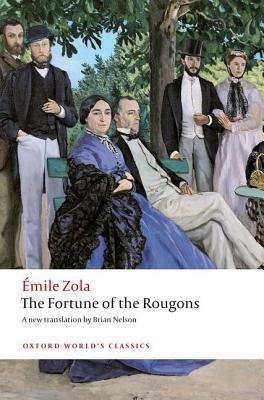
The Fortune of the Rougons by Émile Zola

La Fortune des Rougon, originally published in French in 1871, is the first novel in Émile Zola’s twenty-volume Les Rougon-Macquart cycle. It’s also the book selected for me in the recent Classics Club Spin and the edition I read is an English translation by Brian Nelson.

I’ve already read one of the later books from the cycle – The Ladies’ Paradise – but rather than continue picking them out at random, I thought it might be more sensible to go back to the beginning of the series and try to read them in order. I was a bit hesitant about reading this first book, however, because it sounded as though it was mainly concerned with setting things up for the rest of the series – and that was the case, up to a point, but I found that there was still enough plot to make this an interesting novel in its own right.

The Fortune of the Rougons is set in the fictional French town of Plassans and opens on a Sunday night in December 1851 with two young lovers, Silvère and Miette, joining up with an army of insurgents. It’s the eve of Louis Napoleon’s coup d’état which will result in the formation of the Second Empire under Napoleon III. Silvère wants to give his support to the Republicans who are opposing the coup and thirteen-year-old Miette finds herself coming along to carry the flag.

We then leave Silvère and Miette behind for a while so that Zola can take us back several generations and introduce us to Adelaide Fouque who, through her marriage to the peasant Rougon and a later relationship with the alcoholic smuggler Macquart, is the ancestor of most of the other major characters in the novel. He then follows the lives of Adelaide’s three children – her eldest son, Pierre Rougon, and his illegitimate half-brother and sister, Antoine and Ursule Macquart – as they grow into adults and embark on a family feud. Finally we meet Adelaide’s grandchildren (of whom Silvère is one) and see how they all fit into the events of the formation of the Second Empire.

Once Pierre, Antoine and Ursule have married and had children of their own, the number of characters in the novel quickly multiplies and I’m glad my copy of the book included a family tree as I found myself constantly needing to refer to it. The Rougon-Macquart family are largely an unpleasant group of people – Pierre Rougon tricks his mother into signing over her house to him, depriving his brother of his inheritance, while Antoine Macquart is a violent, aggressive drunk – but there are still some characters with traits I could admire and some I could pity. It seems that Zola’s aim in writing the series was to explore the effects of heredity, so in this book the legitimate Rougon branch of the family are shown to be scheming, avaricious social-climbers while the Macquarts, descended from a rogue, are leading miserable, sordid lives.

The history of the coup d’état and the Second Empire is quite complicated, particularly if, like me, you come to the book with no prior knowledge of these events. With Plassans (based on Aix-en-Provence, where Zola himself grew up) being so far from the action, information comes to the Rougons via the eldest son, Eugène, who lives in Paris, and the people of the town gather in the Rougons’ yellow drawing room to discuss the latest developments. This keeps the reader at a bit of a distance and it took me a while to get everything straight in my head, but later in the book when we rejoin Silvère and Miette marching with the army we get a little bit closer to some of the action.

I didn’t really love The Fortune of the Rougons, but there were parts that I enjoyed very much and I’ll look forward to meeting some of the characters again in the other books in the cycle. I wish I had read this one before jumping straight into The Ladies’ Paradise as I would then have had more understanding of Octave Mouret’s background (he is another descendant of Adelaide Fouque).

Have you read any of the Rougon-Macquart novels? Did you read them in order or at random and do you think it makes any difference?

This is book 33/50 from my second Classics Club list.
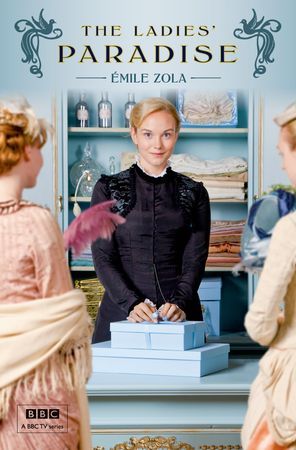
The Ladies’ Paradise by Émile Zola

The Ladies' Paradise The Ladies’ Paradise is only the second book I’ve read by Zola; my first was Thérèse Raquin and the two are very, very different. Au Bonheur des Dames, to give it its French title, was published in 1883 and is the story of a Paris department store, based on the real-life Le Bon Marché.

At the beginning of the novel, Denise Baudu arrives in Paris with her two younger brothers, hoping to find work in her uncle’s draper’s shop. She is disappointed to discover that he is unable to offer her a job because his shop, along with the other small shops in the street, is losing business to a new department store, the Ladies’ Paradise. The new store is able to offer a larger selection of products at cheaper prices all under one roof, and none of the smaller traders can hope to compete. Still, Denise desperately needs to earn money to support her brothers so although she understands how her uncle feels, she is pleased when she is offered a job at the Paradise.

Denise quickly finds that life as a salesgirl at the Paradise is not easy but she’s determined to succeed and overcome whatever obstacles are put in her way. And when she catches the eye of the owner of the Paradise, Octave Mouret, he soon discovers that she is a woman with morals and principles; it’s obvious that she is not going to give him any encouragement – but this only makes him want her more.

I was hoping to love this book as much as Thérèse Raquin but that didn’t happen. The Ladies’ Paradise is a book that I enjoyed, but not one that I loved. It offers some fascinating insights into both Parisian life and the rise of the department store in the late 19th century – and of course, the idea of a larger, cheaper store putting all the small, independent shops out of business is still very relevant today – but I disliked most of the characters and while the long descriptions of the silks, satins and other fabrics sold at the Paradise were beautifully detailed I did get a bit bored after a while. Maybe I just don’t like shopping enough!

However, I did find it fascinating to read about the way the Paradise was run and what it was like to work there. In some ways working at the Paradise was a very different experience from working in retail today, one of the biggest differences being that the salesgirls employed by the Paradise lived and ate on the premises and were treated almost like servants. But from a selling and marketing perspective, I was surprised to learn how modern and sophisticated Mouret’s methods were; a lot of the ideas he had for running the store, advertising its products and attracting customers are still used today (though I didn’t really like the implication that women are so easy to trick and tempt into parting with their money).

The only character I really liked was Denise. I had sympathy with all the ordeals she faced after starting her new job: having trouble fitting in with the other women, feeling that her clothes and hair weren’t right, being bullied by other employees, and worrying about making enough money to take care of her two younger brothers. I found it harder to like or care about any of the other characters (Denise’s brother, Jean, particularly annoyed me – surely he was old enough to take more responsibility for himself and his actions), though I did admire what Mouret had achieved in making the Paradise such a success.

I don’t want to sound too negative about this book because I still found a lot of things to enjoy about it, but I’m hoping the next Zola novel I read will be more to my taste than this one. Any suggestions are welcome!

Thérèse Raquin by Émile Zola

Thérèse is a young woman trapped in an unhappy marriage to her sickly cousin, Camille Raquin. On the surface she appears quiet and passive, never voicing an opinion of her own. But underneath Thérèse is a passionate person who longs to break away from her boring, oppressive existence. When Camille introduces her to an old friend, Laurent, the two begin an affair. Desperate to find a way in which they can be together, Thérèse and Laurent are driven to commit a terrible crime – a crime that will haunt them for the rest of their lives.

If you think I’ve given too much away then I can tell you that this crime takes place quite early in the story and is not the climax of the book. The point of the story is what happens afterwards when Zola begins to explore the psychological effects this action has on the characters.

Thérèse Raquin, as you will have guessed, is a very dark book which becomes increasingly feverish and claustrophobic with scenes of violence and cruelty. I haven’t read much 19th century French literature, apart from a few books by Alexandre Dumas and Victor Hugo, and one thing that struck me about Zola’s writing was how much more daring and graphic this book is than British novels from the same period. The reader becomes locked inside the tormented minds of Thérèse and Laurent, sharing their fear and terror, their nightmares and sleepless nights, their inability to enjoy being together because the horror of what they have done stands between them. If you’ve read Dostoevsky’s Crime and Punishment or Edgar Allan Poe’s The Tell-Tale Heart, there are some similarities here.

This book could be enjoyed just for the dramatic plot (it’s as tense and gripping as any modern thriller) but I also thought the four main characters – Thérèse, Laurent, Camille and Madame Raquin – were fascinating and very vividly drawn. Zola apparently said that his aim was to create characters with different temperaments and see how each of them reacted to the situation they were in.

As the first book I’ve read by Zola, I wasn’t sure what I could expect from Thérèse Raquin but I thought it was excellent and I’ll certainly be reading more of his books.