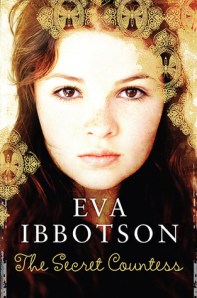
 Before summer draws to an end (not that it’s been much of a summer here anyway – I started writing this during a thunderstorm), I decided to read the appropriately titled A Song for Summer, Eva Ibbotson’s last adult novel, first published in 1997. It has more recently been reissued and remarketed for a YA audience but, like Ibbotson’s The Secret Countess and The Morning Gift, I think it’s a book that could be equally enjoyed by both adults and young adults.
Ellen Carr is the daughter of a suffragette and a solicitor who was killed during World War I. Raised by her mother and two aunts, also former suffragettes, Ellen is expected to go to university and then pursue a suitably impressive career – a politician, perhaps, or the first female President of the Royal Academy. However, it quickly becomes obvious that Ellen’s talents and ambitions lie in another direction. What she really wants to do is cook and clean, so she heads for Austria to take up a position as housekeeper at the experimental Schloss Hallendorf School.
As Ellen tries to settle into her new job and home in the beautiful Austrian countryside, she discovers that the school is not the idyllic place she had hoped it would be. There are lots of eccentric misfits among the staff, as well as several troubled children with difficult family lives whose parents have either sent them to boarding school because they don’t have time for them or because they’re not able to care for them. With her warm, maternal nature, Ellen sets out to solve everyone’s problems and bring some happiness to Schloss Hallendorf.
Although this book was published in 1997, Ellen is not really what you could describe as a ‘modern’ heroine. She rejects a university education and the chance to be a pioneer for women’s rights like her mother and aunts because she prefers to bake and sew and clean. There’s nothing wrong with that, of course, as long as it’s a woman’s own choice rather than something she feels is her duty, but not many of today’s historical fiction authors would choose to write about a woman like Ellen and this book does at times feel more like one written in the 1930s, when it is set, than in the 1990s.
There’s a love interest for Ellen, in the form of the Czech gardener and fencing teacher, Marek Tarnowsky. As we discover early in the novel, there’s a lot more to Marek than meets the eye; not only is he a talented composer and conductor, he is also working undercover to help Jews flee the Nazi regime. The story of Ellen’s domestic life at Hallendorf is interspersed with accounts of some of Marek’s missions, including a daring attempt to rescue his best friend, a Jewish violinist, and eventually Ellen also becomes involved in helping him. However, although I’m sure we are all supposed to love Marek as much as Ellen does, I never really warmed to him and this took away some of the emotional impact of the story.
Although I liked this book, mainly for its portrayal of Austria on the brink of war, I found it the weakest of the four Ibbotson novels I’ve read so far (my favourite is probably Madensky Square). I’ll continue to read her books and hope that I’ll enjoy the next one I read more than this one.

This is book 15/20 of my 20 Books of Summer 2023
This is book 36/50 for the 2023 Historical Fiction Reading Challenge.


 She Reads Novels