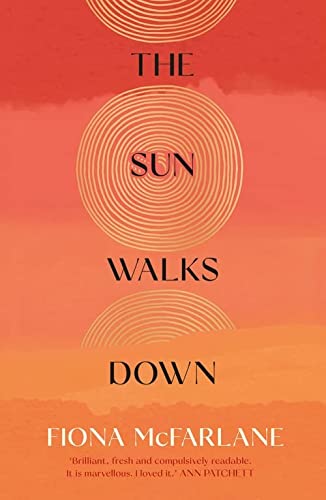
 The Sun Walks Down by Australian author Fiona McFarlane is not a book I had considered reading until it appeared on this year’s shortlist for the Walter Scott Prize for Historical Fiction. Attempting to read all the shortlisted books for the prize is one of my ongoing personal projects and this is the third I’ve read so far from this year’s list (the others are Act of Oblivion and These Days).
The novel is set in South Australia and takes place over a period of seven days in September 1883. On the first day, a dust storm sweeps through the small town of Fairly in the Flinders Ranges and after it has passed, six-year-old Denny Wallace is found to have gone missing. As the whole community becomes caught up in the search for him, McFarlane introduces us to each resident of the town in turn, exploring their lives and the ways in which they are touched by Denny’s disappearance.
As well as Denny’s parents and siblings, we also meet a Pashtun cameleer, a Ramindjeri tracker, a Swedish painter and his English wife, a pair of newlyweds and an assortment of farmworkers and housemaids. Each has their own story to be told and some are given their own chapter, written in the form of a dream, a confession, a prayer or a set of notes. In this way, McFarlane looks at various aspects of life in colonial Australia and the relationships between the Indigenous people and the European newcomers. Although I did find this interesting (I’ve read shamefully little about 19th century Australia) I felt that there were too many characters in the book and the viewpoint changed from one to another too quickly, preventing me from forming a strong connection with any of them. I would also have preferred a tighter focus on the search for Denny as this seemed to get pushed aside for long periods.
I did love the beautiful descriptions of the Flinders Ranges and the way McFarlane uses colours to bring to life images of the sun, sky and clouds. 1883 was the year when Krakatoa erupted and caused a ‘volcanic winter’ with unusually vivid sunsets:
The sky burns and leaps, it gilds and candles – every drenched inch of it, until the sun falls below the ranges. Then the sky darkens. The red returns, stealthy now, with green above and lilac higher still. It deepens into purple. Here’s the strange new cloud, hovering in its own grey light. Then night comes in, black and blue and grey and white, and the moon in its green bag swings heavy over the red nation of the ranges.
I think I would describe The Sun Walks Down as a book that I admired rather than one that I particularly enjoyed. I can see why other people have given it glowing reviews and why it’s being nominated for awards, but it just wasn’t for me. That probably means it will win the Walter Scott Prize this year – not long until we find out!
This is book 20/50 read for the 2023 Historical Fiction Reading Challenge.
 She Reads Novels