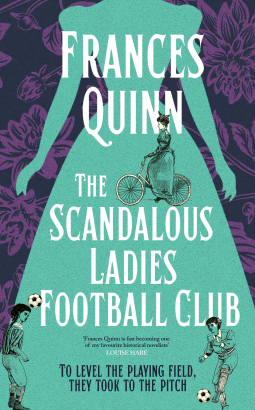
 Published earlier this month to coincide with the World Cup (congratulations to Spain on their win), Frances Quinn’s latest novel is set in the final years of the 19th century and inspired by the formation of the British Ladies’ Football Club. Having loved her two previous books, The Lost Passenger and That Bonesetter Woman, I was hoping for good things from this one and wasn’t disappointed. Despite not being very interested in football (soccer to my blog readers in other parts of the world!) I found this a fascinating, inspirational story.
It’s 1897 and in a world dominated by men, where husbands and fathers make all the rules, the idea of women playing football is considered ridiculous and inappropriate. But when schoolteacher Minnie Newton kicks a ball back to a group of men playing in a London park one day, she’s reminded of how much she enjoyed the game as a child. Minnie places an advertisement in the local newspaper, not sure what kind of response there’ll be, and is thrilled when she receives several replies from interested applicants. However, as the group of women gather on Saturday morning for their first session, it quickly becomes obvious that this isn’t going to be easy. Most of the women have never even watched the sport before, let alone kicked a ball – then there’s the question of what to wear (long skirts are hardly suitable) and the problem of finding somewhere to train. Eventually, though, solutions are found, and soon the club has obtained both a patron – the explorer, writer and women’s rights activist, Lady Veronica Montague – and a coach, retired male footballer Bill English.
The novel focuses on three of the lady footballers. The first is obviously Minnie herself as the club’s founder and leader. The second is Grace Mousel, a shy single woman who lives with her father and spends her days catering to his every whim. Grace discovers that she has a real talent for football but feels that she has to keep her new passion hidden from her father, as he would never understand and would insist that she give it up. Then there’s Harriet Flinders, a married woman whose husband, Richard, is stationed in India, leaving her alone in London with their two sons. Bored and dissatisfied with her marriage, Harriet decides to join Minnie’s club purely because she knows it would annoy Richard if he found out but, like Grace, she soon finds that playing football is something she enjoys both for its own sake and for the independence it gives her.
As for Minnie, we know from the beginning that she’s hiding a big secret – her real name is Adela Adams and she’s a married woman, a fact that would cause her to lose her job as a teacher if it became known. Although I felt that the false identity subplot was recycled from Quinn’s last book, The Lost Passenger, it added tension to her story just as it did to Elinor’s in that book, and we find out only gradually why Adela left her husband and changed her name and what she stands to lose if she’s caught.
Quinn has loosely based the novel on the story of the real life British Ladies’ Football Club, but doesn’t stick very closely to the facts, changing the names of the people involved and imagining matches and rivalries that the club never actually had. There are some similarities, though – the real founder of the club was Nettie Honeyball which, like Minnie Newton, was thought to be an assumed name (although Nettie’s true identity is still unconfirmed); their patron, Lady Florence Dixie, closely resembled Lady Veronica in the book (she explored Patagonia and kept a pet jaguar called Affums); and of course, both clubs, real and fictional, faced a huge amount of prejudice, scorn and ridicule.
Although I found the book very enjoyable, it’s not perfect. In particular, I wished more attention had been given to other members of the club, not just Minnie, Harriet and Grace. Some of them were barely even mentioned by name. Also, without wanting to give away spoilers, I felt that the way the story ended for two of the characters seemed very convenient and clichéd. Other than that, I loved it. It’s obviously a book with a lot to say about feminism, equality and women’s rights, but the message never gets in the way of the story. Definitely worth reading, whether or not you’re a football fan!
Thanks to Simon & Schuster UK for providing a copy of this book for review via NetGalley.

Book 9/20 of 20 Books of Summer