A Bad Business by Fyodor Dostoevsky

Translated by Nicolas Pasternak Slater and Maya Slater

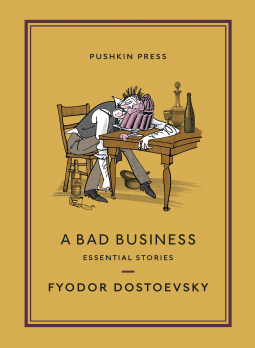
This is the second collection of classic short stories I’ve read from the Pushkin Press Essential Stories series. The first was I Would Prefer Not To by Herman Melville, an author I had never tried before, and I found it a good introduction to his work. In the case of Dostoevsky, I have previously read two of his novels (Crime and Punishment and The Idiot) but was curious to see what his shorter fiction would be like. This collection contains six stories, all in new translations by Nicolas Pasternak Slater and Maya Slater. They are all quite different in subject and style and I think they would give new readers a good idea of what his writing is like, while also being of interest to readers like myself who are only familiar with his full-length novels.

I think my favourite of the six stories was The Crocodile (1865), in which a civil servant, Ivan Matveich, is swallowed alive by a crocodile being exhibited in St Petersburg. There’s not much more to the plot than that, as the rest of the story revolves around the conversations Matveich has with various people from inside the crocodile, but I found it entertaining and surprisingly funny, not something I’ve really associated with Dostoevsky’s work before. It also takes a satirical look at the economic situation in Russia at that time – the German owners of the crocodile refuse to have its stomach slit open to free Matveich because they would be losing their investment, particularly as the crocodile has now increased in value due to becoming so famous!

Conversations in a Graveyard (1873), also published as Bobok, is another satire in which the narrator is sitting in a cemetery after attending a funeral and hears the disembodied voices of the recently buried telling each other their stories. The literary critic Mikhail Bakhtin describes this story as “almost a microcosm of Dostoevsky’s entire creative output,” because it involves many of the themes, ideas and character types that appear in his other work. I probably haven’t read enough of Dostoevsky to be able to fully appreciate this, but I did still find the story interesting – and it reminded me very much of Lincoln in the Bardo!

The title story, A Bad Business (1862), follows a general in the civil service who, after discussing his political ideals with friends, decides to test one of his theories by being nice to people from lower social classes. Unfortunately, when he arrives, uninvited and unwelcome, at the wedding feast of one of his subordinates, things quickly begin to go wrong. A very different type of story is A Meek Creature (1876), about the relationship between a pawnbroker and one of his customers, a girl who pawns items to earn money so that she can advertise in the newspaper for work as a governess. This is a darker story than most of the others in the book and not one of my favourites.

The four stories mentioned so far take up more than 90% of the book, which means that the final two are much shorter. One is The Heavenly Christmas Tree (1876), a sentimental and poignant little story with a fairy tale feel, and the other is The Peasant Marey (also 1876), in which the narrator recalls a childhood memory of being comforted by a peasant after convincing himself there was a wolf in the woods. I liked both of these stories but felt that they suffered from being placed at the end of the collection; I would have preferred the shorter stories to alternate with the novella-length ones to provide more variety.

Although I don’t think any of these are stories I would want to read again, apart from maybe The Crocodile, it was good to have the opportunity to explore Dostoevsky further. I’m hoping to read my copy of The Brothers Karamazov soon.

Thanks to Pushkin Press for providing a copy of this book for review via NetGalley.
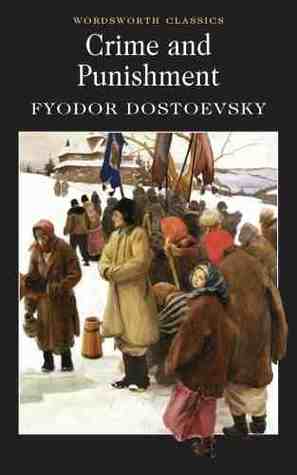
Crime and Punishment by Fyodor Dostoevsky

This is one of my final reads from my Classics Club list and, I have to admit, it wasn’t one that I was looking forward to, having had at least two previous attempts to read it. I did read The Idiot a few years ago (also for the Classics Club) and got on much better with that one, so I was prepared to give Crime and Punishment another chance. I’m glad I did, because I managed to get to the end this time and enjoyed it much more than I thought I would.

Crime and Punishment, Dostoevsky’s 1866 novel, follows the actions and thought processes of Rodion Romanovich Raskolnikov, an impoverished former student living in St Petersburg. In the first chapter we learn that Raskolnikov is planning the murder of an elderly pawnbroker, Alyona Ivanovna, a crime he proceeds to carry out, although it doesn’t go entirely according to plan. At this stage his motives are not completely clear, but it seems that he is simply in need of money: he is struggling to pay the rent, can’t afford to continue with his studies and has discovered that his sister is about to marry a man she doesn’t love for his money.

Nothing in a Dostoevsky novel is simple, however, and other motives soon begin to emerge. At one point Raskolnikov states that the old woman he has killed is just a ‘louse’ and of no use to society. He also explains that he believes in the theory that there are some people who are superior to others and have the right to commit serious crimes such as murder. He considers Napoleon to be one example of such a person and he is keen to test the theory out for himself. Are some men really so great that the law doesn’t apply to them and that they have no need to worry about the consequences of their actions because by committing murder they will have proved their greatness?

Of course, Raskolnikov does not escape the consequences and from the moment he kills the pawnbroker, his emotions are thrown into turmoil. Although he gets away from the scene of the crime presumably undetected, he obsesses over every detail of the murder, becoming feverish and causing his family and friends – who know nothing of what he has done – to worry about him. Despite taking some steps to cover his traces and remove the evidence, there are times when he seems to want to be discovered and goes out of his way to make himself appear suspicious. He becomes more and more tormented as the novel progresses and as Dostoevsky allows us to access Raskolnikov’s innermost thoughts, this is not the most comfortable or pleasant of reads! You wouldn’t really expect a book with the title Crime and Punishment to be comfortable and pleasant, though, would you?

The crime part of the novel is obvious enough, but the punishment takes more than one form. First, there is Raskolnikov’s psychological disarray in the days following the murder, which is a punishment in itself, but there is also the question of whether or not his crime will eventually be found out and he will receive punishment of a different kind. I won’t spoil things by telling you whether he is discovered, betrayed, confesses or escapes justice forever, because once the detective Porfiry Petrovitch gets involved, there is a certain element of suspense which I’m sure you would rather experience for yourself.

Although I don’t think I would describe this book as “one of the most readable novels ever written” as stated on the cover of my edition, once I got into it I found it very compelling and a quicker read than I’d expected it to be. I’m so pleased I gave it another try and that I persevered past Raskolnikov’s nightmare about a horse being thrashed to death, which was where I stopped on my last attempt. And of course, the horse dream, horrible as it may be, is in the story for a reason and its significance starts to become clear later on. I won’t pretend that I fully understood everything that happens in the book, but I can always read it again one day – after I’ve read The Brothers Karamazov, which I think is going to be one of the titles on the second list I put together for the Classics Club.

The Idiot by Fyodor Dostoevsky

The Idiot The Idiot was the book chosen for me by the Classics Club Spin earlier this month. I have to confess I wasn’t thrilled when I saw that this was the book I’d have to read but, as so often seems to happen with my spin books, I ended up enjoying it much more than I’d expected to. This wasn’t my first experience of Dostoevsky’s work; I’ve tried twice to read Crime and Punishment and both times gave up after a few chapters. Luckily, I’ve had more success with The Idiot!

The ‘idiot’ of the title is Prince Lev Nikolaevich Myshkin, a young man who, as the novel opens, is returning home to Russia after spending several years at a Swiss clinic receiving treatment for his epilepsy. On the train to St Petersburg he meets for the first time the man whose fate will become entwined with his own: Parfyon Semyonovich Rogozhin. Rogozhin is passionately in love with the beautiful but self-destructive Nastasya Filipovna, who has suffered a series of misfortunes that have led to her being labelled a ‘fallen woman’.

With no family of his own in the city, the prince introduces himself to the Epanchins, to whom he is distantly related. This family consists of General Epanchin, his wife Elizaveta, and their three daughters, Alexandra, Adelaida and Aglaya. As the story progresses, Myshkin becomes romantically involved with both Nastasya Filipovna and Aglaya Epanchin, but his inability to read between the lines and understand that people don’t always say what they really mean leads to trouble in his relationships with both women. His path will also cross again and again with Rogozhin’s, but while the prince pities Nastasya and hopes to save her from herself, Rogozhin’s love is of the violent and obsessive kind.

The intensity of Rogozhin’s personality is very different from the prince’s own gentle, peaceful nature. In fact, Myshkin seems to possess such simplicity of character, to be so trusting and gullible, so incapable of dealing with the subtleties of St Petersburg society that people think he must be an idiot. Of course, Myshkin is not really an idiot – that is, he doesn’t lack intelligence – but he is what Dostoevsky himself described as a portrayal of a ‘completely beautiful human being’. He is a genuinely good, kind-hearted person, but ironically it’s his goodness and his willingness to always see the best in people that are his weaknesses when it comes to negotiating complex social situations and dealing with people who are less honest than himself.

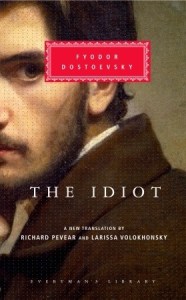
The edition of The Idiot that I read was the one pictured above, published by Everyman’s Library and translated by Pevear and Volokhonsky. This would maybe not have been my first choice of translation (this is the third of P&V’s Russian translations I’ve read and I’ve decided I’m not really a fan) but this is the book I already had on my shelf so it made sense to at least try it. Having said that, I found their translation of this particular book perfectly readable – though with a few strange word choices – and I’m sure I would still have found The Idiot a challenging read regardless of who it was translated by!

To clarify what I mean by ‘challenging’, I didn’t have any problem actually following the plot and understanding what was going on. This is really more of a character-driven novel than a plot-driven one anyway. Although I found it quite absorbing and was never bored, the pace is uneven and there are some long diversions in which various characters discuss religion or politics or philosophical ideas. Three chapters, for example, are devoted to a long confessional letter written by Ippolit, a young man who is dying from consumption – however, I thought this was one of the most powerful and moving sections of the book.

What I did struggle with at times was trying to interpret the actions and motivations of the characters, particularly the two main female characters, Nastasya and Aglaya. I won’t attempt an analysis of those two characters here, except to say that they are both so complex I’m not surprised the unsophisticated, unworldly Myshkin found it difficult to understand what they were really saying to him!

I enjoyed The Idiot a lot more than I thought I would, but I know I would have to read it again to be able to fully appreciate it. I don’t think I would want to do that in the near future but I will certainly try Crime and Punishment again and maybe The Brothers Karamazov as well.

The Classics Club Spin number is…

The Classics Club

Number 17

Last week I decided to take part in the Classics Club Spin. The rules were simple – list twenty books from your Classics Club list, number them 1 to 20, and the number announced today (Monday) represents the book you have to read before 6th October 2014.

The number that has been selected is 17, which means the book I’ll be reading is:

The Idiot

The Idiot by Fyodor Dostoevsky

I have to admit this is not one of the titles on my list that I was hoping for, but I’m prepared to give it a try! I had a failed attempt at reading Crime and Punishment a few years ago, so I’m hoping I might have more luck with a different book.

If you took part in the spin are you happy with your result?