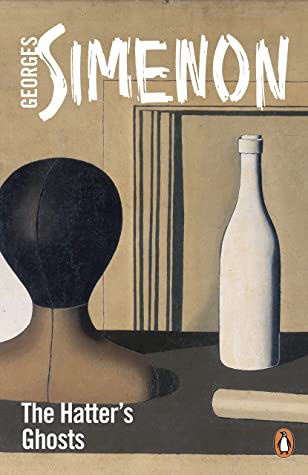
The Hatter’s Ghosts by Georges Simenon (tr. Howard Curtis)

This standalone novel by Belgian author Georges Simenon was originally published in 1949 as Les Fantômes du chapelier and is now available from Penguin Classics in an English translation by Howard Curtis. Although Simenon is better known for his series of Maigret detective novels, he also wrote many books like this one – short psychological thrillers, some of which he referred to as romans durs, or ‘hard novels’. I have read a few of them and my favourite so far has been The Venice Train; this one has some similar plot elements, but is a much darker story.

The novel is set in La Rochelle during a wet and miserable December. It has been raining for twenty days, ever since an old lady was found murdered near the canal. Since then, more bodies have been discovered, all of them elderly women and all of them strangled with a cello string. The newspapers are full of speculation over who the murderer might be, but the reader knows from the opening pages exactly who is responsible – and so does the tailor Kachoudas, who has seen something that has convinced him of the killer’s identity. As the rest of the story unfolds, we are kept wondering whether Kachoudas will go to the police or whether he’ll be the murderer’s next victim.

Although we know from the beginning who the culprit is, there’s still a sense of mystery because we have no idea why he has set out to kill so many women and how he has chosen his victims. The truth is eventually revealed and we discover exactly what is going on behind closed doors, but as this is just a short novel (as many of Simenon’s seem to be), I can’t really go into the plot in any more detail without spoiling it. Anyway, the mystery is only one aspect of the story; the real interest is in following the thought processes of the murderer as he tries to justify his actions to himself and deal with his conflicted thoughts and emotions. I was reminded very much of In a Lonely Place by Dorothy B. Hughes, another novel where we know the killer’s identity from the beginning and spend the rest of the book inside his mind, wondering whether he will give himself away.

The Hatter’s Ghosts is an atmospheric, unsettling novel and I loved the descriptions of the dark, rainy streets of La Rochelle. The Howard Curtis translation is clear and accessible and feels quite modern, while also preserving the tone of the 1940s. If you’re new to Simenon, or have only read his Maigret books, I can definitely recommend any or all of the romans durs I’ve read so far – as well as this one and The Venice Train, I have read The Man from London and The Strangers in the House and am looking forward to investigating some of his others.

Thanks to Penguin Classics for providing a copy of this book for review via NetGalley.

Book #2 read for R.I.P. XVII


The Venice Train by Georges Simenon (trans. Ros Schwartz)

This is one of Georges Simenon’s many psychological thrillers, which he described as romans durs or ‘hard novels’. I’ve read two of his others – The Man from London and The Strangers in the House – and have enjoyed both, so was looking forward to reading this one. First published in 1965 as Le Train de Venise, it has just been reissued by Penguin Classics in a new English translation by Ros Schwartz.

The novel begins with Justin Calmar boarding a train in Venice to return to his home in Paris after a family holiday. His wife and two young children will follow in a few days’ time. During the journey, another passenger engages Justin in conversation and he finds himself agreeing to deliver a briefcase to an address in Lausanne when the train stops at the station there. However, things don’t go according to plan and Justin ends up returning to Paris with the case still in his possession. Unable to resist the temptation, he breaks the locks and looks inside…and what he finds there will change his life forever.

I won’t say too much more about the plot because I wouldn’t want to spoil the suspense of wondering what is inside the case and what Justin will decide to do with it. This is a very short book (176 pages in the paperback version) and for the first half, the tension builds and builds. It would have made a perfect Alfred Hitchcock film! It’s not a crime novel, however, so don’t go into it expecting one; the mystery is never fully explained or resolved, it ends abruptly and we are left with lots of unanswered questions. The events on the train are simply a starting point for Simenon to explore the psychological effects on Justin Calmar as he battles with nerves, guilt and paranoia, lying to his wife and his friends and finding that each lie leads to another.

The second half of the book isn’t quite as strong as the first and I do wish we’d had answers to at least some of those questions, but this is a fascinating and compelling story – my favourite by Georges Simenon so far.

Although I was slightly disappointed that only the first few pages of the book are actually set in Venice – the rest either on the train or in Paris – I wasn’t too disappointed because Paris is, of course, a great setting as well. And as Thyme for Tea and Readerbuzz are hosting their annual Paris in July event this month, the timing couldn’t be better!

Thanks to Penguin Classics for providing a copy of this book for review via NetGalley.

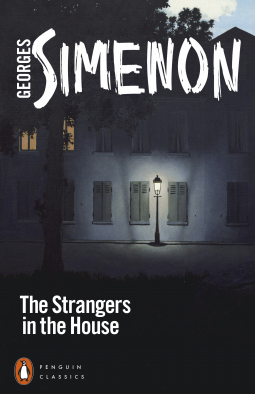
The Strangers in the House by Georges Simenon

Since enjoying my first Georges Simenon book, The Man from London, last year, I’ve been looking forward to reading more. I had intended to try one of his Maigret books next, but the opportunity to read this one came up first; it’s a new Penguin Classics edition of a novel originally published in 1940, The Strangers in the House, and is translated by Howard Curtis. Unfortunately, at 224 pages in the paperback version, it’s just slightly too long to count towards Novellas in November!

The Strangers in the House is one of the many standalone novels written by Simenon that are described as romans dur, or ‘hard novels’. I’m not entirely sure what that term means, but as far as I can tell, it refers to the dark, noirish atmosphere, and the hard, bleak lives that the characters are leading. And the life of our protagonist, Hector Loursat, is certainly bleak! Once a successful lawyer, he fell into a depression when his wife left him eighteen years earlier and turned to alcohol for comfort. Since then, he has spent his time sitting alone with his books and a constant supply of red wine, living in the same house as his daughter Nicole, but barely aware of her presence.

Loursat’s miserable, solitary existence continues until, one night, he hears a gun being fired inside the house and discovers a dead body in one of the bedrooms. When Nicole and her friends become implicated in the murder investigation, Loursat is forced to acknowledge that his daughter is now a stranger to him…or is it in fact Loursat himself who is the stranger in the house?

There’s a detective fiction element to this novel, as Loursat sets out to uncover the truth behind the murder. When suspicion falls on Nicole’s lover, he agrees to defend the young man in court and finds that getting involved in the legal profession again gives him some purpose in life. However, although we see Loursat speaking to the suspects, getting to know Nicole’s circle of friends and learning all he can about the victim, this is not a conventional mystery novel and not one that the reader has much chance of being able to solve. If you’re expecting a story with clever twists and surprises you’ll be disappointed; even the court scenes which take up about half of the book lack suspense.

The book is much more successful as a psychological study of a lonely, reclusive man who is forced to confront his own behaviour and gradually engage with the people and things he has neglected for years. Watching Loursat’s reawakening as he becomes aware of the things that have been going on in his own house without his knowledge is fascinating. Whether or not he finds redemption and whether it’s too late to repair the damage to his relationship with Nicole I will leave you to discover for yourself, if you read the book. All I will say is that Simenon’s storytelling is realistic, unsentimental and ‘hard’.

Have you read this or any of Georges Simenon’s other books? Which can you recommend?

Thanks to Penguin Classics for providing a copy of this book for review via NetGalley.

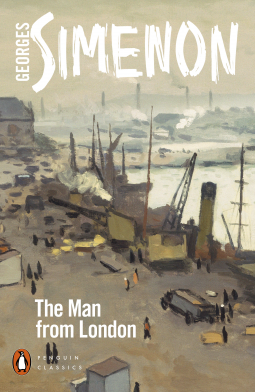
The Man from London by Georges Simenon – #NovNov

I’ve been struggling to concentrate on longer novels for most of the year, despite having more time than ever before to read them! This month’s Novellas in November (hosted by Cathy of 746 Books and Rebecca of Bookish Beck, ) seemed like a perfect opportunity for me to get through some of the shorter books on my TBR, beginning with this one – a Belgian classic from 1934 reissued today by Penguin Classics.

The Man from London is my first Georges Simenon book (I haven’t read any of the Maigret novels, though I feel that I should have done by now), so I didn’t really know what to expect from it. I was pleased to find that it was suspenseful, atmospheric and, in this translation by Howard Curtis, very readable.

The story begins on a cold, foggy night in Dieppe, where railway signalman Louis Maloin is sitting alone in his watchtower, looking down on the docks at the ferry just arriving from England. It’s a sight Maloin observes every day, but tonight something is different: he watches one of the newly arrived passengers fight with another man and knock him into the water, along with the suitcase he is holding. Aware that he appears to be the only person who has seen this happen, Maloin retrieves the case from the water when nobody is around and takes it home with him. When he discovers what the case contains, the decision he makes could have consequences that will change his life forever.

Although there is an element of mystery to the book, with questions over the identities of the two men and where the contents of the case came from, this is really more of a psychological thriller than a crime novel. The fight Maloin witnesses and his reaction to it provides a starting point for an exploration of the state of Maloin’s mind as the process he has set in motion spirals out of control. He experiences every conceivable emotion over the course of the story, ranging from guilt at not telling the police what he has seen and allowing a murderer to walk free, excitement at gaining possession of the case for himself, and terror, knowing that someone could discover what he has done at any minute.

The atmosphere Simenon creates is wonderful, with the tension building and building as Maloin tries to go about his normal life, while being confronted at every turn by the face of the man he has come to think of as ‘the man from London’. The wet, foggy December weather adds to the overall mood, as do the descriptions of the places and people Maloin encounters as he moves around Dieppe trying to avoid the murderer and the police.

The short length of the book meant it held my interest from beginning to end and although I think the potential was here for a longer and more complex novel, I still found it quite satisfying. I’m glad my first experience of Georges Simenon’s work was a good one and I’m definitely interested in reading more of his books now.

Thanks to Penguin Classics for providing a copy of this book for review via NetGalley