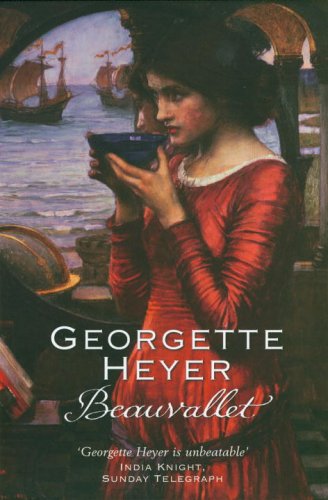
Beauvallet by Georgette Heyer

“All Spain seems to seek me, señor,” answered the stranger merrily. “But who shall slay Nick Beauvallet? Will you try?”

Having read and loved many of Georgette Heyer’s Regency and Georgian romances, I’ve been interested in trying one of her historical novels set in earlier periods – and at the same time, I’ve been a bit wary because they don’t seem as popular or well-liked as the Regencies. I needn’t have worried, though, because I made a good choice with her 1929 novel Beauvallet, set in sixteenth century Spain and England; I can see why it wouldn’t appeal to all Heyer readers, but it was definitely my sort of book!

Sir Nicholas Beauvallet is a notorious English pirate whose name is spoken of in the same breath as Sir Francis Drake’s and at the beginning of the novel his ship, the Venture, is engaged in conflict with the Spanish galleon Santa Maria. The Spanish vessel is captured and the people aboard taken captive, among them the beautiful Doña Dominica de Rada y Sylva and her father, Don Manuel. After a futile attempt to fight off Beauvallet with his own dagger, Dominica knows the situation is hopeless – and so she is very surprised when Beauvallet offers to take them safely home to Spain, swearing to return at a later date to make her his wife. This seems like a ridiculous plan – no Englishman in his right mind would attempt to enter Spain while the two countries are at war – but our hero is not known as ‘Mad Nicholas’ for nothing…

The plot is over the top and not to be taken too seriously, but the book is great fun to read – the perfect way to escape from the pressures of modern day life for a while and retreat into a good old-fashioned adventure story complete with swordfights, sea battles, abductions, imprisonments and daring escapes! Heyer’s attention to period detail is as evident in this novel as in her others, and being set in an earlier century means she has adjusted the language and the dialogue accordingly. While I thought Dominica was quite thinly drawn and not as memorable as many of Heyer’s other heroines, Nick Beauvallet is a wonderful character. He reminded me very much of some of Rafael Sabatini’s irrepressible swashbuckling heroes, particularly Peter Blood – and of course, Captain Blood, another pirate novel, was published just a few years before Beauvallet. As a Sabatini fan, it was probably inevitable that I would enjoy this book!

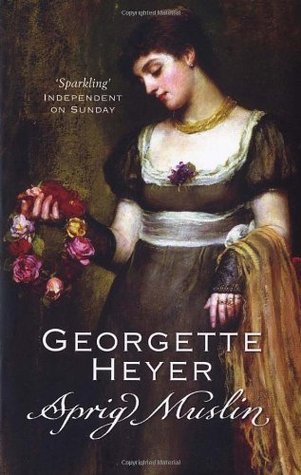
As a romance, the book is quite predictable; right from their first encounter, where Dominica shouts “I hate you! I despise you, and I hate you!”, it’s easy to guess that her hatred will not last long, especially as Nick is not the sort of man to accept defeat, in love or in anything else. But sometimes predictability is not a bad thing, and there were plenty of other twists and turns along the way to make this an exciting and entertaining read. I would like to read the earlier Simon the Coldheart, about one of Beauvallet’s ancestors, but first I will be heading back to the Regency period as the next Heyer novel I have lined up to read is Sprig Muslin.

An Infamous Army by Georgette Heyer

Georgette Heyer’s 1937 novel, An Infamous Army, is one I was particularly interested in reading because it sounded a bit different from most of her others, being as much a story of the Battle of Waterloo as a Regency romance. It can be read as a standalone novel but it also features characters (or descendants of characters) who appeared in her previous novels These Old Shades, Devil’s Cub and Regency Buck.

Several years have passed since Regency Buck ended and the Earl of Worth is in Brussels with his wife, Judith, and their young son. As the threat of Napoleon draws closer, Brussels has become the centre of fashionable society – a place to entertain oneself with dances, picnics and concerts while the outcome of the Vienna Congress and the arrival of the Duke of Wellington are awaited. Judith is hoping to bring about a match between Worth’s brother Charles Audley and her friend Lucy, but she hasn’t counted on Charles falling passionately in love with Lady Barbara Childe, a beautiful but notorious young widow with a reputation for wildness. Although Barbara – or Bab, as she is known – claims to love Charles too, she shows no sign of changing her ways and Judith is sure her brother-in-law is going to be hurt.

The relationship between Charles and Bab develops throughout the first half of the novel, so that by the time the Battle of Waterloo arrives, we are already emotionally invested in the lives of some of the characters who are going to be affected by the battle in one way or another. Heyer is one of those authors you can always count on to have done her research, but everything in this book feels particularly authentic (she famously claimed that every word she attributes to her fictional Duke of Wellington was either spoken or written by him in real life).

Each stage of the battle is described in an incredible amount of detail, not just the tactics and the military manoeuvres, but also the human cost as lives are lost, men are injured and those on the sidelines wait for news of their loved ones. As I’ve mentioned before, I am not usually a fan of lengthy battle scenes, however well written they are, so although I certainly appreciated the accuracy of Heyer’s account of Waterloo and the quality of her writing, I can’t really say that this has become a favourite Heyer novel. This is just a matter of personal taste though, and I’m sure other people will love this book precisely because it does include long battle scenes (by long, I mean they take up most of the second half of the novel).

As for the Charles and Bab storyline, I enjoyed following the course of their relationship, especially as I thought it was difficult to tell at first how Bab really felt about Charles. She comes across at the beginning as self-centred, reckless and fun-loving, the sort of person who causes a scandal wherever she goes (not that it takes much to cause a scandal in 1815 – painting your toenails gold, for example). It took me a while to warm to her, but when I did I found that she was also kind hearted, compassionate and courageous. Even so, she is not one of my favourite Heyer heroines – although, again, I can see why other readers might love her.

Reading An Infamous Army has inspired me to finally try one of Heyer’s six historical novels (i.e. not the ones that are Regency or Georgian romances). I am currently a few chapters into Beauvallet and enjoying it so far; you can expect to hear more about it soon!

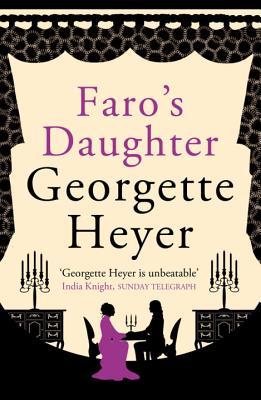
Faro’s Daughter by Georgette Heyer

I am continuing to work, very slowly, through Georgette Heyer’s novels, though not in any particular order – just reading them as I come across them. As I discovered in the comments section of my Historical Musings post on Heyer last month, I seem to have read very few of the books most people name as favourites – books like Cotillion, The Grand Sophy and These Old Shades. I will get to them eventually, but for now I’m posting my thoughts on my latest Heyer read, Faro’s Daughter.

Published in 1941, Faro’s Daughter is one of Heyer’s Georgian novels, set slightly earlier than the Regency period for which she is best known. Our heroine is Deborah Grantham, a young woman who has lived with her aunt, Lady Bellingham, since being orphaned several years earlier. Finding herself struggling financially, Lady Bellingham, who has always enjoyed hosting card parties, has decided to open a gaming house in order to make ends meet. The intelligent and quick-witted Deb presides over the gaming tables and naturally attracts a lot of attention from the men who come to gamble. One of these is Adrian, Lord Mablethorpe, who is five years younger than Deb and convinced that he is in love with her.

Adrian is heir to a fortune and Lady Mablethorpe is horrified at the thought of her son marrying a woman from a gaming house. Luckily, there are still a few months until he comes of age and receives his inheritance, so she enlists the help of her nephew, Max Ravenscar, to ensure that the marriage is prevented. Visiting Lady Bellingham’s establishment to see Deb for himself, Max is surprised to find that she is not at all the common, vulgar woman he had been led to believe. He keeps his promise to his aunt, however, and offers Deb a bribe to stay away from Adrian, but Deb is so offended by this insult that she decides not to inform Max that she never had any intention of marrying Adrian in the first place – it will be much more satisfying to make him suffer for a while!

Like most of Heyer’s novels, this is an entertaining read with a lively plot involving card games, a curricle race, visits to Vauxhall Gardens, and even several kidnappings. It hasn’t become a favourite, though, and that’s because I just never quite managed to like either Max or Deb. Max annoyed me with his constant name-calling and failure to see through any of Deb’s schemes, and while I could appreciate Deb as a clever and resourceful heroine, I couldn’t warm to her either.

Heyer’s romances seem to be divided into a few general types and the ones like this or Regency Buck, to give another example, where the hero and heroine are engaged in a war of words and battle of wits, appear to be the ones I like least. I usually prefer the books where the romance develops from friendship and mutual liking or with a newly married couple learning to love each other. This isn’t necessarily the case when I read books by other authors, but it seems to be true of my experience with Heyer!

This book was a slight disappointment for me, then, although I did still find things to enjoy. Maybe it was just the wrong choice of Heyer at the wrong time, as I couldn’t help comparing it to my last one, The Corinthian, which I found a complete delight to read. I can’t love them all, though, and at least I still have many more unread Heyer novels to look forward to.

Historical Musings #41: Reading Georgette Heyer

Welcome to my monthly post on all things historical fiction!

The author I have chosen to feature this month is one who, I’m sure, has the widest appeal of any I have written about so far in this series of posts. I know there are plenty of readers who don’t usually read other types of historical fiction but love her Regency and Georgian romances, which are so distinctive they belong in a sub-genre of their own. She is, of course, Georgette Heyer.

Heyer was born in London in 1902 and died in 1974, having published over fifty novels, including the romances I’ve already mentioned, six straight historical novels, four contemporary novels and twelve detective stories. I only started reading Heyer relatively recently (in 2010) so I haven’t read all of her books, or even most of them; I know there will be people reading this post who have read – and re-read – a lot more of them than I have, so I certainly don’t claim to be an expert on her work. However, I have read enough to be able to say that, whichever Heyer novel you pick up (of the Regency/Georgian ones, anyway), you can expect historical accuracy, witty, sparkling dialogue, engaging characters and an entertaining plot.

Here are the Heyer books I have read so far, with links to my reviews:

Romances

The Black Moth
Powder and Patch
The Masqueraders
The Convenient Marriage
Regency Buck
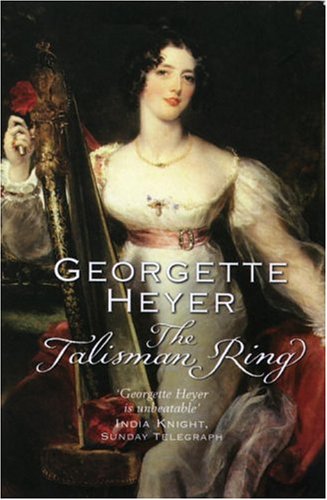
The Talisman Ring
The Corinthian
Friday’s Child
The Quiet Gentleman
April Lady
Snowdrift and Other Stories
Black Sheep
Cousin Kate
Charity Girl
Faro’s Daughter – review coming soon

Mysteries

Footsteps in the Dark
Envious Casca
Duplicate Death

If you’ve never read Heyer before, you may be wondering which of her books would be a good one to start with. Well, the first one I read was The Talisman Ring, and although I’ve read others since that I enjoyed more, it was obviously a very successful starting point for me! I also loved The Quiet Gentleman for the sense of mystery, The Masqueraders and The Corinthian for the adventure, The Convenient Marriage for the humour and Black Sheep for the hero and heroine! Really, I would recommend any that I’ve read, apart from maybe Powder and Patch.

You can find out more about Heyer and her work at Georgette-Heyer.com.

I will be looking at more historical fiction authors in future posts, but for now I would like to hear your thoughts on Georgette Heyer.

Have you read any of her books? Which are your favourites – and which would you recommend to readers who are new to her work?

The Corinthian by Georgette Heyer

When I posted my review of Friday’s Child a few weeks ago, I mentioned that I had a choice of three Heyer novels to read next and asked for some help in deciding which one to choose. The Corinthian received more recommendations than Faro’s Daughter and An Infamous Army so I knew it would have to be my next Heyer…and what a great choice it was! Published in 1940, it’s one of her earliest Regency novels and although I think she wrote better books, I did find this one thoroughly entertaining and fun to read.

Are you wondering what a Corinthian is? Well, it is defined in the dictionary as “a man about town, especially one who lives luxuriously or, sometimes, dissolutely”. The Corinthian of the title is Sir Richard Wyndham, a twenty-nine-year-old ‘Man of Fashion’ who, at the beginning of the novel, is under pressure from his mother and sister to marry the Honourable Melissa Brandon. Despite their insistence that she will make the ideal wife, Sir Richard knows that Melissa is only interested in his money – a thought which makes him so depressed he goes out and gets drunk (or ‘a trifle disguised’ as Heyer likes to call it).

On his way home, he looks up to see a young man attempting to descend from a window down a rope of knotted bed-sheets. Going to offer his assistance, Richard makes the discovery that the young man is actually a young woman: seventeen-year-old Penelope – or Pen – Creed. Like himself, Pen is being forced into a marriage not of her own choosing and has decided to escape by dressing as a boy and running away to the home of her childhood friend in Somerset. Because he is drunk and because it gives him an excuse to avoid Melissa, Richard finds himself volunteering to accompany her – but he is not prepared for the drama and adventure that awaits them on the journey!

I won’t say too much more about the plot, but you can expect a wonderful blend of comedy, action and mystery as Richard and Pen stumble from one farcical situation to another. Not only do they become entangled with jewel thieves, murderers and Bow Street Runners, they also have several encounters with various members of Pen’s family, as well as Melissa’s brother, the hilarious Cedric. As for Pen and Richard themselves, I found them both very likeable. Richard is sophisticated, bored and cynical, but also kind hearted, intelligent and competent, while Pen may be young and innocent but she’s not lacking in courage and is less silly than some of Heyer’s other very young heroines.

One of the great things about Heyer’s Regency novels is how fully they immerse us in the period. This one is no exception but it does have a different feel from the last Heyer Regency I read, Friday’s Child – that one was set mainly in London, in a whirlwind of masquerade balls, high-stakes card games, visits to the theatre and evenings at Almack’s Assembly Rooms, but this one takes us out of the city, with a lot of time spent on the road travelling towards Somerset. I loved the descriptions of what it was like to undertake a long journey by public stagecoach and the various coaching inns Pen and Richard stayed at along the way.

Having enjoyed this book so much, I am now about to start Faro’s Daughter and hoping it’s going to be another good one!

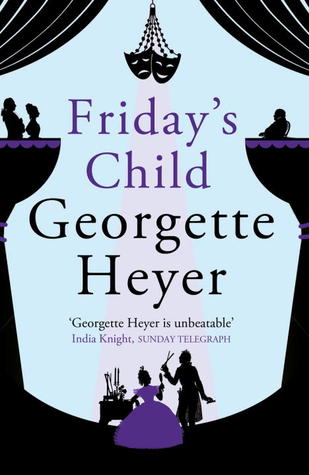
Friday’s Child by Georgette Heyer

This Heyer novel was published in 1944 and as it’s a particularly lively and humorous one, I expect it provided her wartime readers with some welcome escapism. It’s still an entertaining read in the twenty-first century too and although it hasn’t become a favourite, I did enjoy it.

“Friday’s child is loving and giving” says the famous rhyme and that is how the heroine of the novel, seventeen-year-old Hero Wantage, is described by her friends. As an orphan treated as a poor relation in her cousin’s household, Hero’s marriage prospects are not good and she is facing a future as a governess when she receives a surprise proposal from her childhood friend, Lord Sheringham. Hero is under no illusions that Sheringham – or Sherry, as he is known – is actually in love with her; she knows that he needs to marry in order to receive his inheritance and that he has already been rejected by the beautiful Isabella Milborne. It will be a marriage of convenience only, but even this is so much more than Hero could ever have hoped for that she has no hesitation in accepting.

Hero may be young and naïve, but Sherry is only a few years older and no more mature. He has no intention of changing his lifestyle just because he now has a wife, so he continues his reckless spending, gambling and womanising without considering the bad example he is setting for Hero. I don’t think it’s spoiling too much to say that Sherry does gradually come to love and appreciate his wife, but not without a lot of misunderstandings and ‘getting into scrapes’ along the way! And when he does eventually admit to himself how he really feels about Hero, will he have left it so late that he risks losing her to another man?

Although the relationship between Hero and Sherry is at the heart of the novel, with both characters slowly developing and maturing as time goes by, there is also a secondary romance which involves Isabella Milborne (known as the Incomparable) and George, Lord Wrotham, a passionate, hot-headed young man who is always ready to fight a duel. George, along with Gil Ringwood and Ferdy Fakenham, forms Sherry’s little circle of friends – and they become Hero’s friends too, providing most of the humour in the book as they give her some dubious guidance in the social etiquette of Regency London and try to help her out of the disastrous situations she finds herself in.

Friday’s Child has just about everything you would expect from a Heyer novel: duels, card games, gambling, balls and parties, elopements and attempted elopements. It reminded me of two of her other books, The Convenient Marriage and April Lady, which also have storylines revolving around a newly married couple learning to love each other. Although I enjoyed this book much more than April Lady, The Convenient Marriage is my favourite of the three, mainly because I preferred the hero in that one, the Earl of Rule. I do tend to prefer her older, wiser heroes rather than the young, irresponsible ones like Sherry. I also thought this book felt slightly longer than it really needed to be and the constant misunderstandings became a bit repetitive towards the end.

There are other Heyer novels that I’ve liked better than this one, then, but her books are always a lot of fun to read and this is no exception. There are plenty of funny moments, usually involving Sherry’s three friends (I particularly loved the hilarious Ferdy). I have The Corinthian, An Infamous Army and Faro’s Daughter to choose from for my next Heyer. If you have read them, which one would you recommend I read first?

Snowdrift and Other Stories by Georgette Heyer

I always love spending time in Georgette Heyer’s world; with duels, masked balls, elopements, high-stakes card games and lively period slang, her novels provide perfect escapism – and based on this collection, so do her short stories. Originally published as Pistols for Two in 1960, Snowdrift and Other Stories contains eleven of Heyer’s tales of Regency romance and adventure plus three additional stories not included in the earlier book.

I found these stories so enjoyable and so much fun, it was tempting to read them all at once, but instead I decided to just dip in and out, reading one or two at a time over the course of a few weeks. This was probably a good idea as many of the stories in the book are very similar, so better in smaller doses, I think! In particular, there are several that deal with young couples eloping with various family members in pursuit and a series of misunderstandings ensuing along the way – and also several involving duels, fought with either pistols or swords, and never quite going according to plan. Most of the stories have a twist or two, which are usually easy for the reader to predict, but come as a complete surprise to the characters!

I don’t want to discuss all fourteen stories here, but I can honestly say that I liked all of them – some more than others, of course. Some of my favourites included Bath Miss, in which a gentleman agrees to escort the daughter of a family friend home from school in Bath, but finds that the girl is not quite what he’d expected; The Duel, which follows a young lady who goes in search of the disreputable Lord Rotherfield to beg him not to shoot her brother; and Hazard, where a nobleman ‘wins’ a friend’s sister in a drunken game of dice and is horrified when he wakes up the next day and finds himself on the way to Gretna Green. Another which stood out, although it wasn’t one I particularly loved, was Night at the Inn. Unlike the others, which are all romances of various types, this one is more of a suspense story in which three guests arrive at a lonely inn one dark, foggy night.

As for the three extra stories – Pursuit, Runaway Match and Incident on the Bath Road (all from the 1930s, I think) – they are very entertaining too, although they suffered slightly from being placed at the end. Speaking as someone who is not usually a fan of short stories, I did really enjoy this book. I prefer her full length novels but, as I’ve said, if you just want a small dose of Heyer – or maybe if you’ve never read her before and don’t want to commit to anything longer – I would recommend giving Snowdrift a try.

Thanks to Sourcebooks for providing a copy of this book for review via NetGalley.