Deadly Dolls: Midnight Tales of Uncanny Playthings edited by Elizabeth Dearnley

Earlier this year I read Doomed Romances, a short story collection from the British Library’s Tales of the Weird series. I found it very mixed in quality – some great stories and some much weaker ones – but I was still interested in trying another one and I’m pleased to say that Deadly Dolls is much more consistent. As November is German Literature Month, I had initially planned to read the first story in the collection for now, which happens to be a German translation – ETA Hoffmann’s The Sandman – and leave the rest for later, but I then got tempted by the second story and read the whole book last weekend. The stories are all quite short, which made it a quick book to read!

This selection of fourteen stories is edited by Elizabeth Dearnley and as the title suggests, there’s a shared theme of dolls and toys. The Sandman, published in 1817 – and the story on which the ballet Coppélia was based – is the oldest story in the book, with the others spread throughout the 19th, 20th and 21st centuries. It’s a dark story – the Sandman of the title is a mythical character who steals the eyes of human children and takes them back to his nest on the moon to feed to his own children, an image which terrifies our young protagonist Nathanael so much that it haunts him for the rest of his life. I enjoyed it (my only other experience of Hoffmann is the entirely different The Life and Opinions of the Tomcat Murr) but I felt that others in the collection were even better.

A particular favourite was The Dollmaker by Adèle Geras, an author completely new to me. A dollmaker, known to the village children as Auntie Avril, opens a dolls’ hospital, repairing and restoring broken dolls. When three of the children notice that their dolls have been returned to them with alterations that seem unnecessary, they begin to question Auntie Avril’s motives. It seems Geras has been very prolific, writing many books for both children and adults, and I’m surprised I’ve never come across her before. I also enjoyed The Dancing Partner by Jerome K. Jerome (this time an author I know and love), in which a maker of mechanical toys decides to find a solution to the lack of male dance partners reported by his daughter and her friends. Although this is an entertaining story, it does have a moral: that we shouldn’t interfere with nature and try to play God.

At least two of the other stories have a similar message, despite having completely different plots. Brian Aldiss’ fascinating 1969 science fiction story, Supertoys Last All Summer Long, is set in a dystopian future where the rate of childbirth is controlled by the Ministry of Population. Meanwhile, in Ysabelle Cheung’s The Patchwork Dolls, a group of women literally sell their faces to pay the bills. Published in 2022, this is the most recent story in the book and I did find it interesting, if not quite as strong as most of the others. It’s one of only two contributions from the 21st century in this collection – the other is Camilla Grudova’s The Mouse Queen, an odd little tale that I don’t think I really understood and that I don’t feel belonged in this book anyway as it has almost nothing to do with dolls.

Joan Aiken is an author I’ve only relatively recently begun to explore, and as I’ve so far only read her novels it was good to have the opportunity to read one of her short stories. Crespian and Clairan is excellent and another highlight of the collection. The young narrator who, by his own admission, is ‘a very unpleasant boy’, goes to stay with an aunt and uncle for Christmas and becomes jealous when his cousin receives a pair of battery-operated dancing dolls. He comes up with a plan to steal the dolls for himself, but things don’t go quite as he expected! If I’d never read Aiken before, this story would definitely have tempted me to read more! The same can be said for Agatha Christie, whose The Dressmaker’s Doll is another one I loved. This story of a doll that appears to come to life when nobody is watching is maybe not what you would expect from Christie, as it’s not a mystery and there are no detectives in it, but it’s very enjoyable – as well as being very unsettling!

Unlike Doomed Romances, where the stories appeared in chronological order, adding to the unbalanced feel of the book, this one has the stories arranged by subject, which I thought worked much better. For example, two stories which deal with people in love with dolls are paired together – Vernon Lee’s The Doll and Daphne du Maurier’s The Doll. The latter is one I’ve read before (in du Maurier’s The Doll: Short Stories) but I was happy to read it again and be reminded of how good her work was, even so early in her career. There’s also a group of stories featuring dolls’ houses and of these I particularly enjoyed Robert Aickman’s The Inner Room, in which a girl is given a Gothic dolls’ house by her parents and develops an unhealthy fascination with it. In both this story and MR James’ The Haunted Dolls’ House, the houses and their inhabitants seem to take on a life of their own, but in different ways.

I think there are only two stories I haven’t talked about yet, so I’ll give them a quick mention here. They are The Loves of Lady Purple by Angela Carter and The Devil Doll by Frederick E. Smith. I’m not really a big Carter fan, but I’m sure those of you who are will enjoy this story about a puppeteer and his puppet, Lady Purple. I loved The Devil Doll, though. It’s a great story about a ventriloquist whose assistant suffers a terrible fate and is one of the creepier entries in the collection.

This is a wonderful anthology, with only one or two weaker stories, and if you’re interested in trying a book from the Tales of the Weird series I can definitely recommend starting with this one.
Black Hearts in Battersea by Joan Aiken – #WitchWeek2024

This week Chris of Calmgrove and Lizzie Ross are hosting their annual Witch Week, an event inspired by the Diana Wynne Jones book, Witch Week, and this year they are celebrating the work of Joan Aiken. I’ve had the second book in Aiken’s Wolves Chronicles series on my TBR since reading the first, The Wolves of Willoughby Chase, last year and this seemed like a perfect opportunity to pick it up.

Black Hearts in Battersea was first published in 1964 and while I would recommend reading The Wolves of Willoughby Chase first, you don’t really need to as this book would also work as a standalone story. It begins with Simon (the boy we first met living in a cave in the woods near Willoughby Chase) searching the streets of London for his friend, Dr Field. Simon is hoping to study at the Art Academy in Chelsea and Dr Field has invited him to share his lodgings in Rose Alley. However, Rose Alley proves very difficult to find, and when Simon does eventually stumble upon the right address he discovers there’s no trace of the doctor – the house is inhabited by the rather unpleasant Mr and Mrs Twite and their daughter, Dido, ‘a shrewish looking little creature of perhaps eight or nine’.

What has happened to Dr Field and will Simon manage to track him down? This is only one small part of this imaginative, action-packed novel which, like the previous book, is obviously intended for a younger audience but is still an entertaining read for those of us who are older. There are missing children and mistaken identities, kidnappings, shipwrecks and balloon rides, and a plot to kill the King – the King in this case being James III as we are in an alternate history where the Stuarts are still on the throne in the early 19th century and are the target of Hanoverian conspiracies. The other significant difference between this fictional world and the real one is that a large number of wolves have crossed from Europe into Britain and although we didn’t see much of them in Willoughby Chase, they do get alarmingly close to Simon and his friends on several occasions in this book!

Black Hearts in Battersea feels almost like a Charles Dickens novel for children, with the 19th century London setting and the array of larger-than-life characters – who include Dido and the Twite family, the eccentric Duke of Battersea, the excitable Dr Furneaux, who runs the academy Simon attends, and the book’s main villain, Eustace Buckle. I wish I had read this as a child, but as an adult I still found it a lot of fun and I’m sure I’ll read the next book in the series at some point, particularly as this one ends with Dido’s whereabouts unknown!

Book 49/50 for the Historical Fiction Reading Challenge 2024

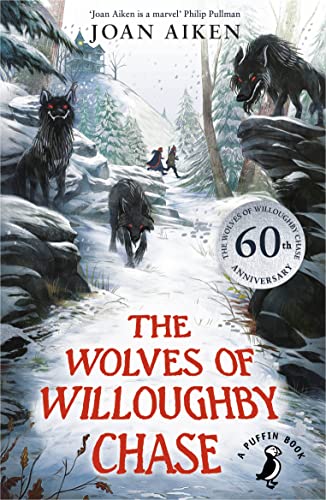
The Wolves of Willoughby Chase by Joan Aiken – #1962Club

I’ve read and enjoyed several of Joan Aiken’s adult novels over the last few years – my favourite so far is Castle Barebane – but until now I’ve never read the book for which she’s most famous, The Wolves of Willoughby Chase. It was first published in 1962, which makes it a perfect choice for this week’s 1962 Club hosted by Simon and Karen.

This is obviously a book aimed at younger readers and I’m sure I would have loved it if I’d read it as a child; however, I was pleased to find that it also has a lot to offer an adult reader. I’m definitely planning to continue with the next book in the series.

The Wolves of Willoughby Chase is set in England in an alternate history where the Stuarts are still on the throne in the 19th century. It’s 1832, early in the reign of King James III, and a tunnel between Dover and Calais has recently been completed, allowing the migration of a large number of wolves from Europe. In reality, of course, the Channel Tunnel wouldn’t open until 1994, so Joan Aiken really was ahead of her time – although obviously the idea had existed in theory for much longer! Other than the tunnel and the presence of wolves, the world described in this book doesn’t seem very different from the real world of 1832, but I’m assuming the alternate history element becomes more significant later in the series.

Being a children’s book, the story is told from the perspectives of two children – Bonnie and Sylvia Green. Sylvia, an orphan, lives in London with her elderly Aunt Jane, but at the beginning of the novel she travels north by train to Willoughby Chase to stay with her cousin Bonnie. Bonnie’s parents, Sir Willoughby and Lady Green, are going abroad for health reasons and have engaged a governess, Miss Letitia Slighcarp, to take care of the children while they are away.

Left alone with Miss Slighcarp, the girls discover that their new governess is not what she claims to be and has another motive for coming to Willoughby Chase. Soon Bonnie and Sylvia are sent off to a horrible school for orphans run by the cruel Gertrude Brisket. Hungry and miserable, they begin to plan a daring escape, but will they succeed – and if so, where will they go? Will their friend, Simon the goose-boy, be able to help them? And what exactly is Miss Slighcarp planning to do now that she is in full control of Willoughby Chase?

Now that I’ve read this book I can see why it is considered a children’s classic and has been so popular with generations of younger readers over the years. It has an exciting plot, child protagonists to relate to, kindly adult characters to love and villainous ones to hate, and an atmospheric setting with snowy, icy landscapes and packs of wolves roaming the countryside. Speaking of the wolves, they play a big part in two memorable scenes near the beginning of the book, but are barely mentioned after that as the human ‘wolves’ come to the forefront of the story instead. The influence of Victorian literature on Aiken’s writing is also very obvious, from the Dickensian names of the characters – Letitia Slighcarp, Josiah Grimshaw, Mr Gripe, Mr Wilderness – to the portrayal of Mrs Brisket’s school, surely inspired by Lowood School in Jane Eyre.

I thoroughly enjoyed this book and just wish I hadn’t come to it so late! I’m already looking forward to reading the second one in the series, Black Hearts in Battersea.

This is book 41/50 for the 2023 Historical Fiction Reading Challenge.

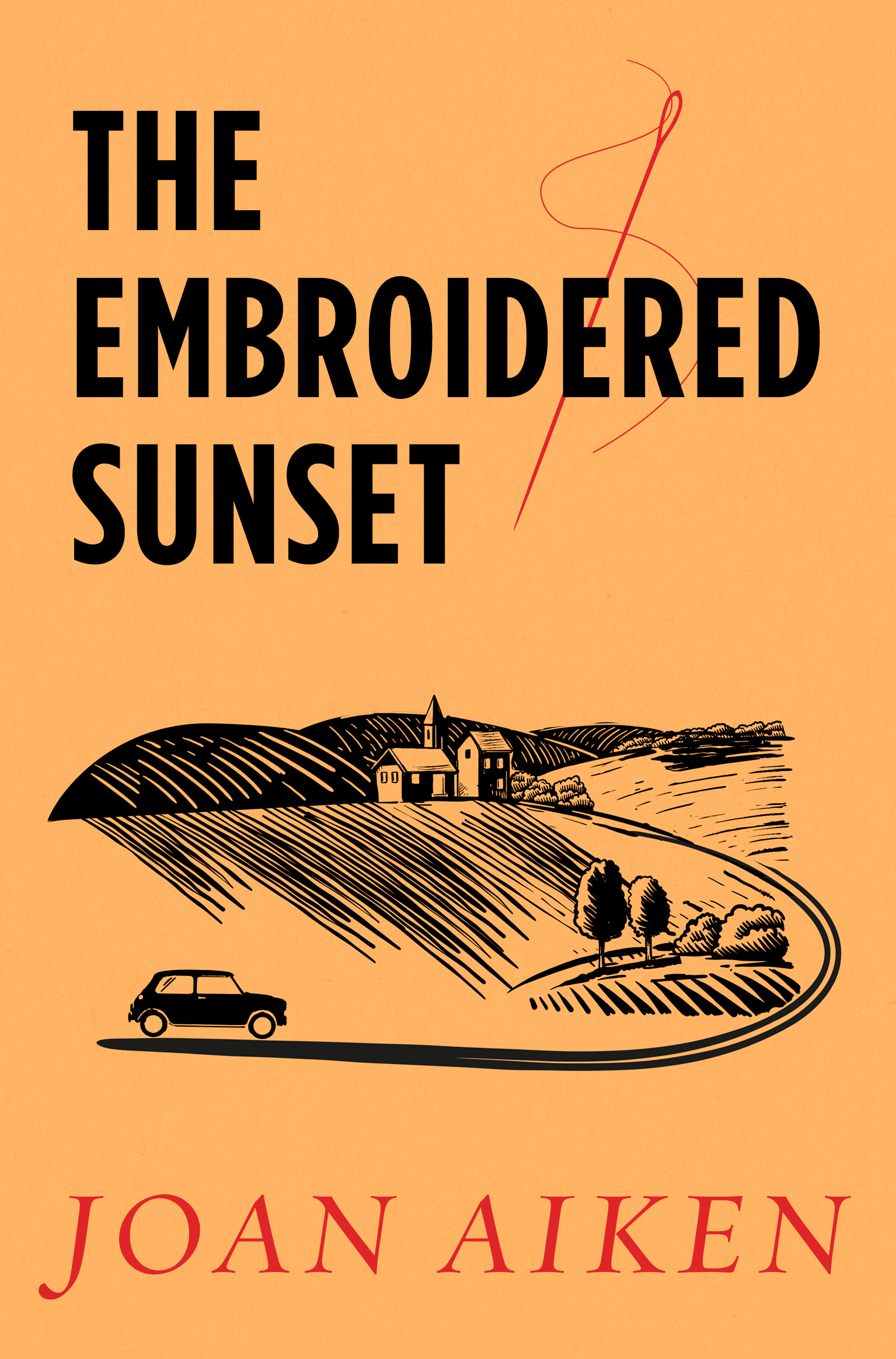
The Embroidered Sunset by Joan Aiken

This is the second of Joan Aiken’s contemporary suspense novels I’ve read; I enjoyed The Butterfly Picnic which I read last year, but I found the plot very bizarre and I was curious to see whether this one would be the same. Well, I can tell you that it’s maybe not quite as over-the-top, but it does come close!

First published in 1970, The Embroidered Sunset begins by introducing us to Lucy Culpepper, a young Englishwoman who has been raised in America by her Uncle Wilbie and Aunt Rose following her parents’ deaths. Lucy is a talented musician who dreams of being taught by the renowned pianist Max Benovek, but her hopes are shattered when Uncle Wilbie confesses that he has spent her inheritance and there’s no money left to pay a piano teacher.

Cleaning the attic later that day, Lucy discovers some beautiful embroidered biblical pictures, the work of Wilbie’s Aunt Fennel who lives in England and used to write regularly, but hasn’t been heard from for a long time. Reminded of the pictures, Wilbie comes up with a plan: if Lucy goes to England and obtains more of Aunt Fennel’s pictures, he will pay her a commission for each one she locates and she can spend the money on piano lessons. While there, she can also try to find Aunt Fennel herself – if the old lady is still alive, that is.

If The Butterfly Picnic felt like a homage to Mary Stewart, this one is packed with references to the Brontës. As well as being set in Yorkshire, there’s a Thrushcross Grange and a Wildfell Hall and even a Colonel Linton and a Cathy Earnshaw, while another character refers to Lucy as Lucy Snowe, the heroine of Villette. However, that’s where the Brontë similarities end; this book has a lively, contemporary feel (for 1970) and while there are some elements that could probably be described as Gothic – an abandoned house, an escaped prisoner, rainy weather – they are woven very lightly into the plot.

I really enjoyed the first half of the novel, with Lucy arriving in Aunt Fennel’s small Yorkshire village, getting to know the eccentric residents and searching for her missing relative. When Lucy does eventually find the old lady, she can’t even be sure whether she really is Aunt Fennel or somebody else, and Aiken keeps us questioning this for the entire book, in a way that I thought was very cleverly done. I felt that the plot lost its way slightly in the second half and the ending seemed to come out of nowhere, with a very surprising fate for one main character and a romance that certainly wasn’t resolved as I’d expected. Still, this is an entertaining novel and perfect escapism, if that’s what you’re looking for!

My favourite Aiken novel so far is still Castle Barebane, but I’ll continue to explore her other books and am hoping to read The Wolves of Willoughby Chase soon.

This is book 3/20 of my 20 Books of Summer 2023

The Butterfly Picnic by Joan Aiken

Although Joan Aiken is best known for her children’s novel The Wolves of Willoughby Chase, she also wrote lots of books for adults. I read one of them, Castle Barebane, last year and enjoyed it so much I knew I would have to read more of them. Unlike Castle Barebane, which was a Gothic historical novel set in Scotland, The Butterfly Picnic, first published in 1972, is contemporary and has much more in common with the suspense novels of Mary Stewart. The characters even reference Stewart’s My Brother Michael once or twice!

The Butterfly Picnic is narrated by Georgia Marsh, a Greek-Chinese-Russian-French orphan with six older brothers, all of them scientists. Georgia has been summoned to the beautiful Greek island of Dendros by her cousin Sweden, another scientist. With no idea why Sweden wants to meet her so desperately, she makes her way to her cousin’s boat which has just sailed into the harbour – and is just in time to witness Sweden’s murder. Unfortunately, Georgia doesn’t see the killer’s face and when she reports the incident to the local police they show very little interest in catching him. In fact, they seem to think Georgia has imagined the whole thing and insist on sending her off on the next plane home. Luckily, the plane is promptly hijacked by Palestinian liberators disguised as priests and Georgia persuades them to return her to the island so she can continue to investigate Sweden’s death.

At this point I was beginning to wonder what on earth I was reading. The plot seemed too ridiculous for words and quickly became even more bizarre…

The plane lands Georgia on the other side of the island where she finds herself accepting a teaching job at a very unusual school inside a castle belonging to a millionaire described as ‘the wickedest man on the island’. However, it seems that someone is determined to prevent Georgia from discovering the truth, and she suffers a series of mishaps including being locked inside a kiln and falling through a trapdoor into an oubliette. While lost in a maze of underground tunnels, Georgia asks herself what Esther Summerson in Dickens’ Bleak House would do: Esther would have bustled up and down the passages doing a great many household errands and embroidering half a dozen yards of ornamental work and jingling her bunch of keys.

The Butterfly Picnic is fun to read and quite a page-turner, but definitely shouldn’t be taken too seriously! As I mentioned above, there are some similarities with Mary Stewart’s novels (the Greek setting, the brave and capable young heroine), while the scientist storyline also reminded me of Agatha Christie’s Destination Unknown, but this is clearly intended to be a parody of those genres of books. As long as you go into it expecting a book that’s more of a comedy rather than a conventional thriller or suspense novel, you’ll probably find it entertaining.

Although I can’t really say that I loved this book as the plot was just a bit too silly, I will continue to try more of Joan Aiken’s novels. The next one I have on my TBR is The Embroidered Sunset and I’m curious to see what it’s like. One final note – be aware that the US title of this book is A Cluster Of Separate Sparks. I wouldn’t want anyone to buy the same book twice!

Book #3 read for R.I.P. XVII

Castle Barebane by Joan Aiken – #1976Club

Since reading some of Jane Aiken Hodge’s books, I’ve been interested in trying something by her sister and fellow author, Joan Aiken. Maybe it would have been more sensible to start with the classic children’s novel The Wolves of Willoughby Chase, for which she’s most famous, but her adult novels appealed to me more and when I saw that Castle Barebane was published in 1976, I decided to read it for this week’s 1976 Club hosted by Karen and Simon. I loved it, so it turned out to be a perfect choice!

The novel is set towards the end of the 19th century and opens with Val Montgomery, a New York journalist, at a party to celebrate her engagement to Benet Allerton. The party is not an enjoyable experience for Val – she feels awkward and out of place around Benet’s wealthy, fashionable relatives and can sense their disapproval of her clothes, her family and the fact that she works for a living. When she discovers that she will be expected to give up her career once she becomes Benet’s wife, she begins to have second thoughts about the marriage.

As luck would have it, Val returns home from the party later that night to find that her half-brother Nils has just arrived from England and when she tells him that she is having doubts about Benet, he persuades her to come and stay with him in London for a while to give herself time to think. However, the next day Nils disappears, leaving a note saying he has been called back to England urgently. Val follows on another ship a few days later, but by the time she reaches London, she discovers that her brother’s house has been abandoned, there’s no sign of Nils or his Scottish wife Kirstie, and their two young children are staying with a cruel and negligent servant. Desperate to know what has happened – and wanting to find someone more suitable to care for little Pieter and Jannie before she goes home to America – Val takes the children and boards a train for Scotland and Kirstie’s old family estate.

The rest of the novel is set at Ardnacarrig, nicknamed Castle Barebane because of its derelict, neglected state. This is where the gothic elements of the story emerge, with descriptions of underground passages, dangerous rocks and treacherous quicksand and tales of at least two resident ghosts who haunt the upper floors of the house at night. Val, who is too practical to believe in ghosts, suspects that if the house is haunted at all, it is haunted by the misery and unhappiness of the people who have lived there. As we – and Val – wait for the truth behind Nils’ and Kirstie’s disappearances to be revealed, the poignant stories of other characters unfold: the elderly housekeeper Elspie and her lost lover Mungo; local doctor David Ramsay and his dying mother; and six-year-old Pieter and his little sister Jannie, who is not like other children.

It took me a while to get into this book; it was very slow at the beginning and I felt that more time was spent on Benet and his family than was necessary, considering that they don’t really feature in the story after the first few chapters. Once Val arrived in London to find her brother missing, though, it became much more compelling. Val is a great character; although I didn’t find her particularly likeable at first – and I don’t think she was intended to be – I admired her dedication to her work and desire for independence when it would have been easier to just marry Benet and conform to society’s expectations. After she breaks free from Benet it’s fascinating to watch her grow and flourish as a character while doing all she can to help the people around her, even when it seems that they don’t really want to be helped. There’s also a new romance for Val, which I liked, but we didn’t see enough of her love interest for me to feel fully invested in their relationship.

Most of the action in the book is packed into the final few chapters; there’s definitely a problem with the pacing and also a bit of needless violence which I wasn’t expecting and felt that the story would have worked just as well without. But despite the novel’s many flaws, I thoroughly enjoyed reading it – both the domestic parts and the gothic adventure parts. The atmosphere is wonderful, there’s a suitably sinister villain and I loved the remote setting (and was impressed by the Scottish dialect which seemed quite accurate, although I’m not an expert). I’m certainly planning to read more of Joan Aiken’s books and am hoping they’re all as good as this one!

~

I’m also counting this book towards the 2021 Historical Fiction Reading Challenge and the R.I.P. XVI event!

~

1976 books previously read and reviewed on my blog:

Sleeping Murder by Agatha Christie
Touch Not the Cat by Mary Stewart
Dark Quartet by Lynne Reid Banks
Some Touch of Pity by Rhoda Edwards
The Children of Dynmouth by William Trevor