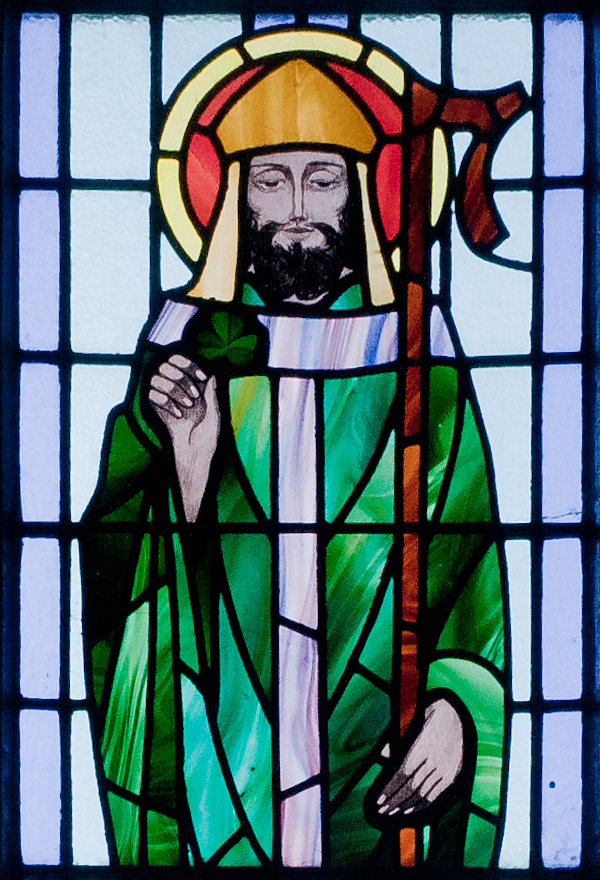
The Lion and the Cross by Joan Lesley Hamilton

The Lion and the Cross If you’re looking for the perfect book to read as St Patrick’s Day approaches, this could be it. Originally published in 1979, The Lion and the Cross: A Novel of Saint Patrick and Ancient Ireland has recently been made available as an ebook by Open Road Media. Narrated by Patrick himself, it is a fictional account of the life of the man who would become Ireland’s patron saint.

The story takes place in the 5th century, a time of unrest and uncertainty as the period of Roman rule in Britain has come to an end, leaving the country vulnerable to attacks from raiders. As the novel opens in the year 410, Magonus Sucatus Patricius, son of wealthy Romano-Britons, is sixteen years old. Despite being the grandson of Potitus the priest, Magonus himself has no intention of devoting his life to religion, but this is something which will slowly change. The first big turning point in Magonus’s life comes when he is captured by barbarian raiders who take him across the sea to Ireland where he is sold into slavery.

Now known as Padraic, or Patrick, he spends the next few years herding sheep in the Irish countryside and – after catching the attention of the Ri and Rigan (king and queen) – trying to survive the intrigues and machinations of the court. During this time his faith strengthens and when he eventually manages to escape from his captivity and from Ireland, Patrick must make the decision whether to one day return and convert the people to Christianity.

In The Lion and the Cross, Joan Lesley Hamilton has drawn on a variety of sources including The Confession of St Patrick, Irish mythology and historical fact to recreate the story of Patrick’s life. As she states in her author’s note, this period of history is ‘obscured by the roiling, silent fog of centuries’ and there are many things we don’t know about Patrick and his world; however, I think Hamilton does a good job of working with what little information is available and finding the right balance between fact and fiction.

The praise at the front of this book compares it to Mary Stewart’s Merlin trilogy, which I have read and loved. Although they are very different stories, I can understand the comparison; like Stewart’s The Crystal Cave, The Lion and the Cross is set shortly after the decline of the Roman Empire, it is narrated by a young male protagonist and it has a slightly magical feel (the first chapter deals with Patrick’s meeting with the Morrighan, a legendary Celtic goddess). The writing is quite beautiful and poetic at times, but let down by the dialogue – some of the characters speak with Irish accents which, to me, don’t sound at all right.

Patrick himself is not the easiest of characters to like. He is a stubborn, arrogant and defiant young man and because of this, despite the ordeals he goes through, I sometimes found him difficult to connect with. Patrick’s personality, though, is an important part of the story; it’s the reason he’s able to survive and to accomplish what he does, and it explains his internal struggles with God and the doubts he has to overcome. I did enjoy learning about Patrick and his life, but the religious element of the novel is very strong (as you would expect from a book about a saint) and I think the ideal reader for this book would be someone with a particular interest in religious history.

Thanks to the publisher for providing a copy of this book for review.

My commonplace book: February 2016

commonplace book
Definition:
noun
a notebook in which quotations, poems, remarks, etc, that catch the owner’s attention are entered

Collins English Dictionary

~

A summary of this month’s reading, in words and pictures.

~

Every sound of the quiet evening came clearly to her ears with an unnatural distinctness; but now each one possessed a different and terrifying meaning. The muffled shouts and laughter of the few remaining bathers from the indoor swimming bath were the cries of fleeing, panic-stricken people. The whisper of the breeze through the pine needles was a frightened man whispering orders in the shadow of fog-shrouded whin bushes. A passing car was the drone of an enemy bomber and the faint lap of water against the sea-green tiles at the far side of the wide pool was the lap of waves against a pebble beach.

Death in Berlin by M. M. Kaye (1955)

~

“The promise of the day!” said Visconti, dreamily and sadly. “Hath it never struck thee how that promise never is fulfilled? Day after day, since the world began, something in the mystery of the dawn is promised – something the sunset smiles to see unfulfilled – something men have ever been cheated of – something men will never know – the promise of the dawn!”

The Viper of Milan by Marjorie Bowen (1906)

~

Louis X

Uncertain health, a clever but overbearing father whose authority had crushed him, an unfaithful wife who had scoffed at him, an empty treasury, impatient vassals always ready to rebel, a famine in the first winter of his reign, a storm which threatened the life of his second wife – beneath what disastrous conjunction of the planets, which the astrologers had not dared reveal to him, must he have been born, that he should meet with adversity in every decision, every enterprise, and end by being conquered, not even nobly in battle, but by the water and mud in which he had engulfed his army?

The Poisoned Crown by Maurice Druon (1956)

~

She looked up as the train passed, and I was almost near enough to catch her eye. She had a round pale face, the usual exhausted face of the slum girl who is twenty-five and looks forty, thanks to miscarriages and drudgery; and it wore, for the second in which I saw it, the most desolate, hopeless expression I have ever-seen. It struck me then that we are mistaken when we say that ‘It isn’t the same for them as it would be for us,’ and that people bred in the slums can imagine nothing but the slums. For what I saw in her face was not the ignorant suffering of an animal. She knew well enough what was happening to her — understood as well as I did how dreadful a destiny it was to be kneeling there in the bitter cold, on the slimy stones of a slum backyard, poking a stick up a foul drain-pipe.”

The Road to Wigan Pier by George Orwell (1937)

~

Flag of Iowa

After all no fledgling had it easy, farmer or crow. Hadn’t he known since he was a boy the way the fledglings had to fall out of the nest and walk about, cheeping and crying, until they grew out their feathers and learned to fly on their own? Their helpless parents flew above them, and maybe dropped them a bit of food, but flying or succumbing belonged to them alone.

Some Luck by Jane Smiley (2014) – review to follow

~

“I must insist upon it,” she continued, “that you shall take me now as I really am — as your dearest friend, your sister, your mother, if you will. I know what I am. Were my husband not still living it would be the same. I should never under any circumstances marry again. I have passed the period of a woman’s life when as a woman she is loved; but I have not outlived the power of loving.”

Phineas Redux by Anthony Trollope (1873)

~

“There is no other way, Robert,” James said quietly, watching the emotions shift across his face. “If Balliol returns you lose everything. At least this way you have a chance to make sure you and your family are protected. Our best hope is that Edward will be able to keep Balliol from the throne. If he succeeds, God willing, you may one day still claim it.”

Renegade by Robyn Young (2012)

~

St Patrick

And so it came to be that they carried me away into bondage, slung over the shoulder of the black-beard while the girl walked, roped behind. I cannot tell you of the voyage, nor of the faces of the many who were taken into captivity with us. I can only say that on that day “…the Lord brought over us the wrath of His anger and scattered us among many nations, even unto the utmost part of the earth, where now my littleness is placed among strangers” in the land known as Eire.

The Lion and the Cross by Joan Lesley Hamilton (1979) – review to follow

~

Everybody was bowing, sliding on to one knee as Henry came into the chamber, leaning on his staff and smiling…Here comes the King, and with the coming of the King, all life must stop, the very air must thicken as if congealed in awe of this gross man who hobbled painfully on his tall staff, nodding and smiling, blinking every second.

Here Comes the King by Philip Lindsay (1933)

~

In a country where so many desire status and wealth, petty annoyances can spark disproportionately violent behaviour. We become frustrated because we feel powerless, invisible, unheard. We crave celebrity, but that’s not easy to come by, so we settle for notoriety. Envy and bitterness drive a new breed of lawbreakers, replacing the old motives of poverty and the need for escape. But how do you solve crimes which no longer have traditional motives?

Ten-Second Staircase by Christopher Fowler (2006) – review to follow

~

Favourite books this month: Phineas Redux and The Viper of Milan