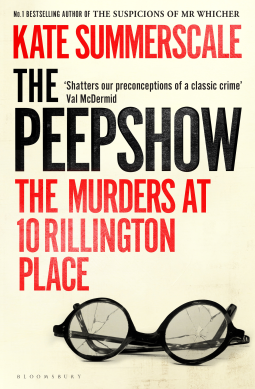
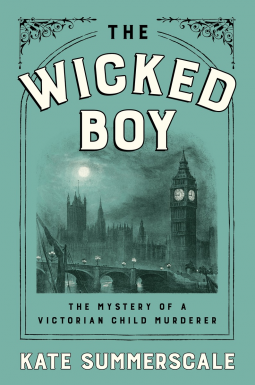
 When I first saw the title of Kate Summerscale’s new true crime book, I wondered if it dealt with the Thompson/Bywaters murder case, the subject of A Pin to See the Peepshow by F. Tennyson Jesse. Then I saw the subtitle and knew this was a book about a different crime – the John Reginald Christie murders at 10 Rillington Place in London. However, I was partly right, because Tennyson Jesse herself was actually involved in this case as well and appears in this book in her role as author and journalist.
In March 1953, John Reginald Christie was arrested following a seven-day manhunt after the bodies of three women were found in his kitchen alcove. The body of his wife, Ethel, was then discovered under the floorboards, as well as the remains of two more women in the garden. Christie admitted to being responsible for all of these deaths and was hanged in July 1953. However, just three years earlier, Timothy Evans, another tenant at the same address, was believed to have killed his wife and baby daughter and was also hanged. Evans had changed his story several times and after withdrawing a confession he had made to the police, he accused Christie of committing both murders. Did the jury get it wrong and hang an innocent man, allowing Christie to go on killing more people?
The Peepshow is a detailed and thorough account of the Rillington Place murders – sometimes a bit too detailed, for example where we are given the personal histories of the most minor of characters or a list of every single reported sighting of Christie in a seven day period. In general, though, it’s all interesting information that adds up to a full picture of not just the crime itself but also the state of British society in the early 1950s. Some of Christie’s victims were prostitutes or from deprived backgrounds and Summerscale spends a lot of time discussing their stories and the sequence of events that brought them into contact with their killer. She also explores the racist attitudes of the period – it seemed that many of the white residents of Rillington Place were so busy complaining about living amongst black people, they failed to notice that they were also sharing the building with at least one murderer. Other topics Summerscale touches upon include illegal abortions (Christie carried these out in his rooms at Rillington Place) and the poor living conditions in multiple-occupancy housing.
To give the book a more personal touch, Summerscale focuses on two people who were investigating the murders from different perspectives. One was Harry Procter, star reporter with the Sunday Pictorial, who arrived at Rillington Place to report on the discovery of the bodies in the kitchen – and remembered that three years earlier he had visited the same house to interview Christie about the Timothy Evans case. Now, with more information available, Procter became convinced that he – and the police – made a terrible mistake and that it was in fact Christie who was responsible for the murders of Beryl and baby Geraldine.
Procter’s theory was shared by the author Fryn Tennyson Jesse, who was researching the case for a new book in the Notable British Trials series. Fryn was dealing with morphine addiction and poor eyesight, but was determined to attend Christie’s trial, where she came to the same conclusion as Procter. However, there was very little appetite from the authorities to look again at the Evans case – the police didn’t want to admit that they failed to identify the correct culprit and it’s believed that the Tory government of the time didn’t want to cast doubt on the justice system as it would strengthen opposition to the death penalty. Although Timothy Evans has now been posthumously pardoned, it seems that we still don’t know for certain what happened to Beryl and Geraldine Evans and if you’re hoping for answers or lots of new evidence, you’re not going to find anything conclusive in The Peepshow. I was left feeling confused about the whole thing, which isn’t really Summerscale’s fault – the confusion was caused by both Evans and Christie confessing to various murders, then changing their stories – but it’s not very satisfying if you prefer everything to be neatly wrapped up at the end of a book.
I did find this an interesting read, although I think it needed more structure; it seemed to jump around a lot, from one topic to another and backwards and forwards in time, which stopped it from flowing as well as it could have done. Still, it was good to learn more about this complex true crime and the social conditions that may have contributed to it.
Thanks to Bloomsbury Circus for providing a copy of this book for review via NetGalley.




 She Reads Novels