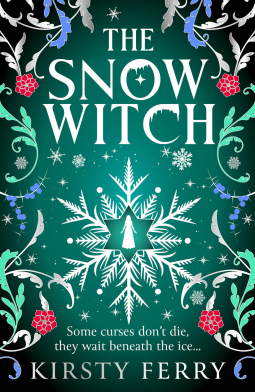
 Close to Hadrian’s Wall in Northumberland, there’s a stream known as Meggie’s Dene Burn. According to legend it’s named after Old Meg, a witch who lived in the area in the 17th century and whose burial site is said to be marked by a pink thorn tree. When Violet Marsh, the modern day heroine of Kirsty Ferry’s The Snow Witch, comes to Hadrian’s Wall to research her new book on the Newcastle Witch Trials, it’s Meg’s story that she finds most captivating. Basing herself near the village of Newbrough, Violet sets out to discover the truth about Meg, who she was and how she died.
The story of Meg Noble unfolds alongside Violet’s and the first thing we learn is that she isn’t old. When we first meet her in 1650, she’s a young woman who has inherited her grandmother’s gift of creating herbal remedies which she uses to help the people of Newbrough. She’s aware that fifteen people have been executed in the recent witch trials just a short journey away in Newcastle and, although she doesn’t really expect the witchfinder to come to Newbrough, she can’t help feeling uneasy. Her childhood nickname, a reference to her white blonde hair, is the Snow Witch, and she worships regularly at the well of the goddess Coventina, both things that could count against her if things go wrong…
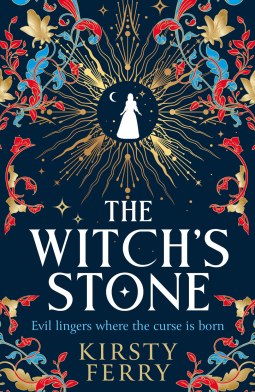
Like Ferry’s previous book, The Witch’s Stone, this is a dual timeline novel where the two narratives become more and more entwined with each other as the story progresses and the characters begin to slip between time. There’s a strong supernatural element as Violet and Meg each become aware of the other’s presence despite being separated by centuries and Violet starts to see scenes from the past play out in front of her almost as if they were really happening. However, although I did like this book, I felt that it was very, very similar to The Witch’s Stone, even in the way the time periods merge together, and I think if I hadn’t already read that other book just a few months ago I would probably have enjoyed this one more.
Meg’s story is tragic and moving, especially when you remember that it’s based on historical fact; whether or not there really was a woman known as Old Meg who was executed for witchcraft in Newbrough, we do know that many other women (and some men) really did face this fate. I was frustrated with Meg’s naivety in thinking that the witchfinders wouldn’t come for her and wished she had just run away from the village, but I suppose then there would have been no story! In the modern day, I enjoyed watching Violet unearthing information about Meg, helped by her partner, history teacher Jake, who turns up unexpectedly, and another man, Ollie, who is in the area researching his family tree. All three become emotionally invested in Meg’s story, in one way or another.
I loved the setting of the book; I have visited some parts of Hadrian’s Wall but not the place where Meg supposedly lived. I was particularly interested by the inclusion of Coventina’s Well, as I recently read about Coventina and her links with water and healing in No Fair Maidens by Kim Willis, a book about ancient British goddesses. It seems that Kirsty Ferry will be writing more books about historical witches: her next one, The Witch of the Solstice is advertised for February 2027 and I’ll be looking out for it.
Thanks to Boldwood Books for providing a copy of this book for review via NetGalley.
The dark atmosphere, witch trial theme and supernatural aspects meet the requirements of RIPXXI, I think!