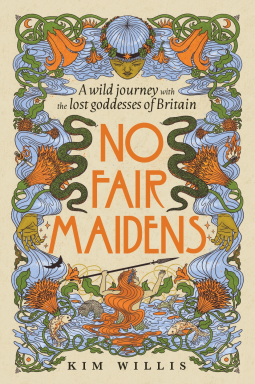
 I’ve read a lot of Greek mythology but very little British mythology, so when I came across No Fair Maidens on NetGalley it seemed like a good opportunity to rectify that. However, I don’t think I read the description of the book properly as it wasn’t quite the exploration of British goddesses that I’d expected but more of a memoir of the author’s own personal journey. Looking at other reviews, it seems a lot of people made the same mistake, but I think as long as you know what kind of book it is before you start, there’s still a lot to enjoy here.
Kim Willis begins by telling us about a time in her life when she began to struggle with mental health issues. She had just been told (wrongly) that she would never be able to have children and was left feeling depressed and empty. It was then that she took a trip to the mouth of the River Severn and drew inspiration from the story of the goddess Sabrina (or Hafren in Welsh), whose name over the centuries became Severn. Sabrina and her two sisters fell to earth in the form of single raindrops and then each chose her own route to the sea, growing and swelling as they went. Willis found it motivating to think of these three women charting a path for themselves with no maps to show the way – and this led her to investigate the stories of other mythical British women.
I had heard of some of the women featured in the book; Morgan le Fay, who appears in the Arthurian legends usually as King Arthur’s half-sister, is probably the most famous, but I was also already familiar with Melusine, the water spirit who turns into a snake for several days each month. The others I knew little to nothing about – Coventina, Arianrhod, Scáthach and my two favourites, Cerridwen and Gwendoline. I won’t say too much about any of the individual women as you may prefer to discover their stories for yourself, but all of them are fascinating and, interestingly, they are all associated with water in some way.
However, relatively little time is spent on the actual myths; most of them are told in just a few pages embedded into each chapter. Much more attention is given to the author’s own reactions to learning about the myths, how she found them inspiring and healing and how they gave her the strength to move forward. Although I appreciate her courage in being so open and honest with the reader about her life and her mental health, I didn’t personally find any of this particularly interesting and struggled to identify with her personality and way of life. I’m sure other readers will like this aspect of the book and find it helpful; it just depends on what you’re looking for, I think.
I did enjoy reading about the author’s travels around England, Scotland and Wales to get to the source of each of the stories and stand on the land where our eight mythological women may once have stood. I’ve been left wanting to know more about these myths – and maybe I’ll actually get round to reading The Mabinogion one of these days!
Thanks to Doubleday for providing a copy of this book for review via NetGalley.
Book 13/20 of 20 Books of Summer


I know Melusine because she’s supposedly an ancestress of the Plantagenets :-), and Morgan le Fay, but I know very little about the others either, and have never heard of some of them. I think I need to read this!
Yes, I mainly know Melusine from Philippa Gregory’s Wars of the Roses series!
I agree, I’m much more interested in the eight mythological women, that seems like a good project!
It was good to have the chance to learn a little bit about those mythologicial women, even if it turned out not to be the main focus of the book.
The British Isles has some *interesting* Mythology, but I think I’ll give this particular book a miss as it seems like one of those mislabeled ventures!
I have been a long term ‘fan’ of Morgan Le Fey though… [muses]
The myths were fascinating to read about, but I think I’ll need to look for a book that goes into more depth. This one wasn’t what I was hoping for!
Years ago I read ‘The Real Middle Earth – Magic and Mystery in the Dark Ages’ by Brian Bates which I keep promising myself to re-read. From memory, and a brief look at the contents list, it probably covers a lot of the ground you’re thinking of.
I’m not surprised that so many people have picked this up expecting such different reads as the title and cover defintely dont lead you to think this would be more of a memoir. Its a shame that the myths get so little page time as thats the element that most intrigues me about this one. I have a feeling I may have similiar connection issues to you. Although I probably will still give it a try at least, sometime.
I definitely wasn’t expecting this to be more of a memoir and probably wouldn’t have requested it from Netgalley if I’d known in advance. Still, the parts about the myths were interesting, especially as I knew nothing about most of these women. It was a good introduction, as it’s left me wanting to know more.
A beautiful cover and a potentially interesting subject but I think too much of a memoir to interest me.
Yes, I love the cover! The book itself just wasn’t what I was expecting or hoping for.
Yes, do read the Mabinogion, especially the Sian Davies translation, well worth the effort! An interesting approach this, especially as I recognised all the mythical names mentioned.
Thanks – I’ll keep that translation in mind. Maybe one to consider for Reading Wales next year. And yes, this was an interesting book, even if it wasn’t quite what I’d been hoping for!
Arianrhod is from the Welsh Mabinogion isn’t she? I would have been disappointed by this book too. I have several of Amy Jeff’s wonderful NF books about British folklore in my piles, plus her new Arthurian one on order, which I must actually read.
Yes, Arianrhod is in the Mabinogion, which I still haven’t read but really should! I haven’t read any Amy Jeffs books yet, but they do all sound interesting and more what I was hoping for than this book turned out to be.