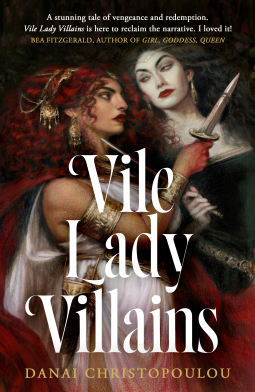
 Literature is full of villains, many of them women. Sometimes they are based on real people and sometimes they are purely fictional. Sometimes their reputations for villainy are deserved and sometimes they’re not. But what would happen if two female villains from two very different works of literature crossed paths, got to know each other and worked together to write new endings to their stories? This is what Danai Christopoulou sets out to explore in Vile Lady Villains.
Our first lady villain is Lady Macbeth. We meet her after she and her husband have carried out their plot to murder King Duncan and she is trying to wash the blood from her hands. She asks the three witches for help and is given a potion to drink, but it doesn’t have the effect she hopes for – instead of removing her burden of guilt, it transports her to an endless corridor lined with doors. Drawn to one with a bloodstained handle to match her bloodstained hand, she opens it and finds herself in a room where another murder has just taken place…
Klytemnestra has just killed her husband, Agamemnon, and is standing over his dead body. The murder was revenge for the death of their daughter, Iphigenia, whom Agamemnon sacrificed in return for winds to sail to the Trojan War, and for bringing his concubine Cassandra home with him. Suddenly a door in the wall appears and a woman dressed in black stumbles onto the scene of the crime…
This is how Christopoulou brings together Lady Macbeth and Klytemnestra (spelled with a K in the book rather than the more common C), two women from different times and different worlds. Together they become lost in a realm of stories, pursued by a mysterious goddess known as the Shepherd, or the Mistress of the House of Books. The Shepherd holds the keys to reopen their doors, but the more time our two villains spend together the more they begin to question whether they really want to return to their own stories and if so, is there anything they can do to redeem themselves first?
This is a difficult book to classify – it’s fantasy and also metafiction; there’s an element of historical fiction where Lady Macbeth’s story intersects with the real woman who inspired her character, Gruoch; there’s Greek mythology with Klytemnestra’s storyline; and there’s a thread of romance running through the novel as well. To be honest, although I could tell from the blurb that this would be an unusual story, I wasn’t really prepared for quite how bizarre it actually was. I enjoyed the beginning and the end but felt lost for a while in the middle. Also, the two women are referred to throughout the book by nicknames they give each other: Lady Macbeth becomes Anassa (the ancient Greek word for queen) and Klytemnestra becomes Claret, a reference to the colour of blood. I found this unnecessarily confusing, although I understand the thinking behind the two women wanting to choose their own names rather than the ones given to them by their creators.
The book is beautifully written, if a bit too flowery at times, which is particularly impressive as Christopoulou explains in her acknowledgements the extra challenges she faced due to English not being her first language. She also gets around the problem of an Ancient Greek woman and an 11th century Scottish woman being able to understand each other by making it one of the rules of the realm of stories, under the control of the three witches (who appear to Claret as the Three Fates, or Moirai). I don’t think it’s essential to have any knowledge of either Shakespeare or mythology, but it certainly helps! This is a very imaginative book with a lot of layers and a lot going on; ultimately it was just a bit too strange for me, but I’m sure the right reader will love it.
Thanks to Michael Joseph, Penguin Random House for providing a copy of this book for review via NetGalley.

