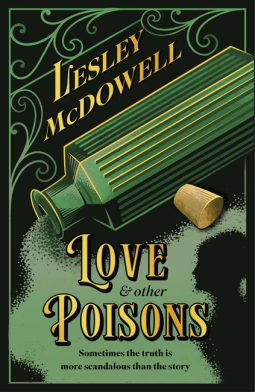
 I wasn’t sure whether to read this new novel by Lesley McDowell as I didn’t get on very well with her last one, Clairmont. Although I liked her writing, I struggled with the structure, the way it would jump from one timeline to another and the lack of context to explain characters’ backgrounds and relationships. I like to give authors a second chance, though, and this book, based on a true crime, did sound intriguing…
In 1857, Madeleine Smith is put on trial in Glasgow for the murder of her lover, Emile L’Angelier. After listening to witnesses and examining the evidence, the jury, still unable to decide whether she is guilty, give a verdict of ‘Not Proven’ and Madeleine is set free. Seventy years later, Harry Townsend, an aspiring filmmaker, believes he has tracked down the woman who used to be Madeleine Smith, now living in New York as a respectable elderly widow, Mrs Sheehy. Harry wants to interview her about Emile’s murder, but when Mrs Sheehy refuses to cooperate, Harry is forced to question whether he has got the right person after all.
We move back and forth between 1857 and 1927 throughout the book, but I found it much easier to follow the plot and understand what was going on than I did with Clairmont, which was a relief! The first few sections were interesting as they set the scene and introduced the characters, but then we settled into the 1857 period and the story of Madeleine’s relationship with Emile and my attention began to waver. There’s a lot of focus on their sexual encounters, some of which are described quite explicitly (I understood why later on), and I started to get impatient waiting for the murder to happen. It does happen eventually, of course, and I was glad I stuck with the book as I found the aftermath of the murder and Madeleine’s trial much more compelling to read about.
Although I did have some sympathy for Madeleine’s position – Emile had become very manipulative and controlling, threatening her with blackmail – I never really warmed to her as a character and I felt that she could have handled the situation differently. I also didn’t like the way she implicated not just the maid Christina, who arranged meetings and passed letters between Madeleine and Emile, but also her own twelve-year-old sister, Janet. None of the other characters in the book were very likeable either; the way Harry Townsend treated the older Madeleine was horrible and I hoped he would never get to make his film! There’s a twist in that particular storyline which I hadn’t guessed, but which seems to fit well with the historical facts.
I’ve never read about the Madeleine Smith case before, although it seems to be well documented, and I wonder whether my perception of this book would have been different if I already knew some of the details before I started to read. Anyway, it was all new to me and I was fascinated by the author’s note at the end of the book where she explained the origins of the novel – the idea was suggested to her by fellow author Emma Tennant who had wanted to work on it as a joint project before her death – and how she chose to interpret some of the historical evidence. She discusses her theory regarding the murder method and weapon (this is where the strong sexual content earlier in the novel suddenly made sense), and how she tried to piece together the clues we have regarding Madeleine’s later life after the trial.
I enjoyed this book more than I thought I would, having seen a lot of very mixed early reviews – but at the same time, I do understand some of the criticisms. Still, I found it interesting to learn about a true crime I was previously unaware of and which has inspired a large number of other novels, plays and adaptations.
Thanks to Headline/Wildfire for providing a copy of this book for review via NetGalley.

Book 11/20 for 20 Books of Summer 2025.


 She Reads Novels