Fire by C. C. Humphreys

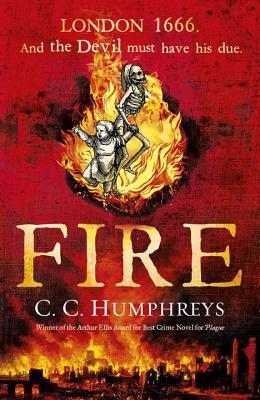
Fire 1666 is famous for being the year of the Great Fire of London. For the religious sect known as the Fifth Monarchists it was also the year in which they believed the monarchy would be overthrown, clearing the way for the kingdom of Jesus. These two events form the basis of C.C. Humphreys’ new novel, Fire, a sequel to Plague, which I read in 2014. Don’t worry if you haven’t had the opportunity to read Plague yet – you will still be able to understand and enjoy Fire, which works as an exciting historical thriller in its own right as well as being a sequel.

As the novel opens we are reacquainted with our old friends, Captain Coke, a reformed highwayman, and Pitman, a ‘thief-taker’. These two men fought on opposite sides in the recent Civil War, but have now formed an unlikely partnership to fight crime in the London area. With Charles II the target of a plot by the Fifth Monarchists, Coke and Pitman have been given the task of foiling the attempt on the king’s life. Assisted by Dickon, a young homeless boy rescued by Coke from a life on the streets, the pair begin to investigate, determined to save the king even if it means putting their own lives in danger.

It’s not only themselves they need to worry about, of course. Pitman is a married man with children, while Coke’s lover, the actress Sarah Chalker, is pregnant. Acting is not considered a suitable career for a respectable woman, but Sarah enjoys it and relies on it as a source of income. Unable to work because of her pregnancy, Sarah is left alone and penniless when Coke finds himself the victim of a cruel betrayal. And then, in the early hours of a September morning, a fire breaks out at Thomas Farriner’s bakery on Pudding Lane…

Fire is an enjoyable read and a fascinating journey through 17th century London life. I’ll have to be honest and say that it’s maybe not the deepest or most literary of historical novels but, like Plague, it’s entertaining and fun to read. Before I started reading I had been afraid that it might be too similar to another book I read earlier this year – The Ashes of London by Andrew Taylor – which is also set during the Great Fire of London and features a plot by the Fifth Monarchists, but the two books are actually completely different.

This is an action-packed novel, taking us to a variety of different settings. We visit the theatre for a production of Hamlet, we find out what conditions were like for those unlucky men pressed into the navy against their will, and we see inside a debtors’ prison, where women and children live in squalor praying that their fortunes will change soon. A map is provided at the front of the book to help us locate each of the London sites mentioned in the story and to show how the fire spreads and progresses day by day.

Something that surprised me about this novel is that the Great Fire itself doesn’t start until we are more than halfway through the book. Instead, Humphreys spends most of the novel setting the scene, moving the characters into place, so that by the time the fire breaks out we are already emotionally invested in the story and are desperate to find out whether our heroes and heroines can find their way out of the dangerous situations they are in.

If C.C. Humphreys brings some of these characters back for a third adventure, I would love to read it; otherwise I’ll investigate his earlier books – I’ve already read Vlad: The Last Confession, but some of his others look interesting too.

Thanks to Century for providing a copy of this book for review.

The Ashes of London by Andrew Taylor

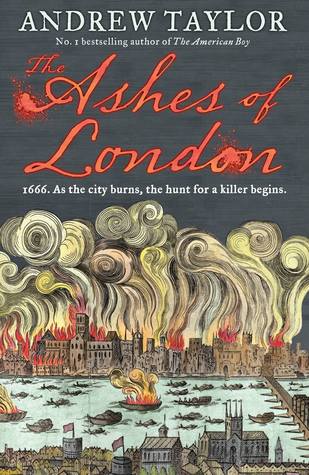
The Ashes of London I always look forward to new books by Andrew Taylor, having enjoyed several of his others in the past. His last two novels, The Scent of Death and The Silent Boy, both featured the same characters (Edward Savill, an 18th century London clerk, and his family) and I had expected there to be more books in that series. However, The Ashes of London is something different: it’s set more than a century earlier – during the Great Fire of London of 1666 – and introduces us to a completely new set of characters.

Our narrator, James Marwood, is the son of a Fifth Monarchist who has recently been released from the Tower of London. All Marwood wants is a quiet life and the opportunity to escape the taint of his father’s disgrace – but as the flames begin to rage across London, it seems that fate has something else in store for him. While he watches St Paul’s Cathedral burn, a young woman runs past towards the fire, taking Marwood’s cloak with her. Later, a dead body is found in the ashes: a man with his thumbs tied behind his back. Marwood, who works for the government, is given the job of investigating the death.

Running parallel with his story is that of Catherine (Cat) Lovett, daughter of a regicide who was involved in the execution of King Charles I and who has been on the run since the restoration of the monarchy. As more dead bodies are discovered in the aftermath of the fire, it seems that Cat must be connected to the deaths in some way…and it’s up to Marwood to find out how.

I don’t think The Ashes of London is one of Andrew Taylor’s best books (my favourite is still The American Boy), but I did enjoy reading it. While I didn’t find it quite as atmospheric as some of his other novels, the setting was certainly a fascinating one. Not only do we witness the destruction of a city by fire and share the sense of loss felt by those who lived there, we are also given the chance to learn something about the political situation in London at that time. I previously knew almost nothing about the Fifth Monarchists, a religious sect who even during the Restoration were plotting to overthrow the monarchy and prepare for the coming of King Jesus, so I found that aspect of the story very interesting.

I enjoyed getting to know both of our main characters, James Marwood and Cat Lovett. Marwood is not a particularly memorable character in himself, but he interested me due to his background and ties with the Fifth Monarchists and regicides. Cat is a strong, independent person who knows how to look after herself, and while I couldn’t quite believe in her as a realistic 17th century woman, her actions do help to drive the plot forward. Apparently this book is the first in a new series, so I expect – and hope – that we will meet both James and Cat again.

Overall, I found The Ashes of London a good Andrew Taylor novel, if not a great one. I’m looking forward to reading the next book in this series, but while I’m waiting for it I would like to go back and read Bleeding Heart Square, the only one of his historical novels I still haven’t read yet.

Ten-Second Staircase by Christopher Fowler

What a wonderful imagination Christopher Fowler has! This fourth novel in the Bryant and May mystery series involves the bizarre deaths of several minor celebrities, a mysterious highwayman complete with horse, cape and tricorn hat, gangs of feuding schoolchildren and a possible link to the Knights Templar. It’s just the sort of case the Peculiar Crimes Unit was created to deal with, and this is one of the most peculiar yet.

Ten Second Staircase As the novel opens, we learn that yet again the PCU is facing the threat of closure, with Bryant and May’s outdated methods of detection coming under attack. Bryant and May – Arthur and John – are the two elderly detectives around whom the rest of the unit revolves. John May is logical, methodical and more open to modern technology, but his partner prefers to rely on his tried-and-tested network of historians, clairvoyants, witches and psychics. Their different personalities and different approaches to crime-solving are the reasons why the two of them have had so much success over the years, right from the very first case they worked on together during the Second World War (described in Full Dark House). Among the successes, however, there has been one failure: the identity of the serial killer known as the Leicester Square Vampire, which has remained unknown since the 1970s.

Bryant and May’s latest mystery begins when a controversial modern artist is drowned in the display case of one of her own art installations. The only witness is Luke Tripp, a twelve-year-boy from nearby St Crispin’s Boys’ School, who claims to have seen a figure resembling Dick Turpin ride into the gallery on horseback and throw the artist into the tank. No sooner have the detectives begun to investigate than the Highwayman strikes again, his second murder as strange and inexplicable as the first. As Bryant and May dig deeper, they uncover some similarities between the Highwayman and the Vampire; if only they can find a way to solve both mysteries at once, the future of the PCU could be secured.

I enjoyed Ten-Second Staircase as I’ve enjoyed all of the previous books in this series, but this is probably my least favourite of the four. The Peculiar Crimes Unit seems to have been facing closure in every book so far and that aspect of the story is starting to feel repetitive, especially as with another nine (at least) books to follow, it was obvious that it would be allowed to stay open. I also couldn’t help feeling that the author was using Bryant and May in this book to voice his own views and opinions on society; this meant that the dialogue sometimes felt more like a lecture rather than a natural conversation between friends.

The things that I did love in this book were the same things I loved in the first three: the unusual and imaginative mystery (which, as usual, I failed to solve), Arthur’s unorthodox detection methods, and the fascinating historical facts and pieces of trivia which are incorporated into the plot. The real attraction of this series, of course, is the partnership of Bryant and May themselves, but we do get to know other members of the PCU as well and some of these characters are developed further in this novel, particularly May’s agoraphobic granddaughter, April, who I’m sure we’ll see more of in future books.

I’ll be continuing soon with book number five, White Corridor!

The Last Confession of Thomas Hawkins by Antonia Hodgson

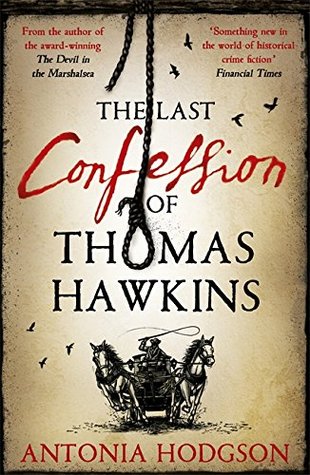
The Last Confession of Thomas Hawkins It’s 1728 and Thomas Hawkins is being escorted through the streets of London towards the gallows at Tyburn. Although he has been found guilty of murder and sentenced to hang, Tom has been promised a pardon and is sure he will be freed. But as he gets closer and closer to the gallows and the pardon doesn’t come, he begins to lose hope. Could this be the end for Thomas Hawkins?

Antonia Hodgson’s debut novel The Devil in the Marshalsea was one of my favourite books of last year. I loved the setting (an eighteenth century debtors’ prison), I loved the entertaining plot, and I loved learning about life in Georgian London, so I was pleased to find that there was going to be a sequel. If you haven’t read the first book, though, that shouldn’t be a problem because The Last Confession of Thomas Hawkins can be read as a ‘standalone historical mystery’, as stated on the book cover. I would still recommend reading the two books in order as there are some minor spoilers in the second one, but it isn’t really necessary.

If you have read The Devil in the Marshalsea you will already have met Thomas Hawkins and will know what he experienced during his time in the notorious Marshalsea Prison. Sadly, as the sequel begins, it seems that Tom has forgotten the lessons he learned in the Marshalsea. He has started to build a new life for himself with Kitty Sparks, bookseller and print shop owner, but this is not enough for Tom and he has returned to his old habits of drinking, gambling and looking for adventure.

It’s not long before things start to spiral out of control again and this time Tom finds himself embroiled in the affairs of Queen Caroline and the king’s mistress, Henrietta Howard, as well as becoming a suspect in a murder investigation. Alternating between Tom’s journey to the gallows and the events leading up to his death sentence, Tom’s story – his ‘last confession’ – gradually unfolds.

This is another great book from Antonia Hodgson and I enjoyed it almost as much as the first. I say ‘almost’ because the fact that The Devil in the Marshalsea was set almost entirely within a debtors’ prison gave the first book a feeling of novelty and originality that this second one doesn’t have. That doesn’t mean I didn’t like the setting of this book too, of course. Hodgson’s portrayal of 1720s London is wonderful: a cockfight in a crowded tavern; a gang leader’s lair in a crumbling slum building; the beautifully furnished rooms of St James’s Palace – all of these are described in vivid detail.

Tom Hawkins, as our narrator, is the perfect character to guide us through Georgian London. His lifestyle means he is familiar with the darker side of society, but his family background makes him a gentleman and it is this combination that brings him to the attention of those who hope to use him for their own ends…including the clever, scheming Queen Caroline (a historical figure I’ve never read about until now). Tom is frustrating, flawed and a bit of a rogue, but he’s also a person you can’t help but like. I’m obviously not going to tell you whether or not he does escape the hangman’s noose, but what I will say is that Antonia Hodgson keeps us in suspense until the end. The final chapter gave me hope that there could be a third book in this series – but if you want to know whether Thomas Hawkins will survive that long, you’ll have to read The Last Confession to find out!

The Crimson Petal and the White by Michel Faber

The Crimson Petal and the White “Watch your step. Keep your wits about you; you will need them. This city I am bringing you to is vast and intricate, and you have not been here before. You may imagine, from other stories you’ve read, that you know it well, but those stories flattered you, welcoming you as a friend, treating you as if you belonged. The truth is that you are an alien from another time and place altogether.”

With these words the unnamed narrator of The Crimson Petal and the White takes us by the hand and leads us on a journey into the depths of Victorian London where we meet a cast of fascinating, diverse characters from all levels of society. One of these is Sugar, a nineteen-year-old prostitute who is writing a novel in her spare time and is prepared to do whatever it takes to improve her situation in life. Another is William Rackham, heir to a perfumery business, who seeks out Sugar after seeing her name listed in More Sprees in London, a guide to the city’s pleasures. From their first meeting at Mrs Castaway’s brothel, a chain of events is set in motion that will change not only Sugar’s life but William’s too.

Sugar is a wonderful character and I came to love her over the course of the book. She’s intelligent, well-read and ambitious and although she sometimes makes mistakes and is not always very ‘nice’, it’s impossible not to sympathise with her and want to see her succeed. I should warn you that Sugar’s story is not a pleasant or comfortable one to read and her work as a prostitute is described in a lot of detail, often quite explicitly. However, I didn’t think it ever felt gratuitous and it all helped to build up a picture of what Sugar’s life was like and to look at the issue of prostitution in a way that 19th century authors didn’t have the freedom to do.

While Sugar is our heroine, there’s another woman who is given almost as much time in the novel – William’s beautiful wife, Agnes Rackham, who is suffering from an illness that is causing delusions, fits and irrational behaviour. We, the readers, know what is wrong with Agnes but as far as her husband is concerned, she is insane. As her story develops, Agnes becomes almost as complex and interesting a character as Sugar, though less sympathetic. Another subplot follows William’s brother, Henry, who has turned down a position in the family business to become a clergyman and has fallen in love with Emmeline Fox, a widow who works for the Rescue Society, an organisation which helps to reform prostitutes. Through the lives of all of these characters and others, Faber is able to explore many different aspects of Victorian society.

The novel is divided into five parts, with section headings ranging from The Streets to The World at Large, giving us some clues as to how Sugar’s story is going to progress. Her rise in the world is great to watch but exactly how she does it is something I’d prefer to leave future readers to discover for themselves – assuming that I’m not the last person to read this book, which is how it feels sometimes! Like The Book Thief which I finally read earlier this month, this is another book I’ve been meaning to read for years and I can’t really explain why it has taken me so long, especially as the Victorian period is one of my favourites.

I loved this book and thought it was beautifully written, but I did have one problem with it – the end. I’m sure I’m not the first person and won’t be the last to have been disappointed by the ending. After reading more than 800 pages, I was hoping for more resolution to the story. I know there’s a book of short stories, The Apple, which is a sort of sequel but I’ve seen mixed opinions of it. If you’ve read it, please let me know if you would recommend it!

The Streets by Anthony Quinn

The Streets In 1882, twenty-one-year-old David Wildeblood comes to London to begin his new job working as a reporter for Henry Marchmont’s weekly newspaper, The Labouring Classes of London. The idea of the paper is to highlight the suffering of some of the city’s poorest people and David’s task is to visit some of London’s worst slum areas, such as the notorious Somers Town, to speak to the inhabitants and report on their living conditions.

Having grown up in rural Norfolk, David is instantly an ‘outsider’, inexperienced in London ways and unfamiliar with the slang. This makes his job very difficult, but things improve when he is befriended by Jo, a young costermonger who can introduce him to people and places he would never have been able to access on his own.

As David continues his investigations into living standards at Somers Town, he is shocked by the state of the housing and the poverty of the people who live and work there. Soon he uncovers something even worse – a network of corruption and exploitation by unscrupulous landlords – and finds that he has gained some very powerful enemies.

The story also has a romantic element and there are two main female characters whom David gets to know throughout the novel. One is Kitty, the daughter of David’s godfather, and the other is Roma, the sister of his new friend, Jo: two very different women. Kitty, with her valuable jewels and pet monkey, comes from a rich, privileged background and while she does take an interest in the welfare of those who are less fortunate than herself, she seems to view them as a project or a problem to be solved. Roma, on the other hand, has endured hardships and made sacrifices from an early age to support herself and her brother: she and Jo are the type of people Kitty considers to be in need of help. David himself doesn’t quite fit in with either of these social groups and it was interesting to see his relationships with both Kitty and Roma develop.

Looking at other reviews of this book I see the word ‘Dickensian’ being used a lot, and while there’s nothing in the writing style or atmosphere that reminds me of Dickens, it is certainly a novel that draws attention to some of the same issues that were obviously very important to Dickens. I could appreciate the huge amount of research Anthony Quinn must have carried out while writing this novel (in the acknowledgments he mentions two 19th century sources: London Labour and the London Poor by Henry Mayhew and Life and Labour of the People in London by Charles Booth) and I found it fascinating from a social history perspective. Fascinating, but disturbing too; the plans of the wealthy for social engineering, segregation of the lower classes and the creation of rural labour camps were uncomfortable to read about.

As a work of fiction, though, I didn’t enjoy The Streets very much at all; the pace was slow and the plot, despite sounding so promising, was not very entertaining. I didn’t feel I was fully engaging with David or any of the other characters (apart from Roma on occasions) and the ‘back slang’ used throughout the book, which I know must have been intended to add some authenticity to the story, really irritated me. What made it even more disappointing is that this book really did sound like something I should have loved: a Victorian setting, a mystery to be solved, and references to Dickens and Eliot on the cover. I didn’t regret persevering to the end, but I was still quite pleased when I reached the final page and could move on to something else.

The Devil in the Marshalsea by Antonia Hodgson

The Devil in the Marshalsea This is a murder mystery with a difference, being set almost entirely within the confines of an eighteenth century debtors’ prison. Our narrator, Tom Hawkins, is a young man who has rebelled against his clergyman father’s plans for his future and is enjoying himself in London, spending all his money on drinking and gambling. After a big win at the card tables one night, Tom is attacked on his way home and his winnings are stolen, leaving him unable to pay his debts. Taken to the notorious Marshalsea Prison, he is horrified to discover that the last occupant of his cell, Captain Roberts, was murdered. The killer has never been caught, but Tom’s new roommate, the charismatic and mysterious Samuel Fleet, is the man most people believe to be the murderer.

The Marshalea is privately run for profit, so it’s not surprising that the prison governors want the killer identified as quickly as possible to avoid any further scandal. Told that his only chance of being released depends on whether or not he can solve the mystery of Roberts’ death, Tom agrees to investigate. Unsure who can be trusted and beginning to wonder whether such things as truth and justice even exist in a place as corrupt as the Marshalsea, Tom eventually uncovers a web of betrayal and deception on a scale he could never have imagined.

Other authors have written about the Marshalsea, most famously Charles Dickens in Little Dorrit, but Dickens’ Marshalsea was a newer building on a site further down the road; set in 1727, Antonia Hodgson’s novel refers to the original prison. Not knowing anything at all about the Marshalsea, this was quite an eye-opening book for me. I was aware that prisoners were often able to offer bribes in return for better living conditions and privileges, but I hadn’t realised there was such a great disparity between the fate of those who could afford to pay and those who couldn’t.

The prison was divided into two sections. The prisoners who had some money to spend or who had influential friends, lived on the Master’s Side, which was almost like a complete town in itself, with coffee houses, bars, restaurants and even a barber. They had the freedom to move around and in some cases were even given permission to go out into London during the day. For the poor people on the Common Side, things were much worse. Crammed into tiny cells and suffering from starvation, disease and overcrowding, they died at a rate of up to twelve a day. Tom Hawkins, whose best friend happens to work for Sir Philip Meadows, Knight Marshal of the Marshalsea, is lucky enough to find himself on the Master’s Side but with the knowledge that if his luck should run out, he could find himself thrown into the Common Side to meet his death with the others.

This is not a book for the faint-hearted as there are some horrible descriptions of sickness, torture and brutality, not to mention the dirty, squalid conditions the unfortunate inmates of the Common Side were forced to endure. Knowing that this was an experience many people really did have to go through makes it even more horrific. Despite this, I found The Devil in the Marshalsea very entertaining and fun to read. The book is filled with larger than life characters and I was surprised to find, when I read the notes at the end of the book, that many of these people really existed and were mentioned in the diary of John Grano, a debtor who spent a year in the prison from 1728-1729.

As a mystery novel, The Devil in the Marshalsea kept me guessing right until the end. I did not work out who the murderer was and even after the truth was revealed there were still more plot twists and revelations to come. As a work of historical fiction it’s equally impressive; I loved the portrayal of eighteenth century London both inside and outside the Marshalsea. I was so pleased to find that there’s going to be a sequel to this book and I’m already looking forward to meeting Tom Hawkins again!

I received a copy of this book from the publisher for review