A Dark and Twisted Tide by Sharon Bolton

A Dark and Twisted Tide This is the fourth book in the Lacey Flint series by Sharon (formerly S.J.) Bolton and I’ve been looking forward to it since finishing the third one more than a year ago!

Having been involved in three very traumatic cases in a short space of time (which you can read about in Now You See Me, Dead Scared and Like This, For Ever) Lacey is now living alone on a houseboat in Deptford Creek, just off the River Thames, and trying to come to terms with her recent experiences. She has also abandoned her career as a detective to become a uniformed police officer again, hoping that her new position patrolling the river with the Marine Unit will be less stressful. While out swimming in the Thames early one morning (not something to be recommended!) she discovers a dead body floating in the river, wrapped in a white linen shroud. It seems that Lacey’s plans for a more peaceful life have been thwarted already…

I wish I could discuss the plot in more detail as it was fascinating, but if I say any more I’ll be giving too much away and spoiling the mystery for future readers. Instead I’ll mention the setting and the atmosphere, which were both as wonderful as I’ve come to expect from Sharon Bolton’s novels. The story is set almost entirely on the Thames and I loved the descriptions of the creeks and waterways, the derelict pumping station and the marina where Lacey’s boat is moored. I didn’t find this book quite as creepy as some of Bolton’s others, but there were a few scenes involving crabs that weren’t very pleasant!

If you’re new to this series you could start here if you wanted to (it’s a complete novel, with a beginning, middle and end), but my recommendation would be to begin with Now You See Me and read the series in order so that you can watch Lacey’s character develop book by book. She’s such a complex and secretive person that although you learn a little bit more about her in each novel you’re always left with the feeling that there’s still a lot more to learn. I particularly enjoy reading about her trips to Durham to visit the prisoner Toc, possibly the only person who really knows and understands Lacey and her troubled past.

Of course, Lacey is not the only interesting character in the series – another is Detective Inspector Dana Tulloch. I’ve never liked Dana much before and her treatment of Lacey in the previous book really annoyed me, but I found myself warming to her at last. In this book, she and her partner Helen make the decision to have a child and I’ll be interested to see how that storyline continues in the next book – assuming there is going to be a next book! I was disappointed, though, that Mark Joesbury doesn’t have a big role to play this time – although he does have a very good reason for his absence.

This is not my favourite book in the series – that would still be the third one, Like This, For Ever – but I did enjoy reading this dark and twisted tale.

I received a copy of this book from the publisher via NetGalley for review.

Like This, For Ever by S.J. Bolton

Like This For Ever Although I don’t read as much contemporary crime fiction as I used to, S.J. Bolton is one author whose books I always look out for. This is the third in her Lacey Flint detective series (or the fourth if you include the novella, If Snow Hadn’t Fallen, which I haven’t read yet). After the events of the previous book, Dead Scared, Lacey has been recovering from her traumatic experiences and is still not ready to return to work. But when young boys start going missing in Lacey’s area of London and their bodies are discovered in the river a few days later drained of blood, Lacey finds herself drawn into another mystery – despite the attempts of DI Dana Tulloch to keep her out of the investigation. However, Dana’s team are making slow progress in solving the crime as whoever is committing these murders does not appear to have a motive and doesn’t seem to fit the typical profile of a serial killer.

The house next door to Lacey’s is the home of eleven-year-old Barney Roberts and his father. Being the same age as the other boys who have disappeared, Barney and his friends are following the case very closely on Facebook. As his father always seems to be working late leaving Barney at home on his own, he has plenty of time to keep up to date with the latest news on the crimes. As Lacey gets to know her young neighbour better she grows concerned for this intelligent boy who is so obsessed with the murders and who still seems to be grieving for the mother who vanished from his life seven years earlier. Can Lacey help Barney find his mother? Will the murderer be caught before he or she has time to kill again? And what is the true identity of the mysterious Peter Sweep, who always seems to be one step ahead of the police?

Bolton’s standalone novels, Awakening and Sacrifice are still my favourites (I loved the gothic elements of her earlier books), but I do like the Lacey Flint series too and Like This, For Ever is the best so far, in my opinion. I found the mystery in this one very difficult to solve – there were several times when I was convinced I knew who the murderer was, only to be proved wrong, wrong and wrong again! I was completely taken by surprise by most of the plot twists (and there are a lot of them). I should have remembered that nothing is ever as it seems in a Bolton novel and if things appear too obvious, it’s usually because they are.

Lacey herself continues to be a flawed and fascinating character and in this book she is more isolated than ever, refusing to allow anyone to get close to her – including Mark Joesbury, another recurring character, with whom she has a very turbulent relationship. In the previous two books, Now You See Me and Dead Scared, Lacey was narrating in the first person, but this story is told in the third person which I thought allowed the real Lacey Flint to be even more obscured from the reader. And with Lacey not at work and on the outside of the investigation, we spend more time getting to know the other members of the Major Investigation Team – especially Dana Tulloch, though I’ve never found Dana a very appealing character and in this book I really disliked her because of the way she was treating Lacey. I did love the character of Barney, the eleven-year-old-boy with a gift for finding everything else apart from his missing mother, and for me he was the real star of the book.

S.J. Bolton’s books can sometimes be very dark and they can sometimes be gory. I tend to avoid this type of crime fiction but am happy to make an exception for Bolton. I didn’t think the gory parts in this book were too excessive, so if you’ve coped with any of her other books you should be fine with this one. While my preference is for historical or vintage mysteries and the traditional methods of detection, it can’t be denied that modern technology opens up lots of fascinating new ways to both commit crimes and solve them. The use of social media, especially Facebook, features very strongly in the plot and we are shown how it can be of help to the police as a source of information and discussion, as well as causing problems when people decide to abuse it.

This is my favourite of the series so far but if you’re new to the Lacey books I would probably recommend starting at the beginning with Now You See Me and reading them in order so that you can get to know the characters and the relationships between them. If you do choose to start with this one, though, it shouldn’t be a problem as Bolton has taken care not to spoil too much of the previous novels. Now I just need to find time to read Blood Harvest, the other S.J. Bolton book I still haven’t read.

Please note that the US title of this book is Lost.

I received a copy of this book via Netgalley for review

The Poisoned Island by Lloyd Shepherd

The Poisoned Island In June 1812 the Solander returns to London from a voyage to Tahiti financed by Sir Joseph Banks of the Royal Society. The ship is carrying a cargo of rare and exotic plants destined for the Kew Gardens. But why is Banks so interested in one particular specimen? Could there have been another motive behind the voyage?

When one of the Solander’s crew is found dead under suspicious circumstances, the magistrate John Harriott and Constable Charles Horton of the Thames River Police begin to investigate. Soon more murders take place – and when he learns that all of the victims were members of the crew, Horton must find out how the deaths could be connected with the recent trip to Tahiti.

I’ve been looking forward to this since I read Lloyd Shepherd’s first novel, The English Monster, last year. When you loved an author’s debut novel there’s always the worry that their next book might be a disappointment, but that was definitely not a problem here because I thought The Poisoned Island was even better than The English Monster! Both novels are complete stories in themselves and it’s not necessary to read them in order, but they do have a few things in common. They each explore the darker side of the British Empire, trade and colonialism (it seemed clear to me that one of the messages of The Poisoned Island is a warning against the dangers of exploiting a country for its resources), they both involve the Royal Society, and there are also some recurring characters, including Harriott and Horton of the River Police.

It’s interesting to see how Horton uses methods of crime-solving that in 1812 are new and innovative. Instead of merely watching and observing or relying on witness statements, he is actively investigating the crimes, looking for clues, searching for evidence, interviewing suspects and trying to find motives. This arouses the suspicion and dislike of London’s other police constables and magistrates but Harriott has faith in him and can see the value of his detection methods. Horton’s wife, Abigail, makes a few brief appearances in the novel too and I thought she had the potential to be a great character. The fact that Abigail was so underused was the only thing that disappointed me about this book; she’s intelligent, courageous and with her interest in natural science I had expected her to play a bigger part in the story.

Interspersed with the main storyline are some chapters set in Tahiti (or Otaheite as it was known at the time) following the adventures of a young Tahitian prince and showing us what happened to the island when Europeans first arrived bringing guns, alcohol and disease with them. But while The English Monster was a dual time period novel with alternating chapters set in different centuries, The Poisoned Island concentrates on Horton and Harriott’s London with only a few flashbacks to an earlier time. Although the murder mystery forms the central plot, there’s also a lot of historical detail that helps to bring the Regency period to life. And I enjoyed learning about the Kew Gardens, the process of collecting and studying botanical specimens, and the work of Joseph Banks’ librarian, the botanist Robert Brown. I’m hoping there will be more Harriott and Horton novels, but if not I will still look forward to whatever Lloyd Shepherd writes next.

I received a review copy of The Poisoned Island from the publisher

Pictures at an Exhibition by Camilla Macpherson

Pictures at an Exhibition In 1942 the National Gallery in London launched its ‘Picture of the Month’ scheme. Each month one of the masterpieces that had been hidden away to protect them from bombing raids during the war would be brought out of storage and put on display. Daisy Milton, who is working in London as a typist, decides to go along every month to look at the paintings in the hope that it will give her something to look forward to and help her get through the days until the war is over. After each visit to the gallery she writes a letter to her friend Elizabeth in Canada, describing the painting and how it made her feel.

In the present day we meet Claire and her husband, Rob. When Rob’s grandmother, Elizabeth, dies she leaves him a box containing the letters she received from Daisy throughout the war. A recent tragedy has almost destroyed Claire and Rob’s marriage and Claire finds some comfort in reading Daisy’s letters and going to look at the paintings once a month just as Daisy did. As the months go by and Claire finds herself drawn into Daisy’s world she starts to see some parallels between Daisy’s life in the past and her own life in the present.

I enjoyed Pictures at an Exhibition, but although I was interested in both the wartime and modern day storylines I did prefer the wartime one because I found Daisy a much more appealing character than Claire. For a long time Claire annoyed me because she seemed so self-absorbed and unwilling to move on with her life. I had more sympathy for Rob, who came across as a kind, considerate husband who was doing his best to make their marriage work and starting to run out of patience. As Claire’s story unfolded I started to warm to her a bit more, but I would still rather have spent more time with Daisy.

My favourite thing about this novel was having the opportunity to learn about the paintings that were displayed in the National Gallery during the war. Each chapter of the book begins with a QR code that you can scan with your phone (if you have the right sort of phone) and it will take you directly to the painting, or you can look them up online yourself later if you prefer – they are all easy to find on the National Gallery website. Some were very famous paintings that I was already familiar with, such as The Arnolfini Portrait by Jan van Eyck and The Hay Wain by John Constable, but there were others I knew nothing about. It was a fascinating experience to view each of these paintings first through Daisy’s eyes and Claire’s, then to be able to look at them myself and see things in them that I might not have thought of otherwise.

Thanks to the author for sending me a review copy of this book.

Three nurses, a ghost and a computer genius

The Nightingale Girls by Donna Douglas / For One More Tomorrow by Elizabeth Bailey / Goodbye for Now by Laurie Frankel

Happy New Year! With a backlog of books read near the end of 2012 still to write about, I am starting 2013 with reviews of not just one book but three. Apologies in advance for the length of this post…I thought these were going to be mini-reviews but they turned out to be longer than I expected!
The Nightingale Girls The Nightingale Girls by Donna Douglas

The Nightingale Girls is set in the 1930s and follows the stories of three student nurses at one of London’s top teaching hospitals, the Nightingale.

Life is not easy for Dora Doyle, who comes from a poor, working class family from the East End of London. Dora sometimes feels out of place among the other, richer girls at the Nightingale and is struggling to find money to buy the books she needs, but she is determined to succeed, partly because she’s passionate about nursing but also because she’s desperate to get away from her abusive stepfather. The aristocratic Lady Amelia Benedict, known as Millie, is from a very different social background to Dora, with whom she shares a room. Millie wants to build a life for herself away from her luxurious home and glamorous friends, but as she is constantly finding herself in trouble and has already failed her preliminary training exams once, it’s going to be difficult to prove that she’s serious about her nursing. The third girl we meet is Helen Tremayne, a second year student. Her domineering mother is on the hospital’s board of trustees and her brother is a doctor, so expectations are high. Helen works hard, but has trouble making friends, especially as the other girls don’t trust her because of her mother.

At first it seems that Dora, Helen and Millie have nothing in common but as they get to know each other during their long, hard days at the Nightingale, a bond begins to form between the three of them. I didn’t feel I got to know Helen as well as the other two but I loved both Dora and Millie. Dora was completely inspirational and a perfect example of someone managing to fulfil her dreams through sheer determination and hard work. And the rebellious but warm-hearted Millie was so endearing. Through her story we see that money and possessions are not everything and that true happiness can come through doing something that we love. There are some great secondary characters too, including the spiteful and snobby but bitterly unhappy Lucy Lane, and the Doyles’ neighbour, Nick, who is desperately trying to make enough money to take his little brother to America. Dora’s grandmother, Nanna Winnie, was another favourite.

It was so interesting to see what was involved in being a trainee nurse in the 1930s. The book shows us the hardships of nursing, but there are also lots of moments of fun and humour, including one hilarious scene involving false teeth. As a historical novel, the setting of 1930s London is wonderful, whether we’re reading about the streets in the East End where the Doyle family live or an afternoon eating cakes and drinking tea at Lyons’ Corner House! The Nightingale Girls is the first in a series of novels about the Nightingale Hospital and I will look forward to reading the others.

Thanks to Random House for sending me a review copy of The Nightingale Girls

For One More Tomorrow For One More Tomorrow by Elizabeth Bailey

For One More Tomorrow, currently available as an ebook, tells the story of Sadie Grey, who is directing a production of Shakespeare’s play, Macbeth. Growing frustrated and disillusioned with some of the actors in the play and their inability to inject real passion into their roles, Sadie is stunned when she meets the ghost of Macbeth himself. Soon Mac, as Sadie calls him, seems to be invading her thoughts and taking over her life, and as her relationship with the ghost develops there are some surprises in store for both Sadie and the reader!

At first Sadie wonders whether Macbeth’s ghost has been produced from her own imagination – he looks and sounds exactly as she had pictured him in her mind, even wearing tartan like the characters in Sadie’s play despite the fact that she knows the real Macbeth would not have done so. And yet it seems that Mac does have an existence of his own outside of her imagination, and some sections of the story are seen from his point of view, as he roams the streets alone or watches rehearsals from the shadows at the side of the stage. Through his own thoughts and his conversations with Sadie, we see that he is not very pleased at the way the story of his life has been distorted by Shakespeare; he’s angry and hurt that his reputation has been damaged and history has been altered in the name of entertainment.

I haven’t read all of Shakespeare’s plays but I have read Macbeth more than once and it’s probably the play I’m most familiar with. I could sympathise with Sadie, who clearly has a real understanding and love of the play; she knows how she wants the actors and actresses to play their roles and it annoys her when they do not portray their characters as she wants to see them portrayed…especially Curtis, the man who is playing Macbeth. I did enjoy the parts of the book that deal with the rehearsals for the play and the problems Sadie encounters as director, but my favourite scenes were those in which Sadie is interacting with the ghost. For One More Tomorrow was an unusual and imaginative story and I’m sure the next time I read Macbeth I’ll remember Mac and how he felt about Shakespeare’s words.

Thanks to the author for sending me a review copy of this book
Goodbye for Now Goodbye for Now by Laurie Frankel

Sam Elling is a computer software engineer who works for an online dating company based in Seattle. Sam has created a new computer algorithm to help people find their perfect partner, but it proves to be too successful as people are meeting their soulmates too quickly and don’t need to use the dating agency anymore. As a result he loses his job but it’s not long before he comes up with another invention.

When Sam’s girlfriend Meredith loses her beloved grandmother, Livvie, she tells him she wishes she could speak to Livvie one more time. Wanting to help in any way he can, Sam creates a computer program based on the online presence Livvie has left behind, including emails, texts and videos. Meredith is shocked but overjoyed to discover that she can now continue to chat to Livvie and exchange emails just as she used to when her grandmother was alive. Soon Sam and Meredith decide to give other bereaved people the same opportunity to communicate with loved ones who are no longer with them, but they are not prepared for the number of moral issues they will have to face.

Different people have different ways of dealing with grief and what works for one person will not necessarily work for everyone. I can’t imagine ever wanting to use this type of technology myself and I tend to agree with the characters in the story who found the whole idea creepy and disturbing. However, I still thought it was fascinating to read about. There’s nothing paranormal involved and the software Sam invents sounds completely believable from a scientific point of view.

With death and grief forming such a big part of this book I had expected something very sad and emotional, but the story was actually not as moving as I had thought it might be. That could be because the main characters – Sam, Meredith, her cousin Dashiell and their clients – are all so ‘nice’ that I had difficulty believing in them as real people and didn’t manage to fully connect with them. What I did love about this novel was the number of thought-provoking questions it raises by showing us how the world reacts to Sam’s controversial new technology and telling the stories of the people who decide to use it.

Is chatting to a computer generated image of a friend or relative who has died really a good idea or is it better to let the grieving process take its natural course? Can social media actually be isolating rather than social? Are there things that our loved ones may have said or done online that we would be better off not knowing about? What about privacy? Nobody seemed to have any problems with allowing Sam to access their family member’s emails, blog, internet browsing history or Facebook and Twitter accounts, but I know I wouldn’t feel comfortable with that. Goodbye for Now may not have been a perfect novel but has left me musing on all of these questions and more.

Thanks to Headline for the review copy of Goodbye for Now

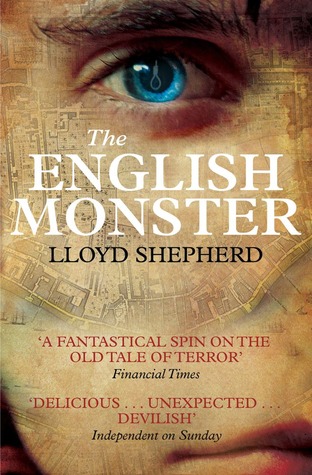
The English Monster by Lloyd Shepherd

Well, this was one of the most unusual books I’ve read for a long time! It got off to a great start and after reading the first few chapters (in which we witness six pirates being hanged at London’s Execution Dock, go on a midnight journey through the dark streets of 19th century Wapping, and meet a sea captain at an inn in Plymouth) I was beginning to feel very excited about this book. It seemed destined to become one of my favourites of the year, although by the time I finished it, I did feel a little bit less enthusiastic about it.

The novel consists of two alternating stories set in different time periods, but while they may appear to be entirely separate at first, there is in fact a link between the two of them. The way in which they are linked is not immediately obvious so I’ll leave you to discover the connection for yourself.

The first story, set in the Regency period, is based on a true crime which involved the killing of members of two different families in the Wapping area of London in December 1811. These deaths became known as the Ratcliffe Highway Murders. There was no official police force in England at that time and the way the case was handled was amateurish and incompetent. The English Monster introduces us to John Harriott, the magistrate of the Thames River Police Office, and Waterman-Constable Charles Horton as they attempt to investigate the murders.

The second thread of the novel, beginning in October 1564, is a good old fashioned swashbuckling adventure story following Billy Ablass, a young man who decides to go to sea to make his fortune and finds himself aboard a ship owned by Queen Elizabeth I, ready to embark on England’s first official slaving voyage. Or at least, I thought I was reading a good old fashioned adventure story – until I came to a very surprising and dramatic twist that made it obvious this was definitely not going to be a conventional historical fiction novel or a conventional murder mystery either. And of course I’m not going to tell you what the twist is – you’ll have to read the book yourself to find out.

When a novel has multiple timelines, I usually find I’m drawn to one period more than the other but with this book I think I can honestly say I enjoyed them both equally. The Ratcliffe Highway story was fascinating, especially the insights we are given into how useless and inadequate the investigation was. I found Charles Horton a very interesting character: a ‘detective’ working in an era when modern methods of detection were almost non-existent. I believe Horton and the magistrate John Harriott are going to reappear in Lloyd Shepherd’s next book and I’m looking forward to meeting them again.

The Billy Ablass sections of the novel were very compelling too, although some of the scenes that dealt with the cruelty and brutality of the slave trade were uncomfortable to read, as you might expect. Unfortunately though, slavery is part of our history and we can’t ignore the fact that it happened. A lot of real historical figures make an appearance throughout these chapters, such as Francis Drake (who is usually thought of as an Elizabethan hero but was also involved in the slave trade), the Welsh pirate Henry Morgan, the notoriously violent buccaneer L’Ollonais, and John Hawkyns, captain of England’s first slave ship. At the end of the book there’s an interesting note from the author in which, among other things, he explains how much of his portrayal of these characters is based on fact and how much is purely fiction.

As a first novel, I thought The English Monster was very impressive. I’m not sure I wouldn’t have preferred the straightforward historical fiction novel the book had initially seemed to be and that’s why some of my enthusiasm faded slightly as I got further into the story, but there’s no doubt Lloyd Shepherd has come up with something very different and very imaginative here. I’m already looking forward to the sequel, The Poisoned Island.

Thanks to Simon & Schuster for sending me a review copy of this book

Two from S.J. Bolton: Now You See Me and Dead Scared

I don’t read a lot of contemporary crime fiction, but one author whose work I’ve been enjoying recently is S.J. Bolton. Last year I read Sacrifice and Awakening and loved both of them. But while those two books had atmospheric settings and a gothic feel (both things which appeal to me in a book) Now You See Me sounded like a more conventional crime novel and I wasn’t sure how I would feel about it. I had been putting off reading it for a while but finally picked it up a couple of weeks ago to read in preparation for reading the sequel, Dead Scared. I’ve decided to combine my thoughts on Now You See Me and Dead Scared into one post as I read them so close together.

Now You See Me introduces us to DC Lacey Flint, a young police detective based in London. After interviewing a witness one evening, Lacey returns to her car to find a dying woman slumped across it. The woman has been stabbed but there’s no sign of her attacker. As more murders take place across the city it starts to appear that they are the work of a serial killer copying the crimes of Jack the Ripper – who happens to be Lacey’s favourite historical figure. Lacey uses her knowledge of the Ripper to guess the killer’s next moves, but it soon becomes obvious that there’s a connection between the murders and Lacey herself, and she’s forced to confront some secrets from her past that she would prefer to keep hidden.

I needn’t have worried that I wouldn’t like this book because I enjoyed it almost as much as the others. What I loved most about Now You See Me was the character of Lacey Flint. As the story’s narrator we’re relying on her to give us all the facts but we quickly discover that there are a lot of things she’s not telling us. I liked Lacey but she’s very flawed and secretive, and the truth about her past is only revealed very slowly as the story progresses. Towards the end of the book, the plot takes a lot of unexpected twists and turns and I loved the fact that S.J. Bolton managed to surprise me after I thought I’d figured everything out!

In Dead Scared we join Lacey again as she goes undercover at Cambridge University to investigate an unusually high number of suicides among the students, most of them attractive young women. Many of these students had reported having problems sleeping and waking from nightmares feeling that someone had been in their room. Posing as a depressed, vulnerable student, Lacey tries to find out what’s going on, but could she be putting her own life at risk?

The only person at Cambridge who knows Lacey’s true identity is Evi Oliver, a psychiatrist with an interesting past of her own. Although most of the book is again narrated by Lacey, there are also some chapters written in the third person from Evi’s perspective. Apparently Evi first appeared in Blood Harvest, the only book by Bolton that I haven’t read yet, and I felt there were a lot of things I didn’t understand about her background – I will have to read Blood Harvest soon!

Now that we’ve had the chance to get to know Lacey better she’s much more open with us and I felt her character had developed a lot since the first book. It would probably be best to read Now You See Me first as it will help you understand Lacey and the way she interacts with the other characters, but this book does stand alone quite well so if you do find yourself reading this one first it shouldn’t spoil things too much.

Both novels also explore Lacey’s relationship with one of her male colleagues, DI Mark Joesbury. It’s obvious almost from their first scene together that they have feelings for each other but neither wants to admit it to the other. There’s a real chemistry between the two of them and this adds another interesting angle to the story.

Like S.J. Bolton’s other novels, Now You See Me and Dead Scared are quick and exciting reads due to the combination of fast-paced plot, short chapters and cliffhanger chapter endings. Bolton is great at creating a dark, menacing atmosphere and building the tension as her characters find themselves becoming increasingly isolated and in danger. These books are not for the faint hearted as the descriptions of the murders and suicides are quite graphic, but if you enjoy reading this type of crime novel I can recommend either or both of these.