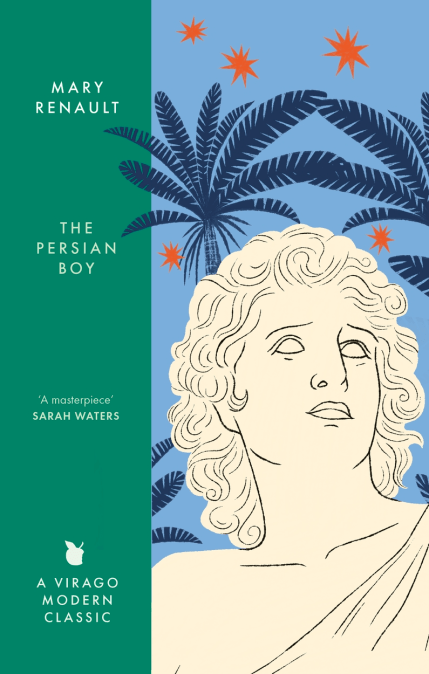
The Persian Boy by Mary Renault

First published in 1972, this is the second book in Mary Renault’s Alexander the Great trilogy, following Fire from Heaven, which I read last year. It was also the book chosen for me to read in the latest Classics Club Spin (the deadline was earlier this month, but I find that Mary Renault’s novels need a lot of concentration and shouldn’t be rushed, so I took more time to finish it).

Fire from Heaven covered Alexander’s childhood and early adult life, up to the death of his father, Philip II of Macedon, and his own accession to the throne; The Persian Boy takes us through the final seven years of his life and has a slightly different style and focus. Unlike the previous book, which was written in the third person, this one is narrated entirely by Bagoas, Alexander’s servant, friend and lover.

We first meet Bagoas as a young boy, the son of a Persian nobleman who is betrayed and killed by his enemies. Bagoas himself is captured, castrated and sold into slavery, eventually finding himself at the court of King Darius III. Having become a favourite of the king, his life is thrown into uncertainty again when Darius is defeated by the Macedonian army and Bagoas is presented to Darius’ conqueror, Alexander, as a gift. At first he is disgusted by what he sees as the barbaric ways of the Macedonians, but over time he becomes a trusted member of Alexander’s inner circle, with a close friendship and romantic relationship beginning to form between the two.

With the book being written from Bagoas’ perspective, the story has a more intimate feel than Fire from Heaven. As Bagoas is a courtier, not a soldier or a fighter, battles are seen from a distance; although he travels with Alexander and his men, Bagoas does not accompany them on the battlefield but waits in camp for them to return, sharing with us the outcome and some insights into the impact, both mental and physical, on the people involved in the battle. So although Alexander’s success as a great military leader is certainly not ignored, the focus here is more on Alexander as a human being. Through Bagoas’ eyes we see a more tender, vulnerable side of Alexander, a man who often feels lonely and isolated, so relies on Bagoas to provide love, warmth and friendship.

I do feel that because of the choice to tell this part of Alexander’s story from the perspective of someone who loved him, we get quite a one-sided view of him. It’s a very sympathetic, heroic portrayal and we don’t hear much of how his enemies viewed him or what his wife Roxane thought or felt – she is pushed completely to the sidelines of Bagoas’ account (understandably, as she tries to poison him, and he wants no more to do with her after that). Hephaistion, Alexander’s lifelong companion, also has a relatively small part in the novel as he and Bagoas mostly avoid each other, having an uneasy relationship as rivals for Alexander’s affection. Renault frequently compares Alexander and Hephaistion to Achilles and Patroclus, something they apparently publicly identified themselves with, but I felt that the emotional impact of Hephaistion’s death later in the novel was lost because of seeing so little of him, especially compared to the first book where he had a much bigger role.

One aspect of the book I found particularly interesting was seeing how both Alexander and Bagoas adapt to the differences between Greek and Persian culture. Alexander wishes to unite the Greek people with the Persian people he has conquered and as time goes by, Bagoas observes him wearing Persian dress and trying to introduce Persian customs such as prostration (which meets with strong opposition from his Macedonian men).

Although there’s obviously a limit to how much we can truly know about the world of the 4th century BC, Alexander’s life has been well documented and Renault discusses in her author’s note the sources she has used and decisions she has made. Bagoas himself only appears a few times in historical sources, but Renault is such a gifted writer she makes everything he says and does seem plausible. I’m looking forward to reading Funeral Games, the final part of the trilogy, which deals with Alexander’s death and its aftermath.

Book 10/20 of 20 Books of Summer

This is also book 6/50 from my third Classics Club list.

Fire from Heaven by Mary Renault

This is the first in Mary Renault’s trilogy of novels about the life of Alexander the Great. It’s been waiting patiently on my shelf for years, since I finished her two books on Theseus, The King Must Die and The Bull from the Sea, and I picked it up last month as it would count towards both the 20 Books of Summer challenge and my Classics Club list.

First published in 1969, Fire from Heaven tells, in fictional form, the story of Alexander’s life from early childhood up to the moment he comes to power following the death of his father, Philip II of Macedon. His complex relationship with Philip – and also with his mother, Olympias – forms an important part of the novel as both parents are influential in shaping the character of the young Alexander. Philip is portrayed as a brutal, harsh, arrogant man, who can be very unkind to Alexander, but there are also moments when they bond and discover things they have in common. Their relationship is further strained by Olympias’ insinuations that Philip is not Alexander’s biological father, as well as Philip’s various infidelities and insistence on taking additional wives.

Alexander is devoted to Olympias from an early age and is disturbed by his parents’ tempestuous marriage. Like Alexander, I initially found her sympathetic, but as the novel progresses she is shown to have both positive and negative qualities, being passionate, vengeful and manipulative, as well as involving herself in religious rituals, particularly the worship of Dionysus. Alexander finds solace from his difficult relationships with his parents in his very close friendship with Hephaistion, another important character in the novel. Renault suggests that Alexander and Hephaistion are lovers, drawing comparisons with Achilles and Patroclus, although it seems that historians are divided on this.

Away from his personal relationships, a lot of time is also spent on exploring the education and experiences that made Alexander the great military leader he would later become: the tuition he receives from Aristotle; the first time he kills a man; his taming of the horse Bucephalus; and his participation in some of his father’s military campaigns. Because this book only covers the first half of Alexander’s life, Renault is able to go into a lot of depth and detail. I’m looking forward to seeing how his character continues to develop in the second book, The Persian Boy, which covers the remainder of his life.

This is not a particularly easy book to read; it needs a lot of concentration and I read it slowly over the course of a few weeks so I didn’t miss anything. It’s obviously very well written and thoroughly researched, which I knew it would be, having read other Renault books, and like many older historical novels it’s also very immersive, with no inappropriately modern language or attitudes, which can sometimes be a problem with newer books. Purely from an entertainment perspective, I didn’t find this as enjoyable to read as the Theseus novels, but I did get a lot out of it and am pleased to have added to my knowledge of a man and a period of history I previously hadn’t read much about.

Book 16/20 for 20 Books of Summer 2025.

This is also book 48/50 from my second Classics Club list.

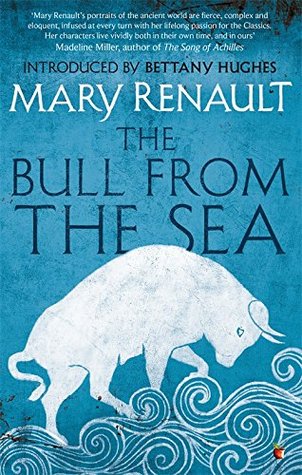
The Bull from the Sea by Mary Renault

Published in 1962, this is the second of Mary Renault’s two novels telling the story of Theseus. It’s been a few years since I read the first book, The King Must Die, and I was worried that I’d waited too long to read this one, but actually, although it does pick up where the first book left off, it wasn’t necessary to remember every little detail because The Bull from the Sea also works as a complete novel in its own right.

It begins with Theseus and his fellow bull-dancers returning to Athens from Crete, having defeated the Minotaur. Mistakenly believing Theseus to be dead, his father Aegeus has committed suicide, leaving Theseus to become the new king of Athens in his place. After his eventful time in Crete, Theseus finds it difficult to settle back into daily life, even with his new duties as king to occupy him. His restlessness soon leads him into a series of adventures with his friend Pirithoos, the pirate king of the Lapiths, and one of these journeys ends in a meeting with Hippolyta, the Amazon queen.

Theseus falls in love with Hippolyta and after challenging her to single combat and winning, he takes her back with him to Athens. A close and loving relationship develops between them, but Hippolyta can never become his wife – his people would not accept her as their queen, but in any case he is already promised in marriage to Phaedra, a princess of Crete. The fates of Hippolyta, Phaedra and the sons they bear Theseus are played out over the remainder of the novel.

Unlike The King Must Die which focused on only a few years in Theseus’ life, The Bull from the Sea covers a much longer period and as it’s not a particularly thick book, this means that several of the episodes in Theseus’ story are not explored in as much detail. His role in taming the bull of Marathon, for example, is dealt with relatively quickly without going into a lot of depth. Much more time is spent on his relationships with Hippolyta and Phaedra and their sons Hippolytos and Akamas, which was good because this was the part of the novel I found the most interesting. Having recently read For the Immortal by Emily Hauser which tells Hippolyta’s story from a feminine perspective, Mary Renault’s portrayal of her relationship with Theseus couldn’t be more different!

It’s the fact that different authors can take such different approaches to the same myths and legends that makes Ancient Greece so fascinating to read about. There is never just one version that everyone agrees on; so much is left open to interpretation. Mary Renault gives logical, realistic explanations for the various aspects of the myths rather than fantastical ones. I was intrigued by her representation of the Kentaurs (centaurs), for example, not as the half human/half horse creatures we would normally think of, but as a sort of ancient and primitive community of people who live in the wild and form close bonds with their horses.

It seems that most people prefer The King Must Die to this book, but I think I actually enjoyed this one more. This is probably because when I read the first novel in 2013 I had previously read very little about Ancient Greece and didn’t find the subject particularly appealing. Since then I’ve been dipping into the period more and more often and becoming more familiar with some of the myths, which could be why I found this book easier to get into and follow. I will be reading more by Mary Renault and am looking forward to starting her Alexander trilogy soon. I already have the first two books, Fire From Heaven and The Persian Boy, ready and waiting on my shelf.

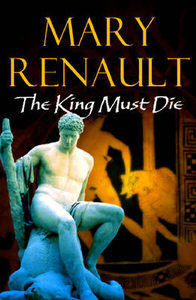
The King Must Die by Mary Renault

The King Must Die After my post on The Odyssey last Friday, I’m staying with an Ancient Greece theme again this week – but in the form of historical fiction this time.

Beginning with his childhood in Troizen, The King Must Die tells the story of Theseus, a story which I’m sure will already be familiar to many readers. Theseus lives with his mother but has never known the true identity of his father, believing him to be the god Poseidon. When he succeeds in raising a boulder to reveal his father’s sword, Theseus learns that he is actually the son of Aigeus, the King of Athens, and sets off for Athens to find him. After an eventful journey during which Theseus becomes King of Eleusis, he arrives in Athens and meets his father at last. But when King Minos of Crete demands that fourteen young people are sent to him to train as bull-dancers, Theseus makes the decision to become one of the fourteen…and finds himself facing the Minotaur in the Labyrinth of the Palace of Knossos.

Mary Renault is an author I’ve been wanting to read for a long time and I became even more interested when I noticed that on the back covers of my Vintage editions of the Lymond Chronicles by Dorothy Dunnett, it says that Dunnett’s writing ‘inspires comparisons with Mary Renault and Patrick O’Brian’. I’ve now read some of Patrick O’Brian’s books and enjoyed them (though not as much as Dunnett) so it seemed a good idea to try Mary Renault too. However, I’ve been hesitant because, as I explained in my Odyssey post, mythology and Ancient Greece are not subjects that really appeal to me. It was finally making it to the end of The Odyssey a few weeks ago that gave me the motivation to pick up The King Must Die at last.

I was curious to see how this book could be described as historical fiction, as a story with a plot involving Poseidon and the Minotaur sounded more like mythology to me. Having read the novel, I now understand that The King Must Die is not simply a re-telling of the Theseus myth but a more realistic recreation of his life, portraying Theseus as a real human being rather than a character from Greek mythology. Most of the essential elements of the myth are here, but they are cleverly incorporated into the historical setting and given logical, plausible explanations.

My favourite part of the book was the section describing Theseus’s adventures in Knossos as a bull-dancer, learning new skills and techniques, and bonding with the other members of his team. I also enjoyed learning about the different customs and rituals of the various cultures and communities Theseus visits on his journey, including the Hellenes, the Minyans and the Cretans. There’s a fascinating author’s note at the end of the book in which Mary Renault explains how she was able to link parts of the Theseus legend to historical fact.

While I did enjoy this book, I do feel disappointed that I didn’t love it as much as I had hoped to. There was nothing specific that I disliked about the book or that I could say didn’t work for me; I certainly couldn’t fault the quality of the writing or the amount of research that must have gone into recreating Theseus’s world. It’s probably just that, as I’ve mentioned, I’m not particularly drawn to this subject or setting. I do still want to read the second half of Theseus’s story in the sequel, The Bull from the Sea!