A Caribbean Mystery by Agatha Christie

This month for the Read Christie 2025 challenge, the theme is ‘amateurs’ and although I’ve read the suggested title, Crooked House, quite recently, there were some alternatives that I haven’t already read – including this one, A Caribbean Mystery. Published in 1964, it’s one of the later entries in the Miss Marple series and not one that had really appealed to me; Miss Marple belongs in St Mary Mead and it seemed incongruous to put her in a Caribbean setting! Now that I’ve read it, though, I can say that although it’s maybe not one of my absolute favourite Christie novels, I did really enjoy it.

You may be wondering why Miss Marple is in the Caribbean. Well, it seems she has been ill and her nephew Raymond has paid for her to spend some time recuperating in the sun on the island of St Honoré. Miss Marple is grateful, of course, and is enjoying the warmth and the scenery, but she’s also beginning to feel bored – every day is the same as the one before and nothing ever really seems to happen! This all changes when she falls into conversation with Major Palgrave, an elderly man staying at her hotel, who tells her a story about a man who got away with murder several times. He asks her if she wants to see a picture of a murderer but as he begins to dig out the snapshot, he suddenly stops abruptly and changes the subject as other people approach.

The next day, Major Palgrave is found dead in his room. High blood pressure is blamed, but Miss Marple is convinced he’s been murdered and that there’s some connection with the photo he was about to show her. To add to her suspicions, the photo now seems to have disappeared from the Major’s belongings. It seems likely that the murderer is one of the other guests, but which one? The most likely suspects seem to be the Dysons, Greg and Lucky, and their friends Edward and Evelyn Hillingdon, two nature loving couples who often travel together and who had been walking up the beach towards Major Palgrave as he told Miss Marple his story. But there are others who can’t be ruled out, including the Kendals, who own the hotel; Canon Prescott and his sister; and Mr Rafiel, an old man confined to a wheelchair, visiting the island with his masseur and his secretary.

I found this a very enjoyable mystery; it’s not one of Christie’s more complex plots but there’s some clever misdirection to send the reader along the wrong track. The first murder takes place early in the novel and the story continues to unfold at a steady pace after that, so it held my interest from beginning to end. Miss Marple also plays a big role, in contrast to some of the other books where we see very little of her. This time, she’s present for the entire novel, interacting with the suspects and victims and sharing her thoughts and deductions with the people she believes she can trust. As usual, people underestimate Miss Marple, dismissing her as a ‘fluffy old lady’, but in time some of them come to see that there’s far more to her than meets the eye!

Some of the characters in this book reappear or are referred to again in the later novel Nemesis, published in 1971. I read that one a few years ago, so it was nice to see how those characters were originally introduced and how Miss Marple gained her nickname ‘Nemesis’. I should probably have read the two books in the correct order as it also meant that I could quickly discount those two recurring characters as serious suspects, but it didn’t really matter. Now I’m looking forward to reading Christie’s memoir Come, Tell Me How You Live for Read Christie in July!

Book 4/20 for 20 Books of Summer 2025.


The Thirteen Problems by Agatha Christie

This month for the Read Christie challenge we’re reading books with authors as characters. The recommended book, The Thirteen Problems, is one I hadn’t read before so I thought this would be a good opportunity to pick it up. First published in 1932, it’s a collection of short stories featuring Miss Marple and her nephew, Raymond West, who is a writer. It has also been published in the US as The Tuesday Club Murders, so you may know it by that title.

There are thirteen stories in the book. In the first, a group of six friends gather at Miss Marple’s home in St Mary Mead and during the evening the conversation turns to mysteries. It seems that each of them has experienced or been involved in some kind of mystery and it’s suggested that over the next few weeks they should take turns telling their story and seeing if the rest of the group can solve it. Five of the friends have professions which they claim are ideally suited for detective work – an artist, a writer, a clergyman, a lawyer and a retired policeman – so they all agree to the plan and the Tuesday Night Club is born! The sixth member of the group, Miss Marple, is just there to make up the numbers; how could an old lady who has barely left her quiet little village possibly know anything about solving mysteries?

After all six have told their stories, several members of the group – with the addition of a doctor and a young actress – meet again at the home of Colonel and Mrs Bantry, where another set of stories are narrated. You won’t be surprised to hear that it’s Miss Marple who provides the correct solution for all thirteen of them, after everyone else has tried and failed!

I tend not to be a big fan of short stories, but I do usually enjoy Agatha Christie’s. This collection isn’t a favourite and I think I know why: it’s because the stories all involve mysteries that have already happened or have already been solved, so we don’t get to see Miss Marple or the other characters actively investigating them at the time. It’s a similar concept to Baroness Orczy’s Old Man in the Corner stories where her detective solves crimes while sitting in the corner of a London tearoom. Still, the stories are all interesting and I even managed to solve one or two of them myself!

Some of the stories have a supernatural feel – although the solutions have more logical explanations. My favourite was Colonel Bantry’s story, The Blue Geranium, in which a woman is visited by a fortune-teller who warns her to beware of a blue primrose, a blue hollyhock and finally, a blue geranium, which means death. When the flowers on her bedroom wallpaper begin to turn blue one by one, the woman begins to fear for her life. Another one I enjoyed was The Blood-Stained Pavement, narrated by the artist Joyce, who was visiting Cornwall to paint some picturesque village scenes. She’s sitting outside working on a painting when she notices drops of blood on the ground that weren’t there just a few minutes earlier. These bloodstains turn out to be important when a woman is reported missing two days later.

Although the stories in this book all stand alone, they are not completely separate as there’s also an overarching narrative, with the group of friends discussing the story that’s just been told and deciding whose turn it is to speak next. By the end of the book, Miss Marple has impressed everyone with her detective skills and has shown them that sometimes all that’s needed to solve a crime is a knowledge of human nature. Just as she does in the full-length novels, she draws on parallels with life in St Mary Mead and people she knows who remind her of the suspects or victims in the stories.

I did enjoy The Thirteen Problems, then, and found the stories just the right length. It’s always a pleasure to spend some time with Miss Marple!

The Adventure of the Christmas Pudding by Agatha Christie

The December prompt for Read Christie 2022 is ‘a story containing precious jewels’ and the book chosen for the group read is Hercule Poirot’s Christmas. I read that one a few years ago, so decided to try The Adventure of the Christmas Pudding instead. This is a collection of six short stories and although only the first one contains precious jewels and has a festive theme, I thoroughly enjoyed reading all six of them!

Agatha Christie herself selected the stories for this collection and the first five in the book are Poirot mysteries. In the title story, The Adventure of the Christmas Pudding, Poirot joins the Lacey family at their country house, supposedly to experience a ‘typical English Christmas’. However, unknown to the family, he has another motive for attending their Christmas celebrations – he is hoping to track down a precious ruby stolen from a foreign prince. Although I felt that the title gave away part of the mystery – it’s obvious that the pudding is going to have some significance – there are still some twists before the full solution becomes clear. And I loved the Lacey children who decide to present Poirot with a murder as a special Christmas treat!

The Adventure of the Christmas Pudding was apparently inspired by Christie’s own memories of spending Christmas at Abney Hall, her sister’s home in Cheshire (presumably without the stolen jewels and murders). The other four Poirot stories in this collection are not set at Christmas, but are equally enjoyable to read. The Mystery of the Spanish Chest, in which a dead body is found in a chest after a party, is excellent. I had no idea who the culprit was or how the crime was carried out and I loved watching the plot unfold. The Under Dog, where Poirot investigates the death of a man who has been hit on the head with a club, is another good one. It’s quite complex and involved and I think it could easily have been developed into a full length novel.

The next two stories are quite unusual. In Four and Twenty Blackbirds, a man who usually dines in the same restaurant every Tuesday and Thursday without fail suddenly turns up on a Monday and asks for food he has never ordered before. Poirot is intrigued, particularly when he hears three weeks later that the man has died after an accidental fall downstairs. I found part of the solution easy to guess, but again there’s more to this story than it would seem at first! Then, in The Dream, Poirot is summoned by an elderly millionaire who is having a recurring dream in which he shoots himself with a revolver. When the old man does actually die a few days later in exactly the manner he has described, Poirot is called back to investigate. I loved this one – it’s very cleverly done!

After all of these Poirot mysteries, it was nice to see Miss Marple make an appearance in the final one, Greenshaw’s Folly. In this story, the elderly Miss Greenshaw, the current owner of the house known as Greenshaw’s Folly, is murdered in the garden just after making a new will. Miss Marple is brought into the mystery by her nephew Raymond West, whose niece has been working at the house, and through her usual methods – a knowledge of human nature and trying to decide who the various suspects remind her of – she proceeds to solve the mystery.

Overall, this is a great collection and I hope I’ve managed to give you a taste of each story without spoiling them too much. I’m looking forward to taking part in Read Christie 2023 next year!

4.50 from Paddington by Agatha Christie

This month’s theme for Read Christie 2022 is ‘a story featuring train travel’. I had already read most of the possibilities – The Mystery of the Blue Train, Murder on the Orient Express and The ABC Murders – but hadn’t yet read the Miss Marple novel 4.50 from Paddington, so that was my choice for this month.

The ‘train travel’ element of the story appears in the very first chapter, with the elderly Elspeth McGillicuddy taking a train to the village of St Mary Mead to visit her friend, Miss Jane Marple. Mrs McGillicuddy happens to glance out of the window just as her train passes another train running parallel in the same direction. At that moment, a blind flies open in the window of the other train and she is horrified to witness a man standing with his back to her strangling a woman. She reports the incident to the ticket collector and the police are informed, but when no dead body is found on the train Mrs McGillicuddy is dismissed as an old woman with an overactive imagination. Miss Marple, however, knows her friend is telling the truth and is determined not to let the matter drop.

Convinced that the body may have been thrown from the train as it passed the grounds of Rutherford Hall, Miss Marple enlists the help of Lucy Eyelesbarrow, a young woman she knows who has established a reputation for herself as a professional and efficient cook and housekeeper. Lucy’s skills mean she is very much in demand and never short of work, but Miss Marple persuades her to take a position at Rutherford Hall for a few weeks so that she can search for the body while she’s there. Settling into her new job, Lucy begins to get to know the residents of Rutherford Hall – the family patriarch Luther Crackenthorpe, his sons, daughter, in-laws and grandchildren – and begins to wonder whether their connection to the murder on the train really was a coincidence after all.

I found this a particularly enjoyable Miss Marple novel – probably in my top two or three. It seems that it has had some criticism due to the lack of clues and logical deductions and I do understand that complaint because we never find out exactly what leads Miss Marple to identify the correct suspect. However, I didn’t have a problem with this. The solution does make sense, even if we don’t know how she arrived at it, and the culprit was actually the person I suspected myself (again, not based on any real evidence – just a hunch!).

Although Miss Marple is the one who solves the mystery, we don’t really see very much of her in this book. Unable to infiltrate the Crackenthorpe household herself, she sends Lucy Eyelesbarrow in her place, which means a lot of the story is written from Lucy’s perspective. Luckily, Lucy is a great character – independent, intelligent and courageous. Several of the male Crackenthorpes are drawn to her and there’s a hint at the end of the book that she’s going to marry one of them. Which one she chooses is left for the reader to decide – although I’ve since discovered that Christie reveals Lucy’s choice in her Secret Notebooks, published in 2009.

There’s only one month left in this year’s Read Christie challenge and the December theme will be ‘a story containing precious jewels’. However, plans for Read Christie 2023 have already been announced and you can register your interest here: https://linktr.ee/OfficialAgathaChristie

At Bertram’s Hotel by Agatha Christie

July’s theme for Read Christie 2022 is ‘a story which takes place on holiday’; I didn’t take part in last month’s read as I’d already read the suggested title (Murder in Mesopotamia), but decided to join in this month with At Bertram’s Hotel.

This late Christie novel, first published in 1965, begins with Miss Marple arriving for a two-week stay at Bertram’s Hotel in London courtesy of her nephew who thought she might like to get away from the village of St Mary Mead for a while. The hotel is one that Miss Marple remembers fondly from her youth and, having heard that it has changed very little over the years, she is looking forward to staying there again. However, it turns out not to be quite the relaxing break she expected; first an elderly hotel guest, Canon Pennyfather, goes missing, then Miss Marple’s attention is drawn to the unusual behaviour of two more guests – the notorious Lady Sedgwick and her estranged teenage daughter, Elvira. It seems that something is not quite right about Bertram’s Hotel, but can Miss Marple help the police to discover exactly what is going on?

I enjoyed this book, although I don’t think it’s one of Christie’s best. There’s no central mystery to be solved – there’s the murder of a minor character which takes place late in the novel, but otherwise we hear about crimes that have happened ‘off the page’ rather than witnessing them ourselves. The sequence of events surrounding the disappearance of the absentminded Canon Pennyfather was fascinating, but again more of a subplot than the main focus of the story. What we do get is a growing sense of unease and a feeling that something is wrong without knowing precisely what it is.

I loved the portrayal of Bertram’s Hotel, which at first appears to be a quaint, old-fashioned establishment that has deliberately tried to preserve its Edwardian charm with the sort of atmosphere, furnishings and food that will appeal to a certain age and class of guest. As the story progresses, Miss Marple’s pleasure at finding the hotel just as she remembered it turns gradually to disappointment as she discovers that you can never really go back and that things don’t stay the same forever, no matter how much you want them to.

Sadly, Miss Marple herself doesn’t have a very big role to play in this novel. Chief Inspector Davy – known as ‘Father’ because he’s close to retirement age – is the person responsible for carrying out the investigations and we see more of him than we do of Miss Marple. However, as usual, she is the one who provides the vital clues and observations that enable the crimes to be solved and the culprits to be caught.

August’s Read Christie theme is a book ‘set in a hot climate’, if anyone wants to join in!

This is book 8/20 from my 20 Books of Summer list.

They Do It with Mirrors by Agatha Christie

This month’s theme for the Read Christie 2021 challenge is ‘a story set after WWII’. There were plenty of options for this one – any book published after 1945 would count – and I eventually decided on They Do It with Mirrors, a 1952 Miss Marple novel.

The story begins with Miss Marple meeting an old friend, Ruth, who tells her that she’s worried about her sister, Carrie Louise, although she doesn’t give any specific reasons for her concern. Carrie Louise, like Ruth, has had several husbands and her latest, Lewis Serrocold, has established a rehabilitation centre for juvenile criminals at their home, Stonygates. Miss Marple agrees to go and visit Stonygates to see if she can find out what’s going on and, on her arrival, she finds a large number of people assembled at the house, including Carrie Louise’s daughter, granddaughter and stepson, as well as several other family members and servants.

As Miss Marple gets to know the various members of the household, she also begins to feel that something is not quite right – and she is proved to be correct when Christian Gulbrandsen, the son of Carrie Louise’s first husband, is found shot dead in his room. At the same time, Lewis Serrocold is shot at in his study by one of the ‘juvenile delinquents’, a young man who claims to be Winston Churchill’s son. Lewis is unharmed, but as one of the other characters remarks, “you don’t expect murder and attempted murder in the same house on the same night!” The police, led by Inspector Curry, soon arrive on the scene and begin their investigations, but it’s Miss Marple, of course, who eventually solves the mystery.

I don’t think this is one of Christie’s best, but I did still enjoy it – and unlike my last Christie novel, Death on the Nile, where I guessed the solution almost immediately, I didn’t manage to solve this one before the culprit was revealed. The title of the book refers to the fact that things and people are not always what they seem and sometimes, like a magician, ‘they do it with mirrors’ to cause confusion and misdirection. Well, I certainly allowed myself to be misdirected, but I do think it would have been possible to work it out if I’d been paying more attention.

This book has an interesting setting which gives Christie a chance to explore Lewis Serrocold’s work with the young offenders and the way in which these young men were viewed by 1950s society. This doesn’t really play a big part in the story and it could have worked just as well as a conventional country house mystery without this element, but it does provide some extra interest.

December’s theme for Read Christie 2021 is ‘a story set during bad weather’. The suggested title is The Sittaford Mystery, which is one I haven’t read yet.

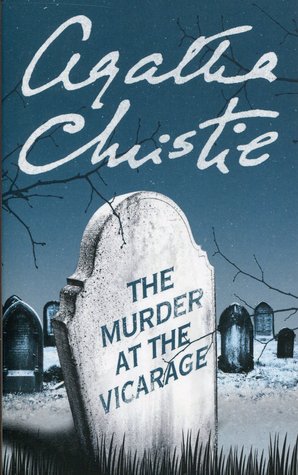
The Murder at the Vicarage by Agatha Christie

This month’s theme for Read Christie 2021 is ‘a story starring a vicar’ and the chosen title is an obvious one – The Murder at the Vicarage, which was first published in 1930 and is the first book in the Miss Marple series. I have read most of the later Marple novels, but never this one and I thought it would be interesting to go back to the beginning and read the book that introduced Miss Marple to the world of crime fiction.

The novel is set, like many of the other Marple novels, in the village of St Mary Mead, a place where everyone knows everyone else and nobody’s behaviour goes unnoticed! When Colonel Protheroe is found dead in the study at the vicarage, shot while waiting for the vicar to return home, Miss Marple and the other villagers immediately begin to gossip and to speculate on who the murderer could be. At first suspicion falls upon Anne Protheroe, the Colonel’s unhappy wife, and Lawrence Redding, the man with whom she has been having an affair. However, Colonel Protheroe was not a popular man and there is no shortage of other suspects – Miss Marple herself insists that she can think of at least seven.

The story is narrated by the vicar, Leonard Clement, who is drawn into the mystery not only due to the murder victim being found in his study, but also because the people of St Mary Mead see him as a trusted friend in whom they can confide and share pieces of information they prefer not to give to the police. The vicar’s narrative is both intelligent and amusing, as he reflects on his household, his domestic arrangements and his relationship with his younger wife, Griselda, as well as carrying out his own investigations into the murder case.

Someone else who is investigating the murder for herself is Miss Marple – and of course she finds her way to the solution before the police do, using her knowledge of human nature and her powers of observation. Miss Marple as she appears in this first novel is slightly different from the woman we meet in the later books in the series and is not particularly well liked by her neighbours, who see her as someone who goes around poking her nose into everyone else’s business. Unlike in some of the other books, where she seems to have been added to the story almost as an afterthought and the plot would have worked just as well without her, in this one she is there from beginning to end – often just in the background, but everything she says and does and every suggestion she makes turns out to be vital to the solving of the mystery!

Although I did enjoy this book, particularly as I found it such a difficult one to solve – I think I suspected almost everyone and allowed myself to get distracted by all the red herrings Christie throws into the plot – it took me a while to get into it. There were so many characters to keep track of and apart from the vicar and his wife and Miss Marple I didn’t really engage with any of them. I found the second half of the book much more compelling, though, as the plot became more and more complex and clever. I have read three Miss Marple mysteries in a row now for the Read Christie challenge, so I’m in the mood for something different next month. The August theme is ‘a story set by the seaside’ and I’m thinking about the Poirot novel Evil Under the Sun.