The Golem and the Djinni by Helene Wecker

The Golem and the Djinni Meet Chava. She’s a golem, a woman made of clay, created by a Rabbi in Poland and brought to life on a ship sailing to America. When her master dies during the voyage, the Golem, only a few days old, finds herself alone in a strange and unfamiliar land.

Ahmad is a djinni, a magical being made of flame, born in the Syrian desert in the seventh century and trapped inside a copper flask by a wizard. Now, many centuries later, the Djinni is released from the flask by a New York tinsmith, but discovers that he is bound to human form by an iron band around his wrist.

As the Golem and the Djinni try to adapt to their new surroundings and struggle to find a place for themselves in New York society, the two are eventually drawn together and their separate storylines begin to merge together in some unexpected ways.

The Golem and the Djinni have many things in common, the most obvious being that they are two non-human creatures trying to survive in the human world. They share a vulnerability and a childlike wonder at the people and things around them, which is what makes them both such endearing characters. But coming from such different cultures, they soon discover that they also have very different natures. Chava, as a golem, is designed to serve a master and satisfy the desires of others, while Ahmad has been imprisoned against his wishes and is desperate to regain his independence. The question of free will is something that comes up in their conversations often. Are the Golem and the Djinni responsible for their own actions or do their natures make them behave in a certain way? How much free will does either of them actually have? And what are the things that make a person human?

I found the relationship between the Golem and the Djinni very moving to read about and I think the reason for that was because it was not written as a typical ‘love at first sight’ romance. At first their relationship is based on curiosity and a longing to be able to discuss things with another outsider. A friendship gradually starts to form but it’s not until they find themselves threatened by a mutual enemy that the Golem and the Djinni realise how much they care about each other. I really liked the fact that the author took her time to introduce us to the characters and allowed their story to develop slowly so that the pace never felt too rushed.

Another thing I loved was the choice of setting – New York in 1899. As the Golem and the Djinni are mythical creatures they could probably have been placed into any setting and their story would still have been interesting, but choosing this specific time and place was particularly fascinating because of the insights we are given into the various immigrant communities of turn of the century New York. Through the Golem we get to know some of the city’s Jewish population and through the Djinni we meet the inhabitants of ‘Little Syria’, as well as learning about the Djinni’s previous life among the Bedouin desert tribes. There are lots of great characters in each of these communities: the old Rabbi who befriends Chava and the tinsmith who befriends Ahmad, the ice cream seller who suffers from a strange affliction that prevents him from looking people in the eye, and the beautiful young girl who receives some late night visits from the Djinni.

As a first novel, The Golem and the Djinni was a very ambitious one but everything worked perfectly. There were so many things about this book that impressed me – the beautiful writing, the clever plot, the blending of fantasy with historical fiction, and most of all, the wonderful characterisation of both Chava and Ahmad. In four months’ time when I make my list of favourite books of the year The Golem and the Djinni is one title that I’m sure will be on that list!

(Now, can anyone tell me why the spelling Djinni is used in the UK edition and Jinni in the American one?)
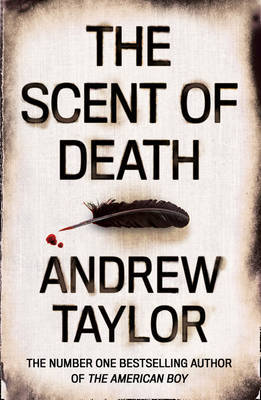
The Scent of Death by Andrew Taylor

The Scent of Death I’ve been looking forward to reading this book, having enjoyed some of Andrew Taylor’s previous novels, including The American Boy (An Unpardonable Crime in the US), so I was pleased to find that The Scent of Death was a similar type of historical mystery, though set in a different time and place.

The story begins in 1778, during the American War of Independence. Our narrator, Edward Savill, is an English clerk who has been sent to Manhattan (an area still under British rule at that time) to investigate the compensation claims of Loyalists who have been dispossessed of their property. Before Savill’s ship even arrives in the port, he sees a dead body being lifted out of the water. Soon another body is discovered – the body of Mr Pickett, a man who has connections with the Wintours, the family Savill will be staying with during his time in New York.

While Savill worries about the people he has left behind in England – his cold, distant wife and his beloved daughter – he also finds himself becoming embroiled in the lives of the Wintour family. As he gets to know Judge Wintour, his invalid wife and his beautiful daughter-in-law Arabella, whose husband is missing in action after the Battle of Saratoga, he starts to suspect they are covering up some secrets. Who killed Mr Pickett and why? Whose is the child Savill hears crying in the night? And what is the mysterious ‘box of curiosities’ he has heard so much about?

One of the things I like about Andrew Taylor’s historical novels is that he makes a real effort to use language appropriate to the time period throughout both the dialogue and the narration. I read a lot of historical fiction and there are a surprising number of authors who make no attempt to do this at all; there are very few who do it as convincingly as Taylor. He doesn’t use any jarring modern words or phrases and it all adds to the atmosphere and authenticity of the story, so that I could almost believe Edward Savill really was an 18th century English gentleman narrating his adventures to us. Remembering that this novel is set in the 1770s, we are also given a range of different opinions on slavery rather than the author just projecting 21st century views onto all of his characters, which would have been unrealistic.

As with Taylor’s other novels, you can never be sure which characters can and can’t be trusted. From Mr Townley and his clerk, Mr Noak, who nursed Savill through his seasickness on the long voyage from England, to the enigmatic Arabella Wintour herself, some of these people turn out to be friends and others enemies. I didn’t actually like any of them apart from Savill himself, but that wasn’t a problem at all – I’m sure we weren’t supposed to like them and were intended instead to get a feel for the hostility and suspicion Savill encountered everywhere he went.

The vivid, atmospheric settings are another strong point of Taylor’s novels. I don’t have much knowledge of the American Revolutionary War and Taylor does such a great job of portraying life in New York during this period: the variety of different people, including soldiers, spies, refugees and slaves, who had made the city their home; the overwhelming heat of summer and the intense cold of winter; and all the danger and intrigue of a city at war. Savill’s investigations take him into the heart of Canvas Town, an area of slums where many of the city’s criminal gangs have settled after it was destroyed by fire, and also away from New York, to the ruins of Arabella’s family plantation, Mount George.

But this was not a perfect book: while parts of it were exciting and absorbing (especially Savill’s journey into the dangerous, lawless ‘Debatable Ground’) and the short chapters made it easy to keep reading, the story moved forward very slowly and at almost 500 pages it felt too long – although admittedly it would be hard to see what could have been taken out. I did enjoy it, though, and while I did come close to solving the mystery, there were still some surprises and plot twists towards the end of the book. So, this was not my favourite Andrew Taylor book and unlike The American Boy will not be one of my books of the year, but it was definitely still worth reading and I hope it’s true that we are going to meet Edward Savill again in a future novel.

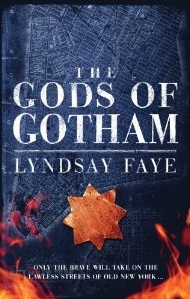
The Gods of Gotham by Lyndsay Faye

New York City, 1845: When Timothy Wilde loses everything in a fire that destroys a large part of Manhattan, his brother Valentine helps him get a job as a ‘copper star’ in New York’s newly formed police force. Due to his knowledge of ‘flash’, a slang spoken largely by criminals, Timothy is assigned to the Sixth Ward, one of the city’s most notorious areas where crime rates are high and where racial and religious tensions are increasing with the influx of Irish immigrants fleeing the potato famine.

Timothy is unenthusiastic about his new job until one night when he’s walking home from work and a ten-year-old girl runs into him, covered in someone else’s blood. Soon Tim finds himself on the trail of a child killer and discovers that he has an unexpected talent for detective work.

I must admit that when I received a copy of The Gods of Gotham from the publisher, I wasn’t sure this was going to be the type of book I would enjoy. Well, I couldn’t have been more wrong, because I loved it! I could tell from the first page that I liked the writing style and by the end of the first chapter I knew I was going to like the narrator too. But the thing I enjoyed most about The Gods of Gotham was the wonderful setting. Every time I picked up this book and started to read I felt I had left the modern world behind for a while and was actually there, walking through the streets of 19th century New York, which is the highest praise I can give to any historical fiction novel. I’ve read so many books set in Victorian London, and it made a nice change to read one set in New York during the same period.

We also meet lots of strong, interesting characters – Mercy Underhill, the reverend’s daughter and the woman Timothy loves; Bird Daly, the little Irish girl he met in the street at the start of the novel; and Silkie Marsh, who runs the brothel at the centre of the murder investigations. And at the heart of the story is the relationship between Tim and his brother Valentine. Timothy himself is easy to like but he isn’t perfect and has enough flaws to make him a believable character. Although he doesn’t always interpret things correctly, he’s intelligent, observant and compassionate. Val is a very different type of person – tough, aggressive, addicted to morphine and drinking – but by the end of the book we learn that there’s more depth to Val than there seemed to be at first.

The use of flash is something that you will probably either love or hate – personally I thought it added to the atmosphere of the book and made the dialogue feel lively and fun. I was surprised to find that I was already familiar with some of the words and it was interesting to see how many of them have now come into everyday use. But there were other words and phrases that meant nothing to me and so the glossary at the front of the book (based on George Washington Matsell’s Vocabulum, or The Rogue’s Lexicon) was very helpful, especially at first!

For me, the actual crime plot was secondary to the setting, the atmosphere and the characters but it was still good enough to keep me guessing until the truth was finally revealed. The Gods of Gotham was something different and original – I loved it and was pleased to discover that there’s going to be a sequel!

I received a review copy of this book from Headline Review.