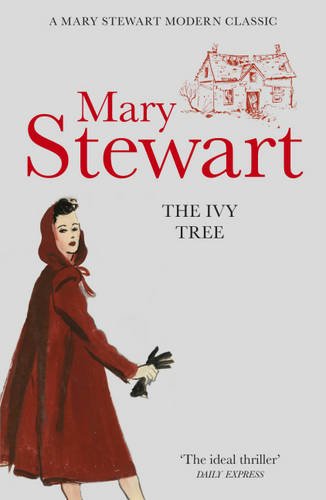
 Mary Stewart was a new discovery for me last year and since then I’ve been enjoying slowly working my way through her novels. I was looking forward to reading this one, The Ivy Tree, as I’ve seen it described as one of her best.
The Ivy Tree begins on a warm, sunny day when Mary Grey, who has recently moved from Canada to the north east of England, is walking in the countryside near Hadrian’s Wall. Suddenly she is approached by an Irishman who has mistaken her for his cousin Annabel who had disappeared eight years earlier. The man’s name is Connor Winslow (known as Con), the great-nephew of Matthew Winslow, owner of the estate of Whitescar. With Annabel believed to be dead, Matthew Winslow is intending to leave his fortune to his other granddaughter Julie – but Con thinks that he should be the rightful heir and he wants Mary Grey to help him claim the inheritance.
Although Mary explains to Con that he has made a mistake and she is not his cousin, he persuades her to impersonate Annabel as part of a scheme to enable him to inherit his great-uncle’s estate. And so Mary comes to Whitescar and, with the help of Con and his half-sister Lisa, easily manages to convince everyone that she is Annabel. But who exactly is Mary Grey and does she have reasons of her own for agreeing to go along with Con’s plans?
The Ivy Tree was published in 1961 and was written as a contemporary novel, although it now has a lovely, old-fashioned feel. I loved Mary Stewart’s descriptions of the setting, especially as I only live a few miles away from Hadrian’s Wall (the wall built by the Romans almost two thousand years ago) and I know exactly what the scenery she’s describing looks like. Her descriptive passages aren’t too long or too detailed, but include just enough information about the landscape, flowers, animals and birds to build up a vivid and realistic picture of the part of the country she’s writing about.
Mary Stewart’s novels (apart from her historical Arthurian novels) are usually described as romantic suspense. The romantic thread in this book was very weak in my opinion, but there was certainly lots of suspense. There are also one or two interesting subplots including one revolving around Julie’s boyfriend Donald, an archaeologist who is spending the summer working at a Roman fort in the area. And I should also mention the animals: there are some horses that have an important role to play in the story, especially Rowan the colt, as well as some funny scenes involving Tommy, a black and white cat.
Mary Stewart’s heroines are usually such nice, pleasant, likeable people, but the narrator of this book, Mary Grey, is an exception because she’s not so instantly likeable and her willingness to take part in Con’s schemes made me doubt and distrust her from the beginning. I didn’t really like any of the other characters either but I enjoyed being kept wondering who was ‘good’ and who was ‘bad’. As for the mystery aspect of the novel, I guessed the truth long before it was revealed but it was still interesting looking out for clues that might confirm whether I was right or not. This is one of those cleverly plotted books that would benefit from being read twice, so you can appreciate all the subtle little hints that the author has dropped into the story. I didn’t love the book enough to want to read it all again immediately but I did take the time to re-read the first chapter and noticed a few clues that had meant nothing to me the first time.
Of the four Mary Stewart novels I’ve now read, I liked this one a lot more than Rose Cottage but not as much as Touch Not the Cat or my favourite, Nine Coaches Waiting. For a better novel about mistaken identities and impersonations I would recommend Daphne du Maurier’s The Scapegoat. You could also try Brat Farrar by Josephine Tey, which I haven’t read yet, but which is referred to more than once by characters in The Ivy Tree when they’re discussing other famous cases of impersonations – yet another book to add to my list!
If you like Mary Stewart too, can you help me decide which of her books I should read next?
 She Reads Novels