The Ice Palace by Tarjei Vesaas – #NovNov25

Translated by Elizabeth Rokkan

After reading my first Tarjei Vesaas book, The Birds, in September, I couldn’t wait to read more of his work. Like The Birds, The Ice Palace has recently been reissued by Pushkin Press and as it’s a very short book I decided it would be perfect for this year’s Novellas in November (hosted by Cathy of 746 Books and Rebecca of Bookish Beck).

First published in 1963, The Ice Palace is the story of two young Norwegian girls, Siss and Unn. Siss is popular, outgoing and the leader of her group of friends at school, yet when the shy, quiet Unn arrives in the village to live with her aunt, Siss is immediately drawn to this girl who seems to be her complete opposite. Soon, Unn invites her back to her house after school and Siss accepts – but when she arrives, the evening doesn’t go quite as she expected. The two girls look at each other in a mirror, then Unn persuades Siss, without explanation, that they should both undress. Unn then confesses that she has a secret, something she’s not able to tell her aunt, but she doesn’t say what it is. Uneasy and uncomfortable, Siss quickly leaves and goes home, feeling disturbed by the experience.

The next day, Unn feels embarrassed and decides not to go to school. Instead, she visits the huge frozen waterfall known as ‘the ice palace’. The last we see of her is when she enters the icy caverns behind the frozen water – she doesn’t return to school or to her aunt’s house and no one has any idea what has happened to her. As Unn’s only friend, Siss is put under pressure to tell the adults anything she knows, but Siss is still confused by her own emotions and struggling to come to terms with the whole situation.

This is a beautifully written novel and the cold, icy imagery is hauntingly atmospheric. The chapter in which Unn discovers the ice palace – ‘an enchanted world of small pinnacles, gables, frosted domes, soft curves and confused tracery’ – is particularly vivid and eerie. The book also has a lot to say about grief, loss and loneliness, exploring the impact of Unn’s disappearance on her aunt, on the community and particularly on Siss.

I did find the book very ambiguous, with a lot left open to interpretation. For example, we are never told what the secret was that Unn was trying to share with Siss and it’s not quite clear what exactly happened between the two girls the evening before Unn disappears. It’s strongly implied, of course, that their interactions have sexual connotations, although I found that a bit unsettling as the girls are only supposed to be eleven years old. I felt it would have worked better if they had been a few years older – but on the other hand, Vesaas obviously intended this to be an uncomfortable book to read, so he achieved his aim there.

Of the two Vesaas books I’ve read, I preferred The Birds as I felt a stronger connection with the main character and found his story more moving, but both are excellent. This one is also a novella, which means I’m counting it as my first read for this year’s Novellas in November!

Thanks to Pushkin Classics for providing a copy of this book for review via NetGalley.

The Birds by Tarjei Vesaas

Translated by Torbjørn Støverud and Michael Barnes

Tarjei Vesaas is a completely new author for me, but when I saw two new editions of his books available from Pushkin Press in English translations, I was intrigued by both of them. I decided to start with The Birds, which sounded fascinating. On the front cover, the author Karl Ove Knausgaard describes it as ‘the best Norwegian novel ever’.

The Birds is a short but powerful book. It’s the story of Mattis, a Norwegian man in his late thirties who sees the world differently. Today he would be described as having a mental disability, but Mattis lives in a time when people are not always so sensitive. He’s aware that his neighbours talk about him behind his back and that the village children call him Simple Simon. He has never been able to hold down a steady job and lives with his older sister, Hege, who supports them both through her knitting.

Mattis has low self-esteem and is afraid of what will happen to him if his sister ever leaves, but he is still able to find pleasure in the small things in life, such as the appearance of a woodcock which begins to fly over their house at night. Although nobody else seems to care, to Mattis this is an important, momentous event and the bird and its fate eventually become symbolic of himself. Another, equally significant event is the arrival of Jørgen, a lumberjack with whom Hege falls in love. Convinced that she’ll go away with Jørgen and abandon him, Mattis struggles to cope with this unwelcome change in his life.

This book was published in 1957 and I was impressed by how sensitively and convincingly Vesaas writes about Mattis and his disabilities. He knows he’s not like other people, which makes him feel inadequate and isolated, so any little victory means a lot to him. I found it very moving to see the joy he feels when two young women are kind to him and his sense of pride when he finally starts his own business as ferryman (despite there never being any passengers). I also had a lot of sympathy for Hege. Although we only really see her through Mattis’ eyes, it’s clear that the situation is equally difficult for her. She loves her brother and is protective of him, but at the same time she feels tired, trapped and frustrated. Life seems to be passing her by, so when she finally gets a chance of happiness, she doesn’t want to lose it.

The Birds is a sad, poignant novel but also has some moments of hope and inspiration and is beautifully written, in a simple, gentle way. I loved it and am now looking forward to reading The Ice Palace which sounds just as good.

Thanks to Pushkin Press for providing a copy of this book for review via NetGalley.

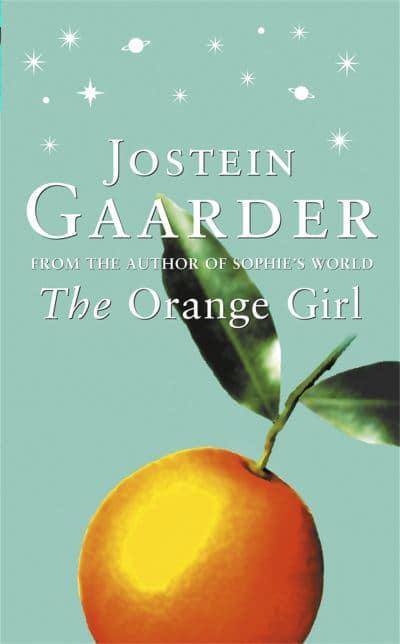
The Orange Girl by Jostein Gaarder (tr. James Anderson) – #NordicFINDS23

What is this great fairytale we live in and which each of us is only permitted to experience for such a short time? Maybe the space telescope will help us to understand more of the nature of this fairytale one day. Perhaps out there, behind the galaxies, lies the answer to what a human being is.

It’s been years since I last read anything by Jostein Gaarder! I loved Sophie’s World and The Solitaire Mystery, which I read around the time they were published in English in the mid-1990s, but although I read a few more of his books after that I found them disappointing in comparison and didn’t explore any of his later work. This month, Annabel is hosting her second Nordic FINDS event, celebrating literature from Finland, Iceland, Norway, Denmark and Sweden, and I thought it would be a good opportunity to try one of the Gaarder novels I never got round to reading.

First published in Norwegian in 2003 and translated into English by James Anderson the following year, The Orange Girl is narrated by Georg Røed, a fifteen-year-old boy whose father, Jan Olav, died eleven years earlier. Georg’s mother has married again and had another child and Georg gets on well enough with both, but he has never stopped wondering about the father he can barely remember. One day, Georg’s grandmother finds a letter written by Jan Olav before his death and addressed to Georg, intended for his son to read when he was old enough to understand it. The Orange Girl includes Jan Olav’s letter in full, interspersed with Georg’s reaction to it and the lessons he learns from it.

In the letter, Jan Olav tells the story of a young woman he meets in Oslo in the 1970s. He comes to think of her as ‘the Orange Girl’ because when he sees her for the first time on a tram, she is wearing an orange dress and carrying a large bag of oranges. When the tram stops, she disappears, leaving Jan Olav desperate to find her again. As the weeks and months go by, he becomes obsessed with tracking down the mysterious Orange Girl and discovering her true identity. Who is she? Why did she need so many oranges? And why is it important for Georg to hear her story so many years later?

On the surface, The Orange Girl is a quick, easy read. Being narrated by a teenage boy, it’s written in simple language (Georg actually feels more like a ten or eleven-year-old than a fifteen-year-old), and like many of Gaarder’s novels, it would be perfect for younger readers. The story of the Orange Girl is entertaining and amusing – particularly when Jan Olav creates a series of imaginary scenarios to explain the huge bag of oranges! I would have liked to have been given a stronger sense of place as Jan Olav follows the girl from Oslo to Seville and back again, but it wasn’t that sort of book; it’s concerned mainly with plot and ideas rather than setting.

However, anyone who has read any of Gaarder’s other books will know that they always contain a philosophical element, and this one is no different. Georg and his father share an interest in the Hubble Space Telescope, which leads to a lot of discussion of the expanding universe and the place of human beings within it. The book also raises the question of whether, if you knew before you were born that you would die early and have all your happiness taken away, would you still choose to be born at all? These are clearly the things Gaarder really wanted to write about here, and the Orange Girl story is just a way of illustrating these philosophical points.

I haven’t been left wanting to immediately search out the rest of Gaarder’s novels, but I did find this one quite enjoyable and am glad I picked it up for Nordic FINDS.

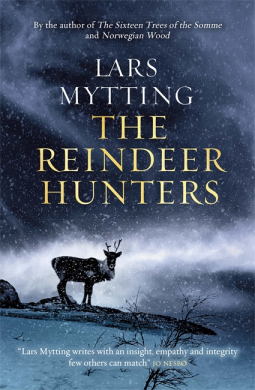
The Reindeer Hunters by Lars Mytting

Translated by Deborah Dawkin.

This is the second book in Norwegian author Lars Mytting’s Sister Bells trilogy. I loved the first, The Bell in the Lake, so was looking forward to visiting the village of Butangen again and finding out how the story would continue.

The Reindeer Hunters begins in 1903, more than twenty years after the events of the first novel. Kai Schweigaard, once a newcomer to Butangen, has settled into his role as village pastor, but is still haunted by memories of Astrid Hekne, the woman he had hoped to marry. He also feels guilt over his involvement in the removal of the two bells which once hung in the bell tower of the local church, commemorating Gunhild and Halfrid Hekne, the conjoined twin sisters who were two of Astrid’s ancestors. When Kai hears about a legendary tapestry woven by the sisters – the Hekne Weave – he sets out to search for it, hoping in some way to make amends for what happened in the past.

In the hills just outside Butangen, Astrid’s son Jehans is leading a lonely life, supporting himself through fishing and hunting, having withdrawn from the rest of the community. One day he finds himself in dispute with another hunter when they both claim to have shot the same reindeer, but this marks a turning point in Jehans’ life as he gets to know the other hunter, an Englishman called Victor Harrison, and an uneasy friendship begins to develop.

This, like the first book, is beautifully written and translated. The setting – a remote Norwegian village steeped in superstition and tradition – is vividly described, making this the kind of historical novel where you can become truly immersed in another time and place. Towards the end of the book, though, we see that scientific progress and new technology are finding their way even to Butangen in the form of electricity, improved travel and advances in dairy farming. Events in the wider world also touch the lives of our characters, including the dissolution of the Norway-Sweden union, the First World War and, finally, the flu pandemic of 1918:

There, on the church steps, Schweigaard had put all his accumulated knowledge into his advice. Mass was cancelled indefinitely. Auctions and public dances were best avoided. Folk ought not to visit other villages. They should maintain a distance from strangers. And always veer on the side of prudence.

I enjoyed reading about Kai Schweigaard’s daily life, his duties as pastor and his relationships with the other villagers and I was completely absorbed in his search for the Hekne Weave and what it might reveal. I was much less interested in the details of Jehans’ hunting and fishing expeditions and, later, Victor’s work as a pioneer of aviation, although other readers will probably find those things more enjoyable than I did! For this reason, I didn’t like this book as much as the first and every time the perspective switched to Jehans or Victor, I found myself wanting to return to the village and continue with Kai’s storyline. I did, however, come to love one of the new characters, Kristine, a young woman who doesn’t have an easy life but displays an inner strength and determination that I really admired.

I’ll be looking out for the final book in this trilogy and will be interested to see where the story will go next.

Thanks to Quercus Books, MacLehose Press for providing a copy of this book for review via NetGalley.
This is book 10/50 read for the Historical Fiction Reading Challenge 2022.

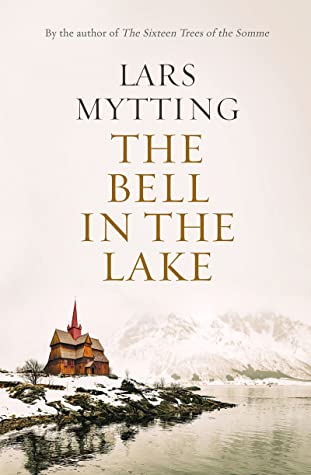
The Bell in the Lake by Lars Mytting

This beautifully written novel, translated from the original Norwegian by Deborah Dawkin, is the first in a planned trilogy based around the legend of the Sister Bells. The bells commemorate conjoined twin sisters Gunhild and Halfrid Hekne, who lived in the remote village of Butangen and died within hours of each other. Their family donated the bells to the local church in memory of the twins and they are still hanging there, in the bell tower, in 1880 when the novel begins…

As the rest of the world heads towards the twentieth century, Butangen appears to be frozen in time, a place where life is still ruled by superstition and folklore, where people still believe in evil spirits and ill omens. When Kai Schweigaard, an ambitious young pastor, arrives in the village he despairs of ever bringing change to a population so resistant to progress and modern ways of thinking.

If only people had light, he thought. If there was a strong lamp in every home, which could illuminate faces and edifying books, I could banish these mad notions in a few years. But at sunset the village grew dark, and with it folk’s minds, and these unknown powers ruled until sunrise.

One of the ways in which Kai hopes to improve life in the village is by replacing the ancient 12th century stave church where a parishioner actually froze to death during Mass with a larger, warmer, more comfortable building. The old church, complete with its pagan carvings and twin bells, is to be dismantled and reconstructed in Dresden, and a young German architect – Gerhard Schönauer – has arrived to make drawings of the church before it is taken down. However, Kai and Gerhard face opposition not only from the people of Butangen, who are suspicious and resentful of anything new, but also from the Sister Bells themselves. The bells are said to have supernatural powers and to ring on their own when danger is approaching – and it seems that the bells don’t want to be removed.

As well as the two men, a large part of the story is also written from the perspective of twenty-year-old Astrid Hekne, who works as a maid in Kai Schweigaard’s household at the parsonage. Despite the differences in their social standing, Kai is considering making Astrid his wife, but complications arise when Astrid finds herself drawn to Gerhard Schönauer. Meanwhile, as a descendant of the twins Halfrid and Gunhild, Astrid feels a responsibility for the bells and decides she must do whatever it takes to prevent Gerhard from transporting them to Dresden with the rest of the church.

The Bell in the Lake is a wonderfully atmospheric novel thanks to Lars Mytting’s beautiful descriptions of the landscape around Butangen, particularly in winter with its frozen lakes and snow-covered hills and valleys, while the supernatural elements and the role of the Sister Bells legend give the story an eerie and mysterious feel. The sense of time is as strong as the sense of place and the characters feel like real 19th century people, rather than modern day people dropped into a random historical setting. However, I think the decision to have Astrid and the other villagers speak in a dialect which seems to be mainly Scottish is a bit strange. I suppose the translator had to find a way to differentiate between the speech of the local people and the outsiders (who speak in standard English), and using Scottish words makes sense because of the close ties with Norway, but I found it slightly distracting and kept forgetting that Astrid was actually Norwegian!

One of my favourite themes in fiction is the conflict between old ways of life and new, and in this novel we see how the inhabitants of Butangen are reluctant to move away from the traditions they have always followed and try to resist any kind of social, scientific or religious progress. Although Astrid has been brought up with the same beliefs, she has a more adventurous spirit than most of her neighbours and longs to see more of the world, which is what draws her to Gerhard. The demolition of the old church, which Gerhard has come to oversee, and the building of the new one is symbolic of all of this. If you’ve never seen a Norwegian stave church, by the way, I recommend googling them – they look amazing and it’s sad to think that there are so few of them left.

Having enjoyed The Bell in the Lake so much, I am looking forward to the other two books in the trilogy and hope we won’t have to wait too long for the next one!

Thanks to Quercus Books for providing a copy of this book for review via NetGalley.

The Mercies by Kiran Millwood Hargrave

I am always drawn to books with pretty covers like this one, even though I know that the story inside doesn’t always live up to the promise of the cover. This one, set in 17th century Norway, did sound fascinating, though, so I hoped that in this case it would be as good as it looked!

The novel opens in December 1617 in the remote island town of Vardø, in the far northeast of Norway. It is Christmas Eve but the men of the island have gone out to sea as usual in search of the fish on which their livelihood depends. Twenty-year-old Maren Magnusdatter watches from her window as she sits by the fire with her mother and sister-in-law mending torn sails. Suddenly there’s a flash of lightning and Maren and her mother run to the window…

And then maybe both of them are screaming but there is no sound save the sea and the sky and all the boat lights swallowed and the boats flashing and the boats spinning, the boats flying, turning, gone.

The effects of that Christmas Eve storm are disastrous both for Maren, who loses her father and brother, and for the town of Vardø as a whole. Where the male population of the town used to be fifty-three, now only thirteen remain – and those thirteen consist of babies, young boys and elderly men. Now the women of Vardø have two choices: abandon the island and start a new life somewhere else – or stay and do the work of the men themselves, so that their community can survive.

Meanwhile, far away in Bergen, a young woman called Ursa is marrying a man chosen for her by her father. The man’s name is Absalom Cornet and he has been summoned from Scotland to take up a position as Commissioner of Vardø. When they arrive in Vardø, Ursa is struck by the strength and independence of the women she meets there and the resilience they have shown in coping with such a terrible tragedy. Commissioner Cornet, though, views the women differently – and when Ursa discovers the true nature of the work her husband has carried out in Scotland and why he has been brought to Norway, she becomes afraid for her new friends.

The Mercies is based on real historical events – the 1617 storm which almost wiped out all the men of Vardø really happened, and so did some of the things that take place later in the novel. I loved the descriptions of the island and the portrayal of a small, superstitious society where outsiders and anyone deemed to be different – such as Maren’s sister-in-law, an indigenous Sámi woman – are regarded with suspicion. It was particularly interesting to see things from two such different perspectives: Maren, who has lived in Vardø all her life, and Ursa, to whom everything is strange and unfamiliar. However, despite the drama and tragedy of Maren’s storyline, she never really came to life for me and I couldn’t quite warm to her; I found Ursa more sympathetic as she struggled to fit into her new community and to come to terms with her knowledge of the sort of man she had married.

This is the first book I’ve read by Kiran Millwood Hargrave (she has previously written YA novels and this is her first one aimed at adults) and I thought her writing was beautiful at times, but I really wish authors would stop writing in present tense; I find it so distracting and distancing! Still, there’s a lot of atmosphere – I think books set in countries like Norway and Iceland do tend to have a certain atmosphere – but apart from those vivid opening scenes describing the storm and its aftermath, I felt that the rest of the story was one I’d read several times before. As soon as I found out who and what Absalom Cornet was, I could predict what was going to happen and I was right.

If you read The Mercies and enjoy it, I would recommend reading The Glass Woman by Caroline Lea too; I thought the two books had a very similar feel and if you like one you will probably like the other.

Thanks to Picador for providing a copy of this book for review via NetGalley.
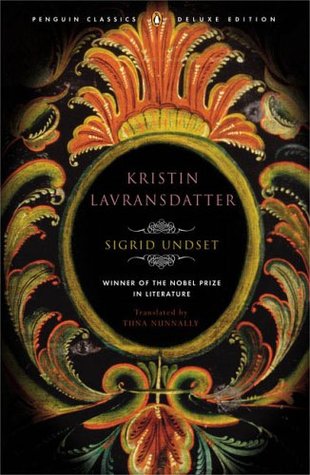
Kristin Lavransdatter by Sigrid Undset

Kristin Lavransdatter I have always loved long books, the sort you can bury yourself in for weeks, becoming immersed in a fully-formed fictional world and getting to know characters who, by the time you reach the final page, feel almost like personal friends. Kristin Lavransdatter, though, is more than just a ‘long’ book – it’s a very long book! With over 1,100 pages in the edition I read, it’s similar in length to classics like War and Peace, Don Quixote and Les Miserables and left me with a similar mixture of feelings on finishing: a sense of achievement at making it to the end; sadness at having to say goodbye to Kristin and her family; and, I have to admit, relief at finally being able to move on to something else. I enjoyed Kristin Lavransdatter – loved it at times – but it’s not always an easy book to read, for reasons which I’ll explain below.

So far I have been describing this as a ‘book’, but in fact Sigrid Undset originally wrote three individual books about Kristin – The Wreath (first published in 1920), The Wife (1921) and The Cross (1922) – which have been combined into one volume in this Penguin Classics edition. It’s still possible to buy them separately (and it would probably seem less daunting that way) but they don’t stand alone very well at all and really do feel like three sections of a longer novel. After finishing the first part I moved straight on to the second and then the third and I was glad I took this approach otherwise I would probably have lost track of what was happening.

Set in the 14th century, Kristin Lavransdatter is, unsurprisingly, the story of Kristin, daughter of Lavrans. We first meet Kristin as a young girl growing up on her parents’ manor at Jorundgaard in Sil, a rural area of Norway. A good, honourable, hard-working man, Lavrans gains respect and admiration wherever he goes and he and Kristin are very close. His wife, Ragnfrid, however, has never fully recovered from the loss of three young sons and as a result her relationships with both Lavrans and Kristin are strained.

Early in the novel, Kristin is betrothed to the quiet, reliable Simon Darre, whose family own a neighbouring estate. She has no reason to dislike Simon, but she feels nothing for him and longs to experience the sort of passion her own parents’ marriage lacks. Her chance comes when she meets and falls in love with Erlend Nikulausson, a man who is handsome, charming and romantic – in other words, everything Simon isn’t. Kristin knows that this is the husband she has been dreaming of and even the knowledge that he has been excommunicated by the church for living with another man’s wife doesn’t change her mind. When Simon finds out about Erlend he agrees to break off the betrothal, but it takes a lot longer for Kristin to persuade Lavrans and Ragnfrid – so long that by the time she is eventually allowed to marry Erlend she is already pregnant with his child.

In case you’re thinking I’ve given away too much of the plot, all of the above happens in The Wreath alone. The other two parts of the book – The Wife and The Cross – explore the consequences of Kristin’s decision to marry Erlend rather than Simon. And the consequences are varied and far-reaching, affecting not only Kristin herself but everyone else around her. It’s a sad and tragic story and this is one of the reasons why, as I mentioned earlier, this is not the easiest of books to read. Whether it’s a death, an illness or an accident, a murder, an act of betrayal or an unhappy marriage, each and every character is subjected to a relentless stream of misery.

My heart ached for Kristin as she discovered that the man she had married was not all that she had hoped he would be – not a hero but a flawed human being – and that making their relationship work was going to be difficult. However, I also had some sympathy for Erlend; he is not a bad man but he is sometimes a weak one, with a tendency to act before he thinks and with none of the skills necessary to manage a farm and household effectively. He makes mistakes and has to live with those mistakes, but so does Kristin and I thought it was unfair of her to place so much of the blame on him. I also felt sorry for their young children, for Simon (who ended up being one of my favourite characters) and for Kristin’s sister, Ramborg. As I said, this is not a happy story for anyone!

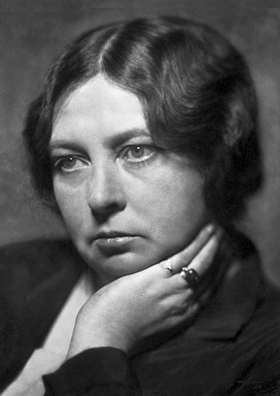
Sigrid Undset (1882-1949)

Sigrid Undset (1882-1949)

As we accompany Kristin on her journey through life, we are also given a lot of information on the history and politics of the period. This becomes increasingly important as Erlend finds himself embroiled in a plot against the king and, I have to admit, I found some of this difficult to follow. If I read the book again (as I’m sure I will want to at some point in the future) I’ll have to concentrate more on that aspect of the story. Of more interest to me was the portrayal of daily life in the valleys and mountains of medieval Norway, a way of life strongly influenced by the Catholic Church, but also steeped in superstition and folklore. The publication of Kristin Lavransdatter led to Sigrid Undset being awarded the 1928 Nobel Prize in Literature “principally for her powerful descriptions of Northern life during the Middle Ages”.

Finally, I should mention that Kristin Lavransdatter was originally written in Norwegian. The English translation I read was a recent one by Tiina Nunnally and I had no problems with it; I thought it was very clear and readable. I’ve heard that the earlier translation from the 1920s by Charles Archer and JS Scott is not as accessible, so I’m happy that I made the right choice.

Kristin Lavransdatter was the book selected for me in the Classics Club Spin back in March – and it kept me busy until June! Now I’m looking forward to starting my next Spin book: Prince of Foxes by Samuel Shellabarger.