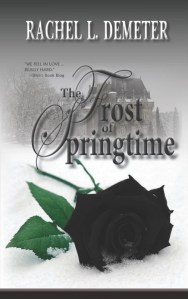
The Frost of Springtime by Rachel L. Demeter

The Frost of Springtime When I was offered the opportunity to take part in a blog tour for Rachel L. Demeter’s The Frost of Springtime, I wasn’t sure whether or not to accept. I read a lot of historical fiction novels and many of them have an element of romance, but I tend not to be drawn to books that are specifically classed as ‘historical romance’ as this one is. The setting sounded intriguing, though, so I decided to give it a try.

The Frost of Springtime is set during the Paris Commune of 1871, a brief period during which a revolutionary government ruled Paris. The novel begins with Vicomte Aleksender de Lefèvre rescuing a young girl, Sofia Rose, who has been sold into a Parisian brothel by her own mother. Sofia becomes Aleksender’s ward but she is later separated from her guardian while he goes away to fight in the Franco-Prussian War.

When Aleksender returns to Paris accompanied by his friend, Christophe Cleef, he finds that the city has been torn apart by revolution, protest and destruction. At home, too, things are changing. His father’s death has left him with new responsibilities and an altered relationship with his brother…and the little girl he saved from a life of misery and abuse has matured into a beautiful young woman of nineteen. Left scarred by his traumatic wartime experiences, Aleksender is in need of love and comfort and it seems that Sofia can provide them. But what about his wife, Elizabeth, the woman he married years earlier as part of an arranged marriage and has never loved the way he loves Sofia?

The Frost of Springtime is a dark and atmospheric story with some great descriptions of a Paris in political turmoil. Although there is certainly a strong romantic thread running through the centre of this novel, there is also quite a lot of history. In fact, there could be too much history for those who are looking purely for a love story, but for me personally the balance was about right. I had no previous knowledge of the Paris Commune and now that I’ve learned a bit about it from reading this book I would like to know more. I may have to do some further reading on the subject!

Aleksender and Sofia were both strong characters – characters I was interested in and cared about. Unless you just don’t like the idea of the age difference or a man falling in love with a girl who had been his ward, I’m sure you’ll feel the same and will be hoping for a happy ending for the two of them. However, I did also like Elizabeth and had a lot of sympathy for her as she really hadn’t done anything wrong and didn’t deserve to be treated badly. Aleksender’s behaviour sometimes disappointed me because it wasn’t always what you would expect from the hero of a romantic novel but this could be partly explained by the fact that he is suffering from what appears to be post-traumatic stress disorder caused by his experiences at war.

frostofspringtimebanner I’m glad I didn’t let my doubts about historical romance put me off reading this book as I did enjoy meeting Aleksender and Sofia and learning about such an interesting period of French history.

If you’d like to read more reviews, interviews and guest posts please see the tour schedule at Enchanted Book Promotions – and don’t forget to enter the tourwide giveaway for an Amazon gift card at this link: a Rafflecopter giveaway

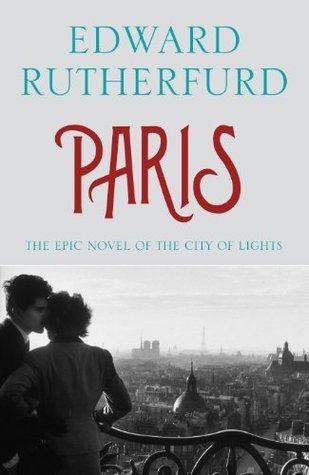
Paris by Edward Rutherfurd

Paris Of all the new books being published this year, this is one that I’ve really been looking forward to, having read and enjoyed all seven of Edward Rutherfurd’s previous books – my two personal favourites, Sarum, set in and around the English city of Salisbury, and Russka, which covers almost two thousand years of Russian history; his other two ‘big city’ novels, London and New York (probably the two I’ve enjoyed the least); his two books on the history of Ireland, Dublin and Ireland Awakening; and The Forest, the story of England’s New Forest.

After reading all of those, I thought I knew exactly what to expect from Paris but I was surprised to find that I was wrong. With all of his other novels, Rutherfurd has followed the same format: beginning in the distant past then moving forward chronologically through the centuries, he attempts to tell the story of a city or a country’s entire history by following several families down through the generations. Paris has a very different structure.

In this book we concentrate on one set of characters who are living in Paris during the late 19th and early 20th centuries (the era known as the Belle Époque). Most of these characters are introduced in the first few chapters of the book and belong to six families, all of different social classes and political backgrounds. First, there’s the bourgeois Blanchard family – Jules Blanchard, the owner of the Josephine department store, and his three children, Gerard, Marc and Marie. Next, there’s Thomas Gascon, an iron worker, and his charismatic younger brother, Luc. There’s the aristocratic Roland de Cygne and his enemy, the revolutionary Jacques Le Sourd. And finally, a Jewish family, the Jacobs, and the Renards, who are merchants. The personal stories of all of these people and their ancestors are cleverly woven around the events that shaped the history of Paris.

Interspersed with this main storyline are several chapters in which we go further back in time and meet some of the earlier generations of our six families. There’s a chapter telling the story of the St Bartholomew’s Day massacre of 1572, for example, and another set in the city’s Jewish community in the 14th century. However, I was disappointed that some of the earlier periods in France’s history were given very little attention at the expense of the Belle Époque chapters. There was nothing prior to the 13th century so the Romans were completely ignored, Napoleon was barely mentioned at all, and I also couldn’t believe that we were only given one short, thinly plotted chapter on the French Revolution. I can see that choosing to focus more on the 1875-1940 thread of the novel allowed Rutherfurd to develop more complex storylines, but unfortunately his characters are just not strong enough to make this new format work. I still thoroughly enjoyed Paris and don’t want to give the impression that I didn’t; it’s just that I’m sure I would have loved it more if it had followed the same chronological structure as the previous books.

While I don’t have any problems with the factual content of Rutherfurd’s books, they do require you to suspend disbelief. You have to be able to accept that Thomas Gascon works on both the Statue of Liberty and the Eiffel Tower and is singled out by Gustave Eiffel from all the other hundreds of workers, that another of our fictional characters spends an evening with Ernest Hemingway and another one models for Coco Chanel, to give just a few examples. Another method he uses is to have the characters conveniently taking sightseeing tours of famous buildings and landmarks, such as the Palace of Versailles or the Père Lachaise cemetery. But although this kind of name-dropping can be annoying in other historical fiction novels, I actually don’t mind it in Rutherfurd’s books and I know he does it because it enables him to show us as many of the city’s famous figures and important events as he possibly can. Sometimes, though, it’s the smaller details and snippets of information that I enjoy the most – a description of a beautiful mille-fleur tapestry or a mention of the famous book shop, Shakespeare and Company.

I know these aren’t the sort of books that would appeal to everyone, though, as you do need to be genuinely interested in learning about the history of the locations each book covers and you also have to be prepared for the fact that most of his books are around 800-1000 pages long. I think of Rutherfurd’s books as interesting, entertaining history lessons. The quality of his writing is nothing very special and his characters are often very thinly drawn, but when you reach the end of one of his novels you feel that you’ve really learned a lot and have gained a good understanding of the place you’ve been reading about.

While this book was not without its flaws, I did love Paris. It’s not his best book by any means, and I definitely prefer the more linear structure of Sarum, Russka and the others, but this book was still a big improvement on his last one, New York. One problem I had noted with New York was that Rutherfurd seemed to run out of ideas towards the end, making the last few chapters very weak. This was not the case at all with Paris – in fact, the final chapter, on World War Two and the French Resistance was one of my favourites. It has definitely been worth the time and effort it took to read this book – and it has left me wanting to visit Paris again soon. I’m not officially taking part in Paris in July (I read this book in June) but Paris would have been a perfect choice!

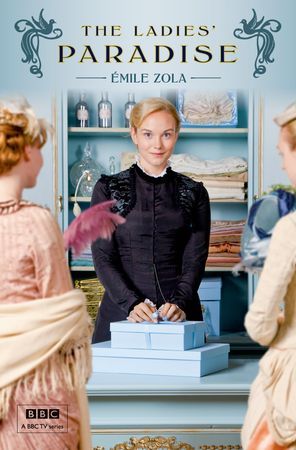
The Ladies’ Paradise by Émile Zola

The Ladies' Paradise The Ladies’ Paradise is only the second book I’ve read by Zola; my first was Thérèse Raquin and the two are very, very different. Au Bonheur des Dames, to give it its French title, was published in 1883 and is the story of a Paris department store, based on the real-life Le Bon Marché.

At the beginning of the novel, Denise Baudu arrives in Paris with her two younger brothers, hoping to find work in her uncle’s draper’s shop. She is disappointed to discover that he is unable to offer her a job because his shop, along with the other small shops in the street, is losing business to a new department store, the Ladies’ Paradise. The new store is able to offer a larger selection of products at cheaper prices all under one roof, and none of the smaller traders can hope to compete. Still, Denise desperately needs to earn money to support her brothers so although she understands how her uncle feels, she is pleased when she is offered a job at the Paradise.

Denise quickly finds that life as a salesgirl at the Paradise is not easy but she’s determined to succeed and overcome whatever obstacles are put in her way. And when she catches the eye of the owner of the Paradise, Octave Mouret, he soon discovers that she is a woman with morals and principles; it’s obvious that she is not going to give him any encouragement – but this only makes him want her more.

I was hoping to love this book as much as Thérèse Raquin but that didn’t happen. The Ladies’ Paradise is a book that I enjoyed, but not one that I loved. It offers some fascinating insights into both Parisian life and the rise of the department store in the late 19th century – and of course, the idea of a larger, cheaper store putting all the small, independent shops out of business is still very relevant today – but I disliked most of the characters and while the long descriptions of the silks, satins and other fabrics sold at the Paradise were beautifully detailed I did get a bit bored after a while. Maybe I just don’t like shopping enough!

However, I did find it fascinating to read about the way the Paradise was run and what it was like to work there. In some ways working at the Paradise was a very different experience from working in retail today, one of the biggest differences being that the salesgirls employed by the Paradise lived and ate on the premises and were treated almost like servants. But from a selling and marketing perspective, I was surprised to learn how modern and sophisticated Mouret’s methods were; a lot of the ideas he had for running the store, advertising its products and attracting customers are still used today (though I didn’t really like the implication that women are so easy to trick and tempt into parting with their money).

The only character I really liked was Denise. I had sympathy with all the ordeals she faced after starting her new job: having trouble fitting in with the other women, feeling that her clothes and hair weren’t right, being bullied by other employees, and worrying about making enough money to take care of her two younger brothers. I found it harder to like or care about any of the other characters (Denise’s brother, Jean, particularly annoyed me – surely he was old enough to take more responsibility for himself and his actions), though I did admire what Mouret had achieved in making the Paradise such a success.

I don’t want to sound too negative about this book because I still found a lot of things to enjoy about it, but I’m hoping the next Zola novel I read will be more to my taste than this one. Any suggestions are welcome!

Stone’s Fall by Iain Pears

With 2011 coming to an end, like a lot of bloggers I’ve been putting together a list of my favourite books read this year. One of the books on my list is Stone’s Fall by Iain Pears, which I finished a couple of weeks ago but haven’t had a chance to post about yet, so I thought it would make sense to tell you about the book today before posting my Top Books of 2011 later in the week.

I really wasn’t expecting to enjoy Stone’s Fall so much because a few years ago, I started to read Iain Pears’ An Instance of the Fingerpost and despite it sounding like exactly the type of book I would usually love, I couldn’t get into it at all and abandoned it a few pages into the second of the book’s four parts. With this book, though, I’ve had a completely different experience and I’ve never been so glad that I decided to give an author a second chance!

Stone’s Fall is a very complex and cleverly constructed novel. At the beginning of the story we are told that a man is dead but before we can understand the circumstances surrounding his death it’s necessary to go back in time and learn as much as we can about his life. And so the book is divided into three sections, each narrated by a different character, and moving backwards from London in 1909 to Paris in 1890 and finally Venice in 1867. The link between all three stories is the mysterious Elizabeth, Lady Ravenscliff, who plays an important part in the life of each narrator and is perceived in a different way by each of them.

The first narrator we meet, in 1909, is Matthew Braddock, a journalist working for a London newspaper. When John Stone, one of the richest and most powerful men in the world, meets his death after falling from an open window, he leaves behind a will containing an unusual bequest. Stone’s widow, Lady Ravenscliff, asks Braddock to investigate but as he begins to dig into the secrets of Stone’s business empire he makes some surprising discoveries.

At the end of the first part I was sorry to have to say goodbye to Braddock and move back in time and on to another narrator. However, it only took me a few pages to get back into the flow of the story – the second narrator is fascinating and I enjoyed the second section even more than the first! And in the third and final part of the book, we switch narrator yet again, with this section of the book being equally compelling.

Many of the characters are unlikeable or flawed in some way, but I found all of them interesting to read about. The way I thought about each character changed as I was given more information to piece together and I was constantly forced to re-interpret what I had just read.

Stone’s Fall is a long book (over 600 pages) and very detailed and the author takes his time in introducing us to each character and building up a full picture of John Stone’s world. However, despite the pace being slow at times I found the plot completely gripping and was never bored – it was all so wonderfully intricate and clever. The balance between the melodramatic plot twists and the more technical details of banking, politics and espionage was exactly right, so that the story was both entertaining and informative.

“Love, Murder, Espionage.” Those are the words on the front cover, but although all three can be found within this book, it also contains so many other themes and ideas that to mention everything would require a post twice as long as this one! And so I’ll finish by simply saying that I loved this book – which I hadn’t expected to, considering the problems I had with An Instance of the Fingerpost. This is a book I’d definitely like to re-read one day because I’m sure my knowledge of some of the later revelations would bring new meaning to the earlier parts of the book. I might even decide to try Fingerpost again too!

The Phantom of the Opera by Gaston Leroux

Gaston Leroux’s novel The Phantom of the Opera has been adapted for stage and screen so many times, many of us will be familiar with the story without ever having read the book. But whether you’ve seen any of the adaptations or not, you can expect the novel to be different in many ways and it’s an entertaining read in its own right. Although I won’t be adding it to my list of all-time favourite classics, I did enjoy it and had fun reading it.

The novel was first published in English in 1911, having previously been serialised in a French newspaper during 1909 and 1910. For those of you who don’t know the plot, the story takes place in the Paris Opera House, which is apparently haunted by a ghost. When Raoul, the Vicomte de Chagny, falls in love with Christine Daaé, a singer at the Opera House, he discovers that he has a rival for Christine’s love: the Opera Ghost himself.

In the prologue, Leroux tells us that this is a true story and that he has carried out extensive research, interviewing some of the characters and studying the archives of the National Academy of Music.

The Opera ghost really existed. He was not, as was long believed, a creature of the imagination of the artists, the superstition of the managers, or a product of the absurd and impressionable brains of the young ladies of the ballet, their mothers, the box-keepers, the cloak-room attendants or the concierge. Yes, he existed in flesh and blood, although he assumed the complete appearance of a real phantom; that is to say, of a spectral shade.

But whether or not you believe that the ghost was real, the opera house was definitely based on a real place, designed by the architect Charles Garnier in the 1860s. Almost the entire story is set inside the opera house, which becomes a whole world in itself complete with an underground lake, a maze of tunnels and even a torture chamber. It was a fascinating setting to read about and in a way, the building is the most important character in the book, providing a lot of the novel’s atmosphere and suspense.

Although the book is presented as if it was a factual account, the writing is never dry. In fact, it’s the opposite: it’s filled with passion and emotion. It’s also very melodramatic and over the top, which made it quite funny at times (though I wasn’t always sure if it was supposed to be!) but what the book lacks in quality of prose is made up for in the storytelling and exciting plot. I didn’t love The Phantom of the Opera, but it kept me entertained and I’m glad to have finally read it.

Thérèse Raquin by Émile Zola

Thérèse is a young woman trapped in an unhappy marriage to her sickly cousin, Camille Raquin. On the surface she appears quiet and passive, never voicing an opinion of her own. But underneath Thérèse is a passionate person who longs to break away from her boring, oppressive existence. When Camille introduces her to an old friend, Laurent, the two begin an affair. Desperate to find a way in which they can be together, Thérèse and Laurent are driven to commit a terrible crime – a crime that will haunt them for the rest of their lives.

If you think I’ve given too much away then I can tell you that this crime takes place quite early in the story and is not the climax of the book. The point of the story is what happens afterwards when Zola begins to explore the psychological effects this action has on the characters.

Thérèse Raquin, as you will have guessed, is a very dark book which becomes increasingly feverish and claustrophobic with scenes of violence and cruelty. I haven’t read much 19th century French literature, apart from a few books by Alexandre Dumas and Victor Hugo, and one thing that struck me about Zola’s writing was how much more daring and graphic this book is than British novels from the same period. The reader becomes locked inside the tormented minds of Thérèse and Laurent, sharing their fear and terror, their nightmares and sleepless nights, their inability to enjoy being together because the horror of what they have done stands between them. If you’ve read Dostoevsky’s Crime and Punishment or Edgar Allan Poe’s The Tell-Tale Heart, there are some similarities here.

This book could be enjoyed just for the dramatic plot (it’s as tense and gripping as any modern thriller) but I also thought the four main characters – Thérèse, Laurent, Camille and Madame Raquin – were fascinating and very vividly drawn. Zola apparently said that his aim was to create characters with different temperaments and see how each of them reacted to the situation they were in.

As the first book I’ve read by Zola, I wasn’t sure what I could expect from Thérèse Raquin but I thought it was excellent and I’ll certainly be reading more of his books.

Review: I’ll Never Be Young Again by Daphne du Maurier

I’ll Never Be Young Again was Daphne du Maurier’s second novel, written when she was only twenty three years old. It’s different from the other books of hers that I’ve read so far. It doesn’t have the suspense or the gothic feel of some of her other works – this is more of a psychological, character-driven book. It’s the story of Richard, a young man who has grown up in the shadow of his famous father, and his struggle to find his own identity. I’m not really a fan of ‘coming-of-age’ novels, but I’m glad I chose to read this one. It certainly seems to be one of her least well known novels –  and I was concerned that this might mean it wasn’t very good. Well, I can tell you that it is good and I enjoyed it a lot more than I was expecting to.

The book opens with Richard – or Dick as he prefers to call himself – standing on a bridge, preparing to jump. Immediately the reader is intrigued, wondering what has happened to drive him to suicide.  At the last minute Dick feels a hand on his shoulder – this is Jake, a complete stranger who saves his life and becomes his closest friend. The first half of the book follows the adventures of Dick and Jake as they leave England and sail to Scandinavia together in search of a new life. The second half is the story of Dick’s relationship with Hesta, a girl he meets in Paris.

The whole book is written in the first person from Dick’s perspective, which is significant as it was apparently the first time Daphne du Maurier wrote from a man’s point of view – and I thought she captured the male voice perfectly. The only problem I had was that I just didn’t like Dick very much. I found his immaturity and whining very irritating – although I understood that the point of the book was to follow his development from an insecure, selfish youth into a sensible, mature adult. Eventually he does begin to grow up and want different things out of life, but this comes too late in the book for me to be able to warm to him. However, the book is so well-written I could still enjoy it even with such an unsympathetic narrator. Her writing is absolutely beautiful and quite dreamlike, as she lets us get right inside Dick’s head and share his thoughts and emotions. There are also some vivid descriptions of the mountains and fjords of Norway and the other places that the characters visit, particularly Paris with its cafés and boulevards.

This would probably not be the best Daphne du Maurier book for a newcomer to begin with, but it’s a good choice for someone who wants to venture away from Rebecca and read one of her less popular novels. A word of warning, though – if you’re going to read the Virago Modern Classics edition, leave the introduction until last as it gives away the entire plot, including the ending (this is good advice with any book – I’ve learned from experience never to read the introduction first).

This is my first book for the Daphne du Maurier Challenge hosted by Chris at Book-a-rama. I wasn’t planning to take part in this challenge until I discovered my local library had almost all of her books. I’m looking forward to reading some more of her work during the next year, as there are still a lot of her books I haven’t read yet. This book also counts towards the 1930s challenge as it was a contemporary novel published in 1932 and set in 1930s Europe – and also the Typically British challenge.

Pages: 304/Publisher: Virago Press (Virago Modern Classics 515)/Year: 2005 (originally published 1932)/Source: Library book