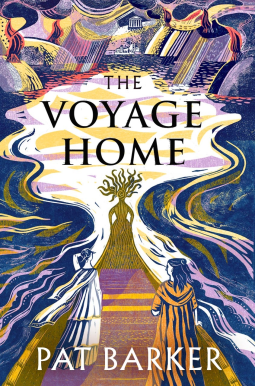
The Voyage Home by Pat Barker

This is the final novel in Pat Barker’s trilogy telling the stories of some of the women involved in the Trojan War. Books one and two, The Silence of the Girls and The Women of Troy, focus on Briseis, who was given to Achilles as a prize of war, although I was surprised by the number of male perspectives that are also included in those two books, considering the titles! In The Voyage Home, we leave Briseis behind to follow three other characters as the victorious Greeks return home from the war.

One of these is Cassandra, the Trojan princess and prophet who is cursed never to be believed. Like Briseis, Cassandra has become a war prize – in her case, she has been taken as a concubine by Agamemnon, King of Mycenae. Then there’s Ritsa, a Trojan slave and healer given the job of accompanying Cassandra on the journey to Mycenae and acting as her personal servant. Finally there’s Clytemnestra, Agamemnon’s wife, who is grimly preparing for her husband’s return. It’s been a decade since Agamemnon sacrificed their daughter Iphigenia to the gods in exchange for a wind to sail to Troy, but Clytemnestra has never forgiven him and is ready to take her revenge.

I enjoyed the first two books in this trilogy and I did like this one as well, but not quite as much. I’ve read several other novels about Clytemnestra and the events of the Oresteia recently (including Elektra by Jennifer Saint and Clytemnestra by Costanza Casati) and I felt that her sections of the novel didn’t offer me much that was new or different. Having said that, the way Barker portrays Clytemnestra’s emotions – her anger, bitterness and grief – was very well done. There are also some atmospheric scenes of ghostly children haunting the palace – although, oddly, chanting British nursery rhymes such as Oranges and Lemons, which pulled me right out of the Ancient Greek setting!

Of the main characters, Ritsa is probably the easiest to like and as a servant, of a lower social status than the others, she has an interesting perspective on the events that unfold. Cassandra is a fascinating, complex character in the unusual position of being both enslaved and the wife of the king. She has already predicted the deaths of herself and Agamemnon but due to the curse she is under, nobody takes her seriously. I would have liked more of the book to have been written from Cassandra’s point of view, but instead Barker concentrates on showing her through the eyes of the other women: Clytemnestra, who views her with suspicion (after all, Agamemnon was her husband first) and Ritsa, who initially resents Cassandra for not being her beloved friend Briseis, who has not accompanied them to Mycenae. Ritsa sees Cassandra as wild and deluded, but gradually starts to have more sympathy for her.

This is a satisfying end to the trilogy, although if you haven’t read the first two books I’m sure you could read this one as a standalone.

Thanks to Hamish Hamilton for providing a copy of this book for review via NetGalley.

The Women of Troy by Pat Barker

After reading Pat Barker’s The Silence of the Girls a few years ago, I wasn’t really expecting a sequel, but here it is: The Women of Troy. I’m sure if you wanted to you could read this one as a standalone, but I would recommend reading both as this is a direct continuation of the first. Together, the two novels tell the story of the Trojan War and its aftermath.

The Silence of the Girls was based on the events of Homer’s Iliad; this second novel is set after the fall of Troy, when the victorious Greek invaders are stranded on the shore, waiting for the winds to change so that their ships can sail home. Trapped there with them are the Trojan women they have taken captive, some of whom were once queens and princesses but are now treated as slaves. Among them is Briseis, who had been taken by the great Greek warrior Achilles as a war prize and then married off to his friend Alcimus after Achilles’ death.

As in the previous novel, Briseis is our main narrator, but there are also some chapters written from other perspectives: Pyrrhus, the son of Achilles, desperate to prove himself as great as his father, and Calchas, a priest and prophet. One of my criticisms of The Silence of the Girls was that, despite the title, we only actually heard the voice of one girl, Briseis, while large sections of the book were written from the point of view of Achilles – and the title of The Women of Troy also seems slightly misleading, as we have two male perspectives and only one female. However, this time I felt that, at least through Briseis’ eyes, we do see more of the other women in the camp than we did in the first book. These include Hecuba, the former Queen of Troy and wife of the murdered King Priam; their daughter Cassandra, who has the gift – or curse – of prophecy; and Andromache, the widow of Hector who was killed by Achilles during the war. All of these women have interesting stories of their own, as well as now all sharing the same problem: how to cope with living amongst the men who destroyed their city.

Then – and now – people seem to take it for granted that I loved Achilles. Why wouldn’t I? I had the fastest, strongest, bravest, most beautiful man of his generation in my bed – how could I not love him?

He killed my brothers.

We women are peculiar creatures. We tend not to love those who murder our families.

As this entire novel is set during that period of waiting for the weather to change, it’s a slower paced and more character-driven story than the previous one. The plot, so much as there is one, revolves around the attempts of the Trojans to bury the body of their beloved King Priam, brutally killed by Pyrrhus and denied proper burial. Despite this, I still found the story quite gripping and enjoyed getting to know some of the women better. I’m wondering whether there will be a third book, as this one felt very like the middle book in a trilogy to me.

Thanks to Penguin UK for providing a copy of this book for review via NetGalley.
Book 40/50 read for the 2021 Historical Fiction Reading Challenge.

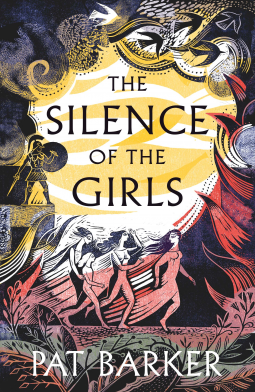
The Silence of the Girls by Pat Barker

There have been a number of novels published recently which look at Greek myths and legends from a feminine perspective. In the last few months I have enjoyed reading Circe by Madeline Miller, which tells the story of the witch Circe from the Odyssey, and For the Immortal by Emily Hauser, the story of Hippolyta the Amazon queen. Pat Barker’s new novel, The Silence of the Girls is another, this time bringing to life the character of Briseis and the events of Homer’s Iliad.

When the city of Lyrnessus falls to the Greeks during the Trojan War, Briseis loses her husband, King Mynes, and her father and brothers. The surviving women are shared out amongst the Greek conquerors as prizes of war and Briseis finds that she is given to the great warrior Achilles as a slave. The events which follow, such as the quarrel which breaks out between Achilles and Agamemnon, King of Mycenae, over the possession of Briseis, and the fate of Patroclus when he impersonates Achilles on the battlefield, will already be known to anyone familiar with the Iliad. If all of this is new to you, though, don’t worry – no knowledge of Homer’s epic is necessary and Pat Barker makes it very easy to follow what is happening.

Most of the novel is narrated by Briseis herself and I found her a very engaging narrator. The nature of her story and the ordeals she faces make her an easy character to sympathise with; I was given a good understanding of how she felt about losing her freedom, becoming a slave and being at the mercy of the men responsible for murdering her family and destroying her city. This is quite a dark novel and Barker doesn’t hold back when describing the brutality of the men in the Greek army, both on and off the battlefield.

I was surprised to find that there are also some chapters written from the perspective of Achilles, who is very much the villain of the book. Although seeing Achilles’ side of the story certainly didn’t make me warm to him at all, it was good to get a different point of view, especially as it allowed us to see scenes and hear conversations that took place when Briseis was not present. However, because of the title of the book, I think it would have been nice if more female characters had been given a voice so that the silence of more than just one girl could be broken. We do meet some of the other women in the Greek camp, but only through Briseis’ eyes and Briseis is the only one we get to know in any depth.

I did really enjoy this book, though. It’s well written, very readable, and a fascinating portrayal of Ancient Greek society. If you’re interested in reading more about Briseis, you could try Hand of Fire by Judith Starkston and For the Most Beautiful by Emily Hauser. She also appears in Madeline Miller’s The Song of Achilles, which will give you a very different view of Achilles as well!

This is book 12/20 of my 20 Books of Summer.

Thanks to Penguin for providing a copy of this book for review via NetGalley.
Remember These? Books beginning with F and G

Before I started blogging I used to keep a list of the books I read in an A-Z notebook – the title, the author and a rating out of 5, but no other information. I did this from the mid-1990s to around the year 2000, but sadly kept no records after that until October 2009 when I started my blog.

I still have the notebook and a few years ago I began writing a series of blog posts highlighting some of the books listed under each letter, but only got as far as E before getting distracted and forgetting to do the rest. I did enjoy working on those posts, so I have decided to continue and try to get all the way to Z this time – and yes, I do have a book listed under Z!

So, without further ado, here is a selection of the books that appeared on the ‘F’ and ‘G’ pages of my notebook. I originally gave the books ratings out of 5 and the additional symbol * means that I particularly loved the book while X means I didn’t finish it. Although I’ve included my original ratings here, these do not necessarily reflect what I would feel about the books if I read them again today!

Books beginning with F and G:

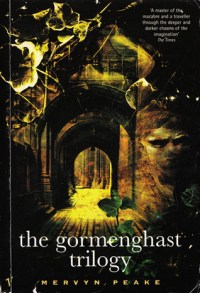
Gormenghast The Gormenghast Trilogy by Mervyn Peake 5/5*
I remember buying this book after watching the BBC adaptation in 2000. My edition includes all three novels in the trilogy – I didn’t like the third one, Titus Alone, but loved the first two, Titus Groan and Gormenghast.

The Far Pavilions by M.M. Kaye 5/5*
This wonderful novel set in India is one of my favourite historical fiction novels. I loved it the first time I read it and when I re-read it in 2010 I was pleased to find that it was still as good as I remembered.

Gone with the Wind by Margaret Mitchell 5/5*
I have read Gone with the Wind several times and don’t know if this particular entry refers to my first read or a later re-read. It’s another favourite, though, so it would get 5/5 from me every time.

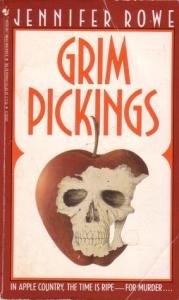
Grim Pickings Grim Pickings by Jennifer Rowe 5/5
This was a great Agatha Christie-style mystery novel set in Australia and revolving around a murder that takes place in an old woman’s orchard where her family have gathered to pick apples. I think it was part of a series, but I never read any of the others.

The Ghost of Thomas Kempe by Penelope Lively 3/5
This is one of Penelope Lively’s children’s books. I can remember what the front cover of my copy looked like (and I think I still have it somewhere) but the story has faded from my mind. I would like to read it again as I think I might appreciate it more now than I did the first time.

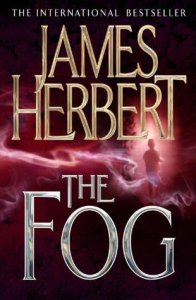
The Fog The Fog by James Herbert 3/5
I very rarely read horror novels these days but I used to read a lot of them. I enjoyed this one, about a mysterious fog that spreads across Britain, altering the minds of everyone who comes into contact with it.

Freezing by Penelope Evans 3/5
I have no memories at all of reading this book. According to Goodreads, it’s a crime novel about a photographer who works in a mortuary and tries to find the identity of a drowning victim who is brought into the morgue one day. It sounds a bit gruesome but I must have enjoyed it enough to give it a 3/5 rating.

First Impression by Margot Dalton 3/5
I can’t remember this one either. It’s another crime novel, this time about a detective trying to solve a missing child case.

Fog Heart The Ghost Road by Pat Barker 2/5
If you’d asked me whether I’d read anything by Pat Barker I would have said no, but obviously I did read this one. I think I’ll have to read it again as I can’t remember anything about it and I suspect it deserves more than 2/5! It’s the third in the Regeneration trilogy and I don’t have any record of reading the previous two, so maybe that was the problem.

Fog Heart by Thomas Tessier 2/5
The story of two couples who are drawn together when they attend a séance and meet a young medium called Oona. I do vaguely remember reading this book, but I wasn’t very impressed by it.

The Ghosts of Candleford by Mike Jeffries 2/5
Neither the title nor the author sound familiar to me but Amazon tells me that this is a ‘classic tale of the supernatural’. Seeing how many books I’ve read and then completely forgotten about has confirmed for me (if I needed to have it confirmed) that starting a book blog was an excellent idea!

Have you read any of these books? Can you shed any light on the more obscure ones?

I’ll be back soon with another selection, but if you missed my earlier Remember These? posts you can see them here.