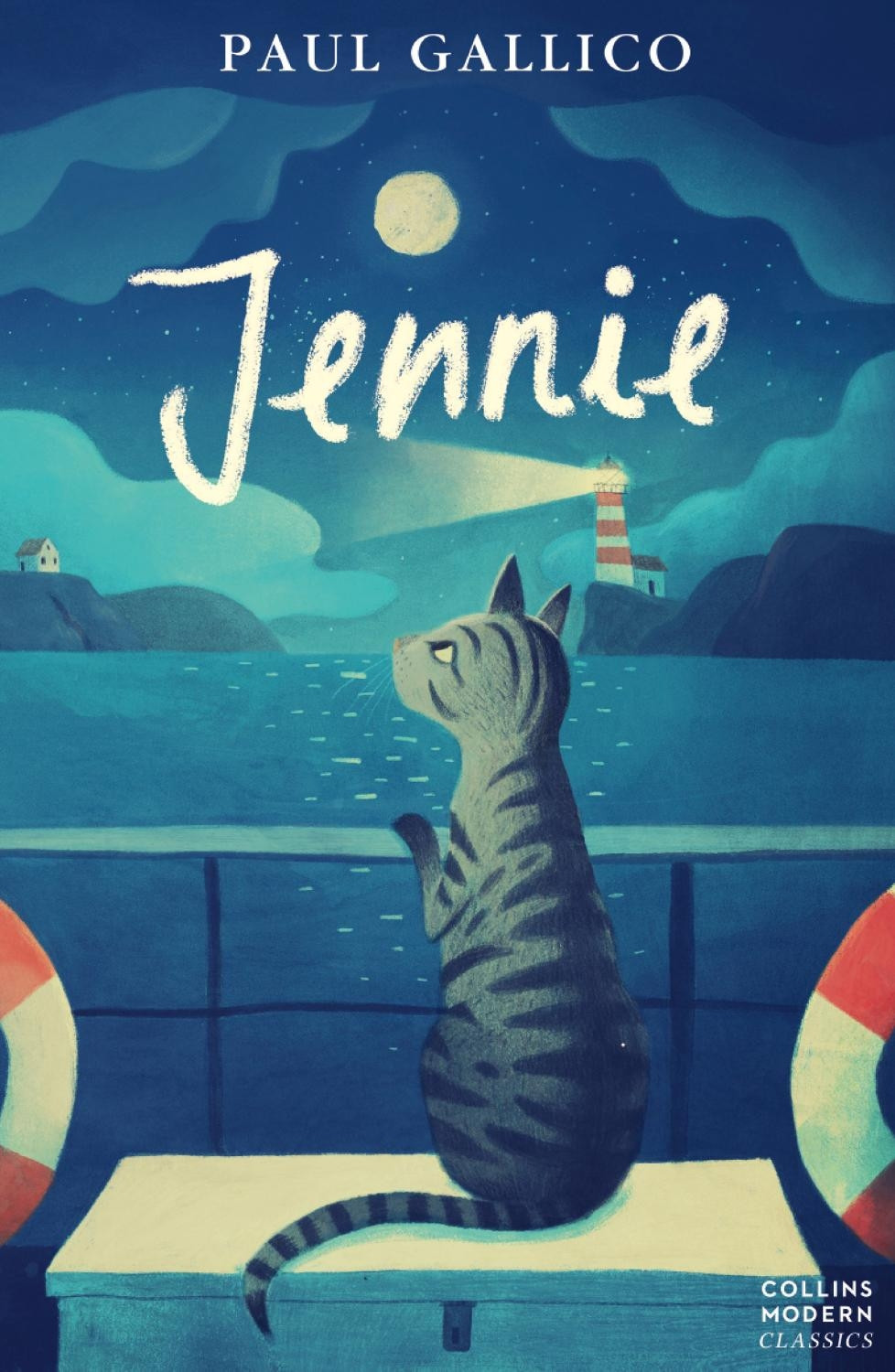
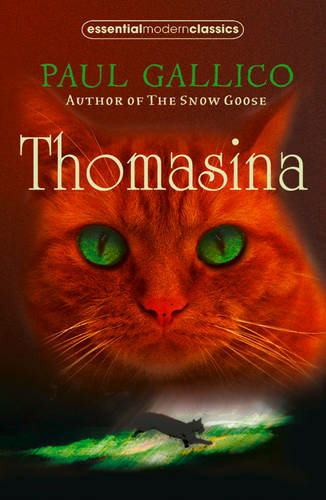
 This week Mallika of Literary Potpourri is hosting her third annual Reading the Meow event – a celebration of cats in literature. Last year I read and loved Paul Gallico’s Thomasina, so reading one of his other cat books seemed like a good plan for this year’s event. Jennie was originally published in 1950 (and also appeared under the title of The Abandoned in the US) and like Thomasina, it’s a book aimed at children that can also be enjoyed by readers of all ages.
Peter Smith is a lonely eight-year-old boy whose father, an Army officer, is often away from home and whose mother is too busy going out with her friends to have any time for her son. Peter has always wanted a cat of his own to provide the companionship he longs for but isn’t allowed one as his nanny is afraid of them. Everything changes for Peter when he is knocked down and injured running across the road after a striped kitten. When he awakens, he finds that he has been transformed into a white cat – and is immediately thrown out of the house by Nanny.
Alone on the streets of London with the body of a cat and the mind of a boy, he encounters an aggressive yellow tomcat, Dempsey, who decides to defend his territory and leaves Peter unconscious. He is rescued by Jennie, a small kind-hearted tabby who believes Peter’s story and offers to teach him how to behave like a real cat. And so Peter finds himself having lessons on washing, lapping milk, catching mice and the important of pausing in doorways to survey his surroundings! Meanwhile, Jennie tells him her own story of how she was left behind when her owners moved away and began to live the life of a stray. She convinces him to travel to Glasgow with her – because she was born there – and this is the start of many adventures the two have together.
I’m so disappointed that I didn’t read this book as a child as I’m sure I would have loved it. I did still enjoy it as an adult but I don’t think it had the same emotional impact on me that it would have had if I’d been in the target age group. It’s a lovely story and Peter and Jennie are both very likeable, but I felt that this book didn’t have the depth and layers that Thomasina had. Having said that, there were still some moments where I felt a tear in my eye, particularly towards the end!
 I loved the relationship between Peter and Jennie and the way they help each other to learn and grow. Peter is completely unprepared for life as a cat and relies on Jennie to teach him even the most basic things, but at the same time, his knowledge of how people behave and think and his ability to read and understand human speech proves very useful to Jennie. Like all good friends, Jennie and Peter have their disagreements – such as whether to accept a kind old man’s offer of a home – and on another occasion, Peter has his head turned by a pretty Siamese called Lulu, but I was sure their friendship would be strong enough to survive! The book was a little bit predictable and I guessed what would happen at the end, but maybe a younger reader wouldn’t.
This was a good choice for Reading the Meow – and also my first book for this year’s 20 Books of Summer! I’m now reading another cat-themed book which I hope to have time to review before the end of the week.

Book 1/20 for 20 Books of Summer 2025.


 She Reads Novels