The Big Four by Agatha Christie

The November theme for the Read Christie 2025 challenge is spies. I’ve already read the recommended book, Cat Among the Pigeons, and most of the suggested alternatives – I don’t want to read Postern of Fate yet as it’s the final Tommy and Tuppence book and I’m working through that series in order – so I looked for one I hadn’t read that featured international intrigue and espionage. The Big Four seemed suitable but I was a bit wary about reading it as it seems to have a bad reputation. I needn’t have worried, though, because although it’s clearly not one of her better books, I still enjoyed it!

The novel is narrated by Arthur Hastings, which is always a good thing – I love Hastings! – and he plays a big part in the story, having adventures of his own, not just as narrator and sidekick to Poirot. The book begins with a man arriving unexpectedly in Poirot’s doorway, appearing feverish and exhausted. Unable to speak, he writes the number 4 several times on a sheet of paper, and when he recovers he explains that he was referring to an international crime ring consisting of the Chinese mastermind Li Chang Yen, an American, a Frenchwoman and a mysterious fourth person known only as ‘the Destroyer’. Together they form the Big Four, a group trying to cause global unrest so that they can take over the world.

The rest of the book takes the format of a series of loosely connected episodes, as Poirot, with the help of Hastings, tries to identify the other three members of the Big Four. Of course, with their own spies and agents in every corner of the world, the Big Four know that Poirot and Hastings are on their trail and set various traps for them, some of which they fall into and some they don’t. Poirot attempts to set traps of his own, but although he manages to identify the American and the Frenchwoman fairly quickly, Number Four proves much more elusive.

I found The Big Four more entertaining than I expected, considering that Christie herself described it as “a rotten book”. It’s understandable why she would feel that way as the book was published in 1927, during a time when Christie was struggling financially and emotionally and had disappeared from her home for several days. She felt she had to force herself to complete this book and the next one, The Mystery of the Blue Train. This also explains the episodic nature of the book, because it was based on twelve previously published short stories which Christie reworked into a full-length novel rather than trying to come up with a completely original idea while she wasn’t in the right frame of mind to do so.

Despite the book’s origins and its silly, far-fetched plot, I think it’s better than some of her later thrillers, such as Destination Unknown, but I can see why it’s not well regarded and it certainly doesn’t feel like a typical Poirot novel. As I’ve said, though, it has Hastings in it, which is always a bonus, and we also get to meet – sort of – Poirot’s twin brother, Achille! It was a fun, undemanding read for me in this busy month of November, but probably not one I’ll want to revisit.

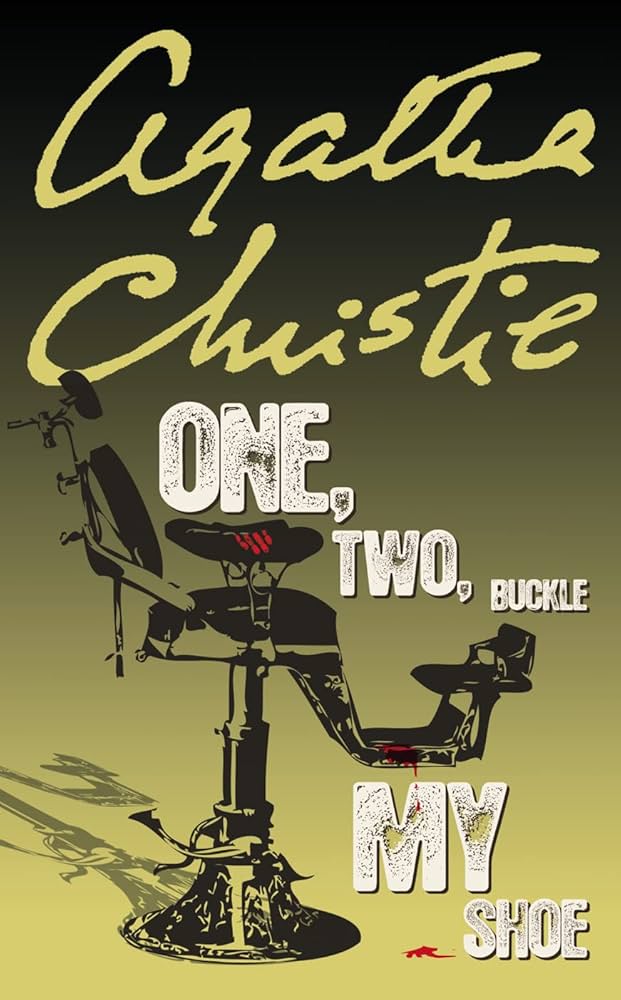
One, Two, Buckle My Shoe by Agatha Christie

This month’s theme for the Read Christie challenge is ‘medical professionals’ and One, Two, Buckle My Shoe is the perfect choice as it begins with the murder – or could it be suicide? – of a dentist. His name is Mr Morley of Queen Charlotte Street, London, and our old friend Hercule Poirot just happens to be attending an appointment on the day of Morley’s death. It seems that Poirot has a fear of visiting the dentist, but despite being nervous and preoccupied he still has his powers of observation and notices a young man in the waiting room who ‘looks like a murderer’. Learning of Mr Morley’s death later that day, however, it seems that the young man is not the only suspect. All of the patients who attended appointments in the hours before the body was discovered are under suspicion, along with the dentist’s family and servants.

Poirot works with Chief Inspector Japp of Scotland Yard in the early stages of the investigation, but when Japp uncovers information to suggest that Morley’s death was a suicide, Poirot is not satisfied. Too many things don’t make sense. Why, for example, did Morley’s secretary receive a fake telegram summoning her to an aunt in Somerset, ensuring that she would be absent from work on the day of the death? Poirot decides to continue investigating on his own, but it’s only when he begins to question whether he’s fallen into a trap that he is able to solve the mystery.

One, Two, Buckle My Shoe was published in 1940 and was the final Poirot novel to feature Inspector Japp. I do like the books where Poirot has someone else to work with and discuss some of his theories with, whether that’s Japp or (preferably) Captain Hastings. It’s also one of several Christie novels with titles based on nursery rhymes (Hickory Dickory Dock, Five Little Pigs and A Pocket Full of Rye are some of the others). Christie uses lines from the One, Two, Buckle My Shoe rhyme as the chapter titles and each line has some relevance to the events of the story – for example, in the first chapter we see a buckle fall off a woman’s shoe as she steps out of a car, although we won’t understand the significance of that until much later.

Published during the war, there are strong themes of political and financial instability and people with different views of how the world should move forward. One of the suspects, Alistair Blunt, is a prominent banker; another, Howard Raikes, is a political activist from America; and a third, Mr Barnes, worked for the Secret Service. However, this is only one part of the story and the book never becomes excessively concerned with politics. There are other suspects and other clues and motives as well and although I couldn’t solve the mystery myself, I enjoyed seeing Poirot explain it all in the denouement!

The Read Christie theme for September is ‘religious figures’ and the recommended title is At Bertram’s Hotel, which I’ve read relatively recently. I’ll wait to see what other options they suggest before deciding if I’ll take part.

Book 19/20 for 20 Books of Summer 2025.

Third Girl by Agatha Christie

This is the final book I’ve read for this year’s Read Christie challenge. I had intended to read it in November, but didn’t have time. I’m glad I’ve still managed to fit it in before the end of the year because, although I don’t think it’s one of Christie’s absolute best, I did enjoy reading it.

Norma Restarick is the ‘third girl’ of the title. The term refers to the practice of two girls who are living together in rented housing advertising for a third girl to take the spare room and share the rent with them. Norma crosses paths with Hercule Poirot when she approaches him for help because she thinks she may have committed murder – but after meeting Poirot in person, she flees, saying she’s made a mistake and he is too old to be of assistance.

Concerned – and insulted – Poirot tries to find out the reason for Norma’s visit to him and learns that the girl is acquainted with his friend, the mystery writer Ariadne Oliver. This makes it possible for Poirot, with Mrs Oliver’s help, to track down Norma’s family at their home in the country and the two girls she lives with in London. But Poirot is still confused. Norma says she thinks she has tried to poison her stepmother because a bottle of weed killer has been found in her room, yet she has no memory of actually doing it. It’s also not the only time Norma has experienced gaps in her memory. Convinced he doesn’t have all the facts and that the murder Norma originally referred to was not the attempted one she’s now confessing to, Poirot begins to investigate.

A common theme in Christie’s later books seems to be that society is changing and the world is moving on and she doesn’t like or understand it. Published in 1966, this book is firmly set in the 1960s and the older characters take every opportunity to complain about the fashions (particularly men with long hair), the music, the culture and what they see as rampant drug use amongst young people. I found this interesting as it gives the book a very different feel from the earlier Poirot novels. I think Poirot, like Christie herself, probably felt much more at home in the 1930s!

Third Girl is also unusual because for most of the book we don’t know if a murder has actually been committed and if so, who the victim is. This makes it less of a conventional detective novel and more of a psychological study of Norma Restarick. As we learn more about Norma’s past, there’s a real sense of her vulnerability and how she could be being manipulated by other people. Even when the true nature of the crime that needed to be investigated became clearer, I still didn’t correctly guess who the culprit was – and to be honest, I thought it was quite an unconvincing solution, which relied on several of the characters being very unobservant.

What I did love about this book is that Ariadne Oliver plays such a big part in it from beginning to end. She is often said to represent Christie herself and gives her a chance to comment on the writing of detective novels! It’s always nice to see her pop up in a Poirot mystery and I wish she was in more of them. In Third Girl, Mrs Oliver adds some humour to the book, as well as inadvertently providing Poirot with some of the key clues. Poirot is also present from the beginning of the book, rather than appearing halfway through as he often does.

I’m pleased to have completed eight of the twelve monthly reads for the 2024 Read Christie challenge. I’m looking forward to joining in again in 2025!

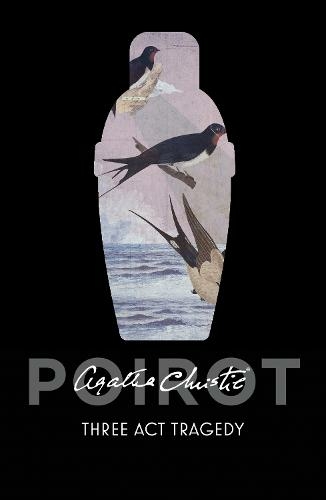
Three Act Tragedy by Agatha Christie

This month for the Read Christie challenge we are reading Christie novels published in the 1930s and I have chosen Three Act Tragedy from 1934. The book was also published in the US as Murder in Three Acts and that’s not the only difference – apparently the motive for one of the murders was also changed for the US edition. I’m not sure if there are any other Christie novels with significant differences between editions or if this is the only one.

Three Act Tragedy is a Poirot mystery but also features one of Christie’s other recurring characters, Mr Satterthwaite, who appears in The Mysterious Mr Quin and Murder in the Mews. At the beginning of the novel, Satterthwaite and Poirot are both attending a dinner party hosted by the stage actor Sir Charles Cartwright at his home in Cornwall. When one of the other guests, the Reverend Babbington, suddenly drops dead after taking a sip of his cocktail, several people suspect murder – yet there are no traces of poison in his glass. Soon afterwards, another death occurs under similar circumstances at a party attended by many of the same guests, but this time the victim is confirmed to have died from nicotine poisoning. Are the two deaths connected and if so, did the same person carry out both murders?

This is another entertaining Christie novel; maybe not one of her strongest plots, but the motive for the first murder is very unusual and I didn’t guess either that one or the motive for the second murder. I did start to suspect who was responsible, but not until much later in the book, so I can’t claim to have solved the mystery. We don’t see very much of Poirot himself as this is one of the books (like Lord Edgware Dies, which I read last month) where he sits at home and waits for other characters to provide him with information, rather than going out to interview suspects and search for clues himself. Instead, the deaths are investigated by Mr Satterthwaite and Sir Charles, with help from Miss Lytton Gore, affectionately known to her friends as Egg.

I would have liked Poirot to have played a bigger part in the story as although I like the elderly Mr Satterthwaite, he’s not very skilled at detecting, and I never really felt fully engaged with either Sir Charles or Egg. There’s an interesting cast of supporting characters, such as Muriel Wills, who writes plays under a male pseudonym, but I felt that some of these weren’t really used to their full potential. This wasn’t a favourite Christie, then, but I did still enjoy it – and it was good to see Poirot sharing a little bit of his personal history in a conversation with Satterthwaite, as he usually reveals very little about himself.

Next month for the Read Christie challenge (and for August and September as well) we are moving on to the 1940s and 1950s. There are plenty of books I still have to read from those decades, but one I definitely have lined up is N or M?, the third in the Tommy and Tuppence series. I’m hoping to make that one a July read.

This is book 5/20 of my 20 Books of Summer 2024.

Lord Edgware Dies by Agatha Christie

This year’s Read Christie challenge has a ‘Through the Decades’ theme and this quarter we’re reading books from the 1930s. My choice for May is Christie’s 1933 Poirot mystery Lord Edgware Dies (published in the US as Thirteen at Dinner).

The novel is narrated by Poirot’s friend, Captain Hastings – a nice surprise as I tend to love the Hastings books and hadn’t realised he was in this one. At the beginning of the book, Poirot and Hastings are visiting the theatre to watch a performance by the American impressionist Carlotta Adams, known for her impersonations of famous people such as the actress Jane Wilkinson. After the show, they are approached by Jane Wilkinson herself, who asks for Poirot’s help in obtaining a divorce from her husband, Lord Edgware. The actress desperately wants to marry the wealthy Duke of Merton and tells Poirot that if Edgware won’t agree to a divorce, she’s just going to have to kill him!

When Lord Edgware is indeed found dead in his own home, having been stabbed in the neck, Jane Wilkinson appears to be the obvious suspect – after all, she was seen entering the house that evening and everyone knew that she wanted her husband dead. However, Edgware had already agreed to a divorce earlier that day, taking away Jane’s motive. And Jane had spent the whole of that evening at a dinner party with twelve other guests, all of whom can provide her with an alibi. Was Jane really in two places at once – or was it Carlotta Adams who entered Lord Edgware’s house in disguise?

This is a very enjoyable Poirot novel with a clever solution, although I don’t think it’s an absolute favourite as I found it a little bit lacking in atmosphere. The whole story takes place in London and we don’t see much of Poirot actually going out in search of clues – instead he sits and waits for the clues to come to him, much to the frustration of Hastings who wishes Poirot would take a more active role in solving the mystery, like their old friend Inspector Japp:

Poirot replied that he preferred to solve it sitting at home.

“But you can’t do that, Poirot.”

“Not entirely, it is true.”

“What I mean is, we are doing nothing! Japp is doing everything.”

“Which suits me admirably.”

“It doesn’t suit me at all. I want you to be doing things.”

“So I am.”

“What are you doing?”

“Waiting.”

Of course, Poirot is the one who correctly identifies the murderer while Japp, as usual, jumps to the wrong conclusions. I also failed to solve the mystery; although I did guess part of the solution very early on, I allowed myself to get distracted by the red herrings, of which there are many!

What I particularly loved about this book was the relationship between Poirot and Hastings and the way they work so well together, with some chance remarks of Hastings’ inadvertently pointing Poirot in the direction of important clues. Having the novel narrated by Hastings means the reader gets to hear Poirot discussing possible theories with him and sharing his thought processes, which I find more enjoyable than the books where we have no idea what Poirot has been thinking until the end. It also means that we only see the various suspects and witnesses from Hastings’ perspective; Jane Wilkinson, for example, presents herself in public as so silly and vacant that we know there must be more to her than meets the eye. Jane is a great character and Jenny Driver, Carlotta Adams’ friend who owns a fashionable London hat shop, was another favourite.

I’m hoping to read another 1930s Christie novel in June, then for July-September we move on to the 40s and 50s!

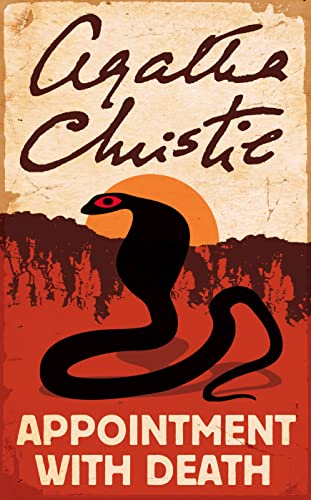
Appointment with Death by Agatha Christie

The September prompt for Read Christie 2023 is a motive: hatred. This is obviously a common motive for murder and there are plenty of Christie novels to fit this month’s theme, but the suggested title is Appointment with Death, a 1938 Poirot mystery set in the Middle East.

Newly qualified doctor Sarah King and French psychologist Dr Gerard are relaxing in the lounge of their Jerusalem hotel when their attention is drawn to an American family who have just entered the room. The head of the family is Mrs Boynton, a monstrous woman who takes a sadistic pleasure in controlling the lives of her adult children. Even her eldest stepson Lennox, who is married, is still completely under her thumb. As Sarah and Dr Gerard learn more about the Boyntons, they each begin to develop a personal interest in the family – Sarah because she has become romantically attracted to Lennox’s brother, Raymond, and Gerard because he thinks he has spotted the early signs of schizophrenia in the youngest Boynton child, Jinny.

When the party moves on to Petra, with the additions of British politician Lady Westholme, her spinster friend Amabel Pierce, and a certain Hercule Poirot, a murder takes place. Nobody has much sympathy for the victim, but the murderer must still be caught – and who better to catch them than Poirot? Insisting that he can solve the mystery in twenty-four hours, he sets out to interview the suspects and sort through the available clues, while remembering a conversation overheard from his hotel window one night: “You do see, don’t you, that she’s got to be killed?”

I always enjoy Christie – even her weaker books are entertaining – but this is a particularly good one! The relationship between the members of the Boynton family is fascinating; Mrs Boynton is a truly horrible woman who has ensured that her children and stepchildren have no friends, no freedom and no independence. Why she has allowed them to come on this trip at all is a mystery in itself and one of the questions Poirot will have to answer.

I loved the Middle East setting (a part of the world Christie knew well due to her travels with her archaeologist husband, Max Mallowan) and although the crime is committed amongst the historic sites of Petra, it almost still has the feel of a typical country house mystery with caves and tents taking the place of rooms. I can’t really claim to have solved the mystery, but I did narrow it down to two suspects and one of them was correct! I missed an important clue which would definitely have pointed me in the right direction earlier on if I had picked up on it, but I think Christie is very fair with the reader in this book and all the clues are there to be seen, as long as you’re paying attention.

I’m not sure yet whether I’ll be taking part in Read Christie next month, but if not I’m looking forward to reading Endless Night in November.

Hickory Dickory Dock by Agatha Christie

February’s prompt for the Read Christie 2023 challenge is a murder method – the use of a blunt object. A lot of Christie’s novels involve murders carried out in this way and there were plenty of suggestions on the official challenge page this month. I chose a book I hadn’t read, Hickory Dickory Dock, which is a Poirot mystery first published in 1955.

The novel begins with the unthinkable – Poirot’s very efficient secretary, Miss Lemon, has made a mistake! Several mistakes, in fact, in a letter she has been typing. When Poirot asks her if something is wrong, she confesses that she’s worried about her sister, Mrs Hubbard, who has recently begun working at a student hostel on Hickory Road. Strange things have been happening at the hostel, Miss Lemon explains – a number of items have been stolen, but there seems to be no logic behind the thefts. A diamond ring, light bulbs, a stethoscope, lipstick, one shoe…what can be the connection? Finding an excuse to visit Hickory Road for himself, Poirot begins to investigate. At first it seems that there could be a fairly innocent explanation, but as these little incidents begin to take a more malicious turn, Poirot needs to discover the truth before somebody is killed.

This is one of several Christie novels that uses part of a children’s rhyme as its title, but apart from the name of the street, it doesn’t have any significance to the plot this time – unlike, for example, A Pocket Full of Rye or Five Little Pigs. That was a bit disappointing (surely a mouse or a clock could have been worked into the plot somehow!) but otherwise I enjoyed this book. I don’t think it’s one of the very best Poirot novels, but even a slightly weaker one is still fun to read. Although the crimes being committed seem quite trivial at the beginning, it gradually becomes clear that something more serious is going on in the background and once the murder takes place, the plot becomes much more compelling.

Setting the novel in a house full of students gives it a busy, bustling feel and means there’s a large cast of characters to provide both victims and suspects. The students are of all nationalities, some British, some French, with others from Africa, Jamaica, India and a whole range of other places. As the book was written in the 1950s, you can probably guess that the way these characters are portrayed is not always politically correct; there’s some racist language and some attitudes that aren’t considered acceptable today. However, for the most part, the students seem to mix together across racial and class boundaries, forming the usual friendships and rivalries you would find in any large group of young people.

I can’t really claim to have solved the mystery, as I worked out part of it but not all of it, but I don’t think it was one of Christie’s cleverest plots and the solution wasn’t as surprising as some of her others. Still, it was entertaining, as all of her books are, and I’m looking forward to reading more as Read Christie 2023 progresses. The March prompt is a motive – anger. I’m not sure yet whether I’ll be joining in with that one, but will see if I can fit it into my March reading.