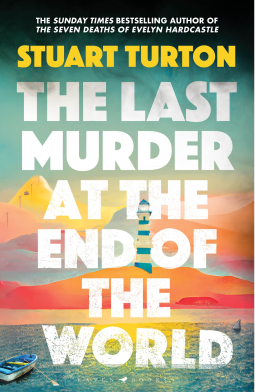
The Last Murder at the End of the World by Stuart Turton

Stuart Turton is, in my opinion, one of the most original and imaginative authors writing today; although I know his style doesn’t work for everyone, I loved his first book, The Seven Deaths of Evelyn Hardcastle, which was unlike anything else I’ve ever read. His second novel, The Devil and the Dark Water, a mystery set aboard a 17th century Dutch trading ship, disappointed me, but I recently read his short story, The Master of the House and loved that one too, so I was curious to see what this, his newest novel, would be like.

The Last Murder at the End of the World combines a murder mystery with a post-apocalyptic setting. The world as we know it has been destroyed by a black toxic fog that has swept across the planet, killing everyone it touches. The only place the fog hasn’t reached is a small Greek island, home to the Blackheath scientific research facility. The island is inhabited by one hundred and twenty-two villagers and three scientists from Blackheath, who have become known as the Elders. While the scientists continue their research into the fog and the security system that is holding it back from the island, the villagers farm the land and obey the rules set out for them by the scientists, while being discouraged from thinking too deeply for themselves.

Disaster strikes when one of the scientists is murdered and the barrier keeping the fog at bay is broken down. If the islanders can solve the murder within ninety-two hours, the barrier will be restored – if not, the fog will envelop the entire island. One of the villagers, Emory, is more resourceful than the others; rather than just accepting the situation and her place in society, she has always been curious and eager to learn. The task of investigating the crime, then, falls mainly to Emory – but to make her job even more difficult, the security system has also wiped the memories of the villagers, so someone could be a murderer without even knowing it.

The Last Murder at the End of the World is a difficult book to write about without spoiling too much. From the beginning, we are faced with lots of intriguing questions. Why do none of the villagers live past the age of sixty? Who or what is ‘Abi’, the omniscient voice who is present in everyone’s mind? Are the three Elders working with the villagers or against them? Everything is explained eventually but I won’t discuss the plot in any more depth here. I think if you’ve read other dystopian/post-apocalyptic novels you’ll already have an idea of the sort of things being explored, such as why some people survived and not others and whether society can be rebuilt to make the new world a better place than the last one.

The murder mystery element is interesting mainly because of the limitations that are placed upon it – the short period of time in which Emory has in which to solve the mystery and the fact that nobody can remember anything they may have done or witnessed on the night of the crime. There are also some surprising plot twists and revelations that meant I was constantly questioning and re-evaluating everything I thought I had figured out. However, this is definitely a book where the characters take second place to the plot; the three scientists are particularly difficult to like and, apart from Emory, the villagers are bland and not easily distinguished from each other. For this reason, The Last Murder at the End of the World is a novel I enjoyed from an intellectual perspective but not from an emotional one.

Thanks to Raven Books for providing a copy of this book for review via NetGalley.
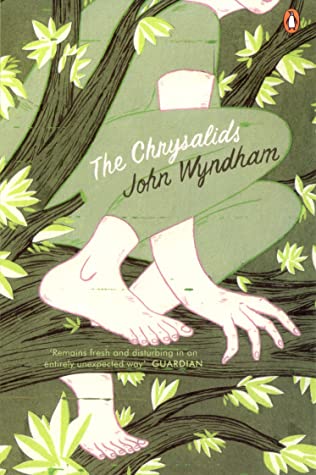
The Chrysalids by John Wyndham

The Chrysalids is the book that was chosen for me in the recent Classics Club Spin. The deadline for posting our Spin book reviews was supposed to be yesterday, but I got confused with the dates and am a day late! Anyway, after enjoying all of the books I’ve previously read by John Wyndham – The Midwich Cuckoos, Chocky and The Day of the Triffids – I had high hopes for this one and wasn’t disappointed. It’s another fascinating, exciting and thought-provoking novel – although not quite what I’d been expecting.

I deliberately tried not to read too much about this book before I started it, so I assumed the Chrysalids must be some sort of monstrous alien beings similar to the Triffids. However, this is not really that kind of book at all; it’s a post-apocalyptic novel exploring the changes in society brought about by an unspecified (though presumably nuclear) disaster known as the ‘Tribulation’. There are no monsters, although some of the characters view their fellow humans that way.

Our narrator, David Strorm, was born many years after the Tribulation in rural Labrador, a part of the world where normal life has resumed to some extent, although the ‘Old People’ have been almost forgotten and their technological advances have been lost in the mists of time. The people of Labrador are living an almost medieval existence, ruled by religious zealots who believe that as God created humans in his image, all human life should conform to a set of strict specifications. Anyone who is found to deviate from this in any way is considered a blasphemy and exiled to the Fringes, a wild and lawless region to the south. Unfortunately, as a result of the nuclear apocalypse, mutations have become very common.

David is still a child when his best friend Sophie is banished to the Fringes after her shoe comes off, revealing a sixth toe. Having witnessed Sophie’s fate, David becomes aware of the importance of keeping his own mutation – the power of telepathy – a secret. A mental abnormality should be easier to hide than a physical one, but the very fact that he and his telepathic friends look just like everyone else makes them a bigger threat to the religious leaders who are determined to identify and drive out every blasphemy. Can David and the others continue to keep their special ability hidden – and what will happen if they get caught?

What makes The Chrysalids so interesting is that although it was published in 1955 and set in some distant point in the future, the themes and ideas it explores are still very relevant to our lives today. Intolerance, bigotry and prejudice have sadly not gone away and there is still a tendency for some groups to judge others for not being ‘people like us’. The Chrysalids raises the interesting question of what being normal actually means and why any of us should have the right to decide whether another person is normal or not. Later in the novel another community is introduced who also consider their own way of life to be superior and to them it’s the religious fundamentalists of Labrador who are seen as primitive and savage.

Like the other Wyndham novels I’ve read, the science fiction elements in this one are really quite understated; the main focus is on the changes in society and in daily life caused by an apocalyptic or paranormal incident. I think this is why I enjoy reading Wyndham so much even though I don’t consider myself a big fan of science fiction in general. However, although I loved most of this book and found it quite gripping, I felt that the message became a bit unclear towards the end, possibly intentionally, with the introduction of that other community (it’s difficult to discuss it properly here while trying to avoid spoilers). Still, I was left with a lot to think about, which is always a good thing, and I wished there had been a sequel, or at least a few more chapters, as it seemed there was a lot more to learn about this world and our characters’ place in it. If you’ve read this book I would love to hear your thoughts!

This is book 31/50 from my second Classics Club list.

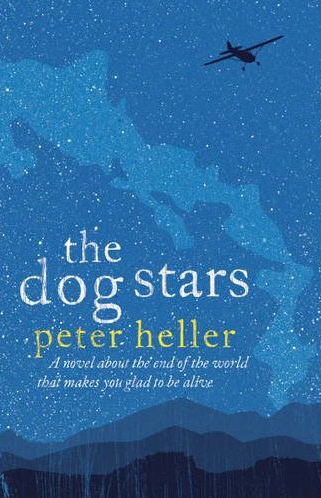
The Dog Stars by Peter Heller

The Dog Stars is a post-apocalyptic novel set nine years after life on earth was almost entirely wiped out by a flu-like illness. Among the few survivors is Hig, a pilot from Colorado who lost his beloved wife Melissa to the disease and has been left alone with his dog Jasper and his Cessna plane. He spends a lot of his time flying over the mountains surveying the area and searching for food for himself and his nearest neighbour, Bangley, a tough, aggressive man who is obsessed with guns and killing.

Under normal circumstances, Hig and Bangley would have had little in common, but to survive in this new world they have decided to work together to protect the abandoned airport compound they both call home. Then one day Hig hears a voice on his radio and is intrigued. He wants to find out who else might be out there, but there’s one big problem – if he flies too far he might not have enough fuel to get back…

I have read very few novels in this genre so The Dog Stars was not the type of book I would normally choose to read and at first I didn’t think I was going to like it, especially when I discovered it was written in an unusual, disjointed, almost stream-of-consciousness style. I expected to pick up the book, read a few pages then put it down again – so I was surprised to find how completely I was drawn into Hig’s world and although I didn’t love the book it was certainly an interesting experience.

The writing style is very different and it took me a while to get used to it. The sentences are short and often incomplete and don’t seem to follow the normal rules of grammar or punctuation. I usually hate this kind of experimental writing and often I can’t see any reason for it, but with this book it did seem to suit the story and I think I do understand why the author chose to write it in this way. I can accept that a man spending most of his time alone with only his dog for company, rarely interacting with other humans, may eventually begin to think differently; another possibility is that Hig’s command of language has been affected by the illness he suffered from (and was lucky enough to recover from, unlike most of the population). Either way, Hig’s story probably wouldn’t have been nearly as effective or memorable if it had been written in normal prose. However, it did make the book much more challenging to read than it would otherwise have been!

I found it depressing that almost all of the other characters who appear in the book are so mindlessly brutal and violent. If you’re living in isolation and come across another survivor, why not talk to them and see if you can help each other, instead of immediately attacking them or stealing from them without even trying to make contact first? I realise that people were competing for dwindling resources and worried about running out of food, but it was hard for me to understand their behaviour. It could be realistic, I suppose, but it seemed such a sad and pessimistic outlook. That’s why I liked Hig, who even in this lonely, desolate world manages to retain some of his compassion and humanity. He kills when he needs to in order to protect himself or when he is threatened by intruders, but he doesn’t take the pleasure in it that Bangley does. He also pays regular visits to some families of Mennonites nearby who have become infected with the disease, and takes them food and supplies.

We are only given brief descriptions of how the flu and the blood disease that followed led to the destruction of most of the world’s population – I would have liked to have learned more about what happened, but that was not the focus of the novel. Instead this is a story about people trying to survive in the wilderness that remains. And in the end, the novel does take a more positive, optimistic view and leaves us feeling more confident that there might still be hope for the human race.

The Dog Stars has been compared to The Road by Cormac McCarthy which I haven’t read so can’t comment on how similar or different they are. With my very limited knowledge of dystopian/post-apocalyptic fiction I would recommend that fans of the genre give this one a try, but I think it was a bit too far out of my comfort zone for me!

I received a copy of The Dog Stars from Headline for review