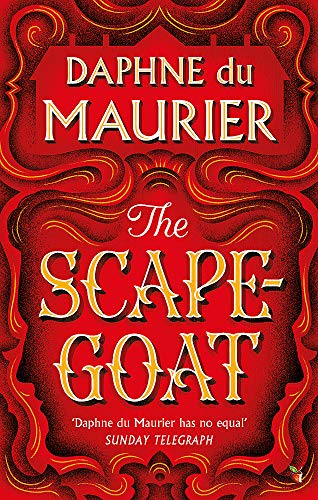
The Scapegoat by Daphne du Maurier (re-read) – #DDMReadingWeek

This week HeavenAli is hosting another of her Daphne du Maurier Reading Weeks, assisted by Liz who is collecting the links this year. As you may know, du Maurier is one of my favourite authors; I have now read all of her novels and short story collections at least once and some of her non-fiction (I attempted to rank them all in this post, just for fun). For this year’s Reading Week I’ve decided to re-read her 1957 novel The Scapegoat, which is one I particularly loved when I first read it back in 2011 (here’s my original review). I’ve wanted to read it again ever since, not just because I enjoyed it so much, but also because I formed a theory about what was actually happening in the book and I was curious to see whether I would feel the same way on a second read. I’ll discuss this later in this post, but don’t worry – I’ll include a spoiler warning for those of you who haven’t read the book yet.

The novel opens in Le Mans where our narrator, John, an English academic, is on holiday. When he meets a man who looks and sounds just like him at the station, he feels an instant connection with him and after spending the evening drinking and talking, he accompanies the other man back to his hotel room. He learns that his new friend is a French count, Jean de Gué, and that they have something else in common – they are both depressed and dissatisfied with life, John because he is lonely and has no family, Jean because he has a large family, all of whom are causing him problems. As the night wears on, John falls into a drunken stupor and when he wakes up the next day his companion has disappeared, taking all of John’s clothes and possessions with him and leaving his own in their place.

When Jean’s chauffeur arrives, ready to drive him home to his château in the French countryside, John begins to protest, explaining that there has been a mistake – but then, on an impulse, he decides to take this opportunity to leave his old life behind for a while and continue to impersonate Jean de Gué. On reaching Jean’s château, John finds that nobody suspects he is an impostor and he is able to take Jean’s place within the family. He also begins to understand why Jean had said his family life was so difficult – there are all sorts of tensions and conflicts between various members of the family and to make things worse, the de Gué glassworks is facing financial ruin. It’s up to John to put things right, if he can.

I enjoyed this read of The Scapegoat as much as my first. If you take everything at face value, of course, it requires a huge suspension of disbelief. Not only do John and Jean look completely identical, so much so that not even Jean’s mother, wife or daughter guess the truth, but they also sound exactly the same (and John’s French is so fluent that nobody suspects a thing). Is this likely? Of course not, but it provides du Maurier with her starting point for this fascinating novel and it’s perfectly possible to just accept the plot for what it is and enjoy the story. After all, it’s no more ridiculous than the book that apparently inspired this one – Anthony Hope’s The Prisoner of Zenda. And as always with a du Maurier novel, you can expect beautiful descriptions, a strong sense of place and interesting, if not necessarily very likeable, characters.

*My Scapegoat theory (includes spoilers)*

When I first read this book in 2011, I found myself beginning to wonder – what if John and Jean weren’t doubles after all? What if there was only one man, with multiple personalities (now known as dissociative identity disorder)? It makes so much more sense to me that Jean, feeling that he has made a mess of his life, has created a new identity to deal with the problems he has caused for himself. At the end of the book, when everything has been resolved, he has no further need of John and although it’s not clear exactly how much Jean has learned and how he will manage his relationships and business affairs in the future, he feels that he can now cope on his own. He tells John that he has emptied John’s bank account, sold his flat and furniture in London and resigned John’s position as university lecturer – in other words, destroyed John altogether, because John never really existed and is no longer necessary.

After finishing the book on that first occasion, I remember looking at other reviews and being surprised that almost nobody else had mentioned that any of this had occurred to them too. I accepted that I must have misunderstood the whole book; however, the Daphne du Maurier website quotes a letter written by Daphne herself regarding The Scapegoat which seems to support my interpretation. Her reference to ‘that man’s nature’ doesn’t really make sense to me if there were actually two separate men in the book.

“Every one of us has his, or her, dark side. Which is to overcome the other? This is the purpose of the book. And it ends, as you know, with the problem unsolved, except that the suggestion there, when I finished it, was that the two sides of that man’s nature had to fuse together to give birth to a third, well balanced.”

On reading the book for a second time, I have been paying closer attention and looking for subtle clues and hints. There are just three main obstacles in the way of my theory. First, there’s Jean’s dog, César, who is hostile towards John and the only member of the household who seems to sense that something is wrong. However, when Jean and John meet up again at the end of the book, Jean explains that John hasn’t been whistling to César in the correct way and this is why he hasn’t been obeying his commands. Also, during a scene in a hospital, we are told that Jean is blood group O and John is blood group A – but as it’s John himself who tells us this I don’t think it can be taken as conclusive evidence of anything. The only thing I can’t manage to explain away is that when Jean calls the château to inform John that he’s coming home, it’s a servant who answers the phone and tells John that someone wants to speak to him. If it wasn’t for this one moment, I would have been nearly convinced that I was right!

I did find plenty of things to support my theory, including the fact that, when speaking to Jean’s family for the first time, John finds that the ‘tu‘ form of French comes naturally to him, although he’s never used it before; the way John muses that Jean’s ‘inner substance was part of my nature, part of my secret self’; and in particular, the whole conversation he has with Jean’s mistress, Béla, in Chapter 12.

‘You said something a while ago about taking stock of oneself,’ I said. ‘Perhaps that’s just what I’ve been doing, over a period of time, and it came to a head that evening in Le Mans. The self I knew had failed. The only way to escape responsibility for failure was to become someone else. Let another personality take charge.’

‘The other Jean de Gué,’ she said, ‘the one who’s been hidden for so long beneath the surface gaiety and charm, I’ve often wondered if he existed. If he’s going to emerge, he’d better do so now. Time’s getting on.’

What do you think?

*End of spoilers*

Overall, after finishing my second read of the book, I think probably the way everyone else has interpreted it is the correct way, but du Maurier does like to be ambiguous and I enjoyed looking below the surface and dissecting the different layers! It really is a fascinating novel and still one of my favourites by du Maurier. Now I just need to find time to revisit some of her others!

Rebecca by Daphne du Maurier (re-read)

Sometimes re-reading a favourite book can be a disappointment; perhaps you’ve changed too much as a person since the last time you read it and the story and characters no longer have the appeal they used to have – or maybe it just loses some of its magic because you’ve read other books in the meantime that are similar and better. Luckily, I experienced none of that disappointment when I picked up Rebecca for a re-read recently. I fell in love with it all over again!

For those of you who have not yet read Rebecca, I’ll give a brief summary of the plot – and the first thing I should probably say is that we never actually meet Rebecca herself. She dies a year before the novel opens, although with her bright and vibrant personality she is a very strong presence throughout. Our narrator, in contrast, is a shy and awkward young woman who remains nameless from beginning to end; our only clue is that she has a ‘lovely and unusual’ name and one which is difficult to spell. It is while working as a companion to the overbearing Mrs Van Hopper in Monte Carlo that the narrator meets and falls in love with Rebecca’s widowed husband, Maxim de Winter, who is thought still to be grieving for his wife. The last thing she expects, then, is to receive a proposal of marriage from Maxim and to be whisked off back to England to his house in Cornwall.

Although the narrator is captivated by the magnificence of her new home, Manderley, and its beautiful surroundings, she also feels intimidated and out of place. She knows that Rebecca lived here with Maxim for years and that Rebecca was so much better at everything than she will ever be – something the housekeeper, Mrs Danvers, won’t let her forget. It’s not long before the narrator begins to tell herself that her marriage is a mistake…she’s convinced that Maxim still loves Rebecca, but is there more to this situation than meets the eye?

I’m not sure whether this is the third or the fourth time I have read Rebecca, but I do know that it must be at least ten years since I read it last – long enough that I can remember the outline of the plot but not every little detail. Reading it again was a wonderful experience, right from the famous opening line, “Last night I dreamt I went to Manderley again”. As I’ve said before, du Maurier is one of the most atmospheric writers I’ve ever come across; she makes it so easy to picture every scene in vivid detail. All of her novels are beautifully written, but this one particularly so.

I know a lot of readers find the second Mrs de Winter frustrating, but I have never had a problem with her, probably because when I first read this book as a teenager I was also a shy, sensitive person so I found it easy to understand and sympathise with her. It’s worth remembering that she is only twenty-one, completely alone in the world (to the point where, when she sits down at her new writing desk at Manderley, she can think of no one to write to but Mrs Van Hopper) and has never been taught to manage servants, host a party or do any of the other things that are suddenly required of her. Not everyone can be as confident as Rebecca, after all, and it is the narrator’s sense of inferiority whenever Rebecca is mentioned which drives the plot forward and adds to the feeling of tension and claustrophobia.

I didn’t care for Maxim this time round, though. I know his distant, brooding nature is as important to the plot as his wife’s uncertainty and paranoia – and if they had been different people the story would not have worked – but I thought he could have been much more supportive of her, particularly after (trying not to spoil too much here) the white dress scene. It’s sad that she seems so much more comfortable and at ease with Maxim’s friend, Frank Crawley, than she does with her own husband. On the other hand, I felt slightly more sympathetic towards Mrs Danvers this time; I can see that she’s much more complex than I’d thought on my earlier reads.

Finally, I want to say that this is one of the few cases where I think the film (the 1940 one with Joan Fontaine and Laurence Olivier) is as good as the book. What do you think?

This re-read means that I’m coming to the end of a little project I have been working on over the last few years. In 2009, having previously only read Rebecca and Jamaica Inn, I decided I wanted to read the rest of du Maurier’s novels and I have now read all of them, with the exception of Castle Dor which I’m hoping to read soon (after I’ve read that one I’ll do a round-up post and pick out some of my favourites). I do still have some of her short story collections and most of her non-fiction books to look forward to, though!

This is book 8/20 of my 20 Books of Summer – and also book 99/100 from my Classics Club list.

Wuthering Heights by Emily Brontë (re-read)

Since I started blogging in 2009 (which seems so long ago now) I have discovered lots of great books, have tried genres I had never thought about trying before, and have been introduced to some wonderful new authors. One thing that has been sadly neglected, though, is re-reads of my old favourites – something that used to form such an important part of my reading life. Making more time for re-reads has been a goal of mine for the last few years, but I have never actually done it; I’m determined that 2017 will be different! I have re-reads of Rebecca and The Count of Monte Cristo coming up soon for the Classics Club, both of which I’m looking forward to, but before I get to those two, I’ve been revisiting a book I first fell in love with as a thirteen-year-old: Emily Brontë’s 1847 classic, Wuthering Heights.

For those of you who have not yet had the unforgettable experience (in one way or another) of reading Wuthering Heights, here is a quick summary. The novel opens in 1801 with Mr Lockwood, the new tenant at Thrushcross Grange in Yorkshire, paying a visit to nearby Wuthering Heights to meet his landlord, Heathcliff. Lockwood is hoping for some peace and quiet in which to enjoy his stay at the Grange and at first he is happy with what he sees in Heathcliff. It’s not long, however, before he discovers that what he had mistaken for quiet reserve hides a cruel and violent nature. After passing an uncomfortable night at Wuthering Heights, in which he is treated with hostility by the inhabitants and tormented by strange dreams, Lockwood retreats to the safety of his own lodgings, where he begs his housekeeper, Nelly Dean, to tell him what she knows of Heathcliff and his household.

Most of the novel is narrated by Nelly Dean, as she relates the story of Heathcliff’s first arrival at Wuthering Heights, a child brought back from Liverpool by old Mr Earnshaw, and raised alongside Earnshaw’s own children, Catherine and Hindley. As the years go by, the childhood friendship between Heathcliff and Catherine begins to develop into something more, but when Edgar Linton from Thrushcross Grange enters Catherine’s life, Heathcliff finds himself pushed aside. He devotes the rest of his life to causing misery for the Lintons – as well as taking revenge on Hindley who, unlike his sister, had never accepted Heathcliff as one of the family.

It seems that a lot of people who dislike Wuthering Heights approached it for the first time expecting a romantic love story and in that case I can understand why they would be disappointed. The relationship between Heathcliff and Cathy is hardly a conventional romance and although there is love, it is an obsessive and unhealthy love. When I first came to this book as a young teenager, though, I had no idea what it was about and no expectations whatsoever, so none of that bothered me. At that age, I loved it for the darkness, the melodrama and the passion. The blurb on the back of my old Penguin copy (not the one pictured above) describes Wuthering Heights as “perhaps the most passionately original work in the English language” and I think I would agree with that. Who could forget the moment Catherine declares her love for Heathcliff:

“If all else perished, and he remained, I should still continue to be; and if all else remained, and he were annihilated, the universe would turn to a mighty stranger: I should not seem a part of it. My love for Linton is like the foliage in the woods: time will change it, I’m well aware, as winter changes the trees. My love for Heathcliff resembles the eternal rocks beneath: a source of little visible delight, but necessary. Nelly, I am Heathcliff! He’s always, always in my mind: not as a pleasure, any more than I am always a pleasure to myself, but as my own being.”

Another reason people have for not liking Wuthering Heights is the unpleasant, unsympathetic characters. Well, I can’t argue with that. They are certainly unpleasant – not just Heathcliff and Cathy, but most of the supporting characters too, from Nelly herself, who puts the child Heathcliff “on the landing of the stairs, hoping it might be gone on the morrow”, to the elderly servant, Joseph, “the wearisomest self-righteous Pharisee that ever ransacked a Bible to rake the promises to himself and fling the curses to his neighbours”. And although I’ve always had a soft spot for Hareton Earnshaw, Hindley’s son, I struggle to find any sympathy for any of the others. But again, not liking the characters has never been a problem for me where this particular book is concerned.

This is not the first time I’ve re-read Wuthering Heights but it is the first time for quite a few years. I was worried that I would feel differently about it, but I’m pleased to say that I still loved it. I did find different things to notice and appreciate this time – with more knowledge of Emily Brontë herself than I had during previous reads, I could think about the ways in which she may have drawn on her own life for inspiration in writing her novel (the descriptions of Hindley’s drunken behaviour, for example, were surely influenced by Emily’s experiences with her brother Branwell). I also found myself constantly noting down favourite passages and phrases, such as the wonderful description of Cathy’s relationship with the Lintons as “not the thorn bending to the honeysuckles, but the honeysuckles embracing the thorn”.

I thoroughly enjoyed my re-read and am looking forward to re-reading more old favourites during the rest of the year.

What do you think of Wuthering Heights? Do you love it or hate it?

Flashback Challenge

The Flashback Challenge will run from January 1, 2010 – December 31, 2010 and will be hosted by Aarti and Kristen M.

You can sign up for the following levels:
Bookworm – Up to three books
Scholar – Four to six books
Literati – Over six books

Within these levels, we have mini-challenges! These are:

1. Re-read a favorite book from your childhood
2. Re-read a book assigned to you in high school
3. Re-read a book you loved as an adult

I love re-reading books and this challenge will tie in perfectly with my new Great Books feature, so I’m signing up for the Literati level.

I would like to re-read any or all of the following books, though my list will probably change during the year as I have so many other books I want to re-read too!

Watership Down by Richard Adams (childhood)
Little Women by Louisa May Alcott (childhood)
To Kill a Mockingbird by Harper Lee (school)
Shogun by James Clavell (adult)
Rebecca by Daphne du Maurier (adult)
The Thorn Birds by Colleen McCullough (adult)
The Moonstone by Wilkie Collins (adult)
The Far Pavilions by M.M.Kaye (adult)

Books read for this challenge (updated 2 April 2010)

1. The Far Pavilions by M.M. Kaye
2. Watership Down by Richard Adams