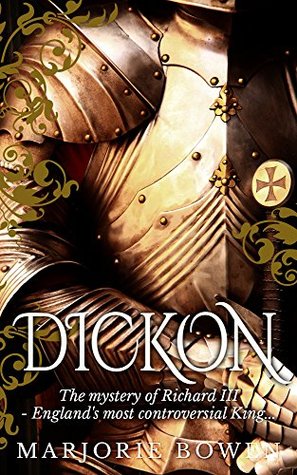
 Marjorie Bowen (1885-1952) was a very prolific author of historical fiction, romance, crime and horror, producing over one hundred and fifty books during her lifetime. Endeavour Press have gradually been making some of them available to modern readers and there are several that I’m interested in reading, but I decided to start with this one, Dickon, as it is set during one of my favourite historical periods: the Wars of the Roses.
The title refers to Richard III (Dickon, of course, is a nickname for Richard) and the novel follows Richard throughout his entire life, beginning with the moment when, as a child, he learns that his father, the Duke of York, and elder brother, Edmund, have been killed at the Battle of Wakefield. The book is divided into three sections; the first is called The Three Suns, which refers to the parhelion which appeared in the sky at the Battle of Mortimer’s Cross, but could also be a pun on the three remaining ‘sons’ of the Duke of York – and covers Richard’s childhood up to the point where his brother wins the throne for York, becoming King Edward IV.
The middle section, The Bear and Ragged Staff (a reference to the emblem of the Earl of Warwick) concentrates on 1470-1472, the period of the rebellion of Warwick and George, Duke of Clarence. Finally, The White Boar takes us through Edward’s death and the period immediately afterwards – Richard’s own brief reign and his tragic end at the Battle of Bosworth in 1485. There is no doubt that Richard suffered a lot of misfortune and tragedy and this is symbolised in the novel in the form of Jon Fogge, a man-at-arms whom Richard believes has been haunting him throughout his life, bringing bad news and bad luck to the Plantagenets.
Dickon was published in 1929 and I think it’s fair to say that it’s quite different from the majority of historical fiction that is being published today. The dialogue has a very old-fashioned feel, being sprinkled with words like ‘thou’, ‘thee’, ‘doth’ and ‘hath’, something that seems to have been dropped by most modern historical novelists, and the whole novel also has an air of innocence, with sex scenes only hinted at rather than explicitly described. I do like ‘older’ historical fiction but I suspect some readers will find this book too archaic and romanticised.
In her preface to the novel, Marjorie Bowen says that she has studied all of the known sources and “has violated no known fact, nor presented any character or action in any light that is not probable, as well as possible”. I did notice a few historical inaccuracies, but as I’m not completely sure how much material was available in 1929 and how much has only come to light in more recent years, I’m not going to be too critical. There are also a lot of controversies surrounding Richard III and his reign – there is no one version of events that has been accepted by everybody – so different authors and historians do have different theories and different interpretations. I was particularly curious to see how Bowen was going to approach the mystery of the disappearance of the Princes in the Tower, so I was disappointed to find that her solution was simply to ignore the whole episode!
Richard himself is portrayed as sensitive, loyal and trusting, a brave warrior and a devoted brother, father and husband. His character lacks the depth and complexity I would have liked and sometimes seems too good to be true, although I can appreciate that this is one of the earliest pro-Ricardian novels, written decades before books like The Daughter of Time or The Sunne in Splendour, and that the author was trying to provide an alternative to the usual view of Richard as the hunchbacked villain of Shakespeare’s play.
If you’re completely new to this period of history and the life of Richard III, this book is maybe not the best place to start, but I did find it quite enjoyable and a good addition to my collection of Wars of the Roses fiction. I will be reading more by Marjorie Bowen.
Thanks to the publisher for providing a review copy via NetGalley.




 She Reads Novels