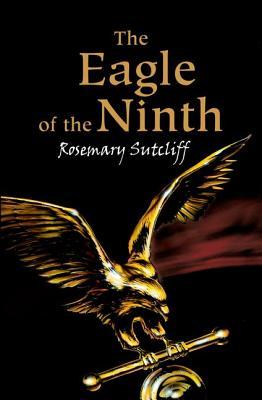
 The second book I’ve read for Karen and Simon’s 1954 Club this week is a children’s classic by Rosemary Sutcliff. This book has been on my TBR for years because, although I’ve enjoyed a few of Sutcliff’s other novels set in other time periods, the Roman period has never been a favourite of mine and I wasn’t sure whether I would love this book the way everyone else seems to have done. Of course, I needn’t have worried; The Eagle of the Ninth is a beautifully written novel with wonderfully vivid and colourful descriptions, a gripping plot inspired by historical fact, a very likeable young hero and even a touch of romance – what’s not to love?
The novel tells the story of Marcus Flavius Aquila, a young centurion posted at a fort in Roman Britain. When Marcus is badly injured during a battle, he is discharged from his duties and goes to stay with his uncle while he recuperates. Here he forms three new relationships, all of which will have an impact on his future life: the first is with Esca, a defeated gladiator Marcus purchases as a slave at the Saturnalia Games in order to save him from a worse fate; the second, with Cub, a tame wolf-cub adopted by the household as a pet; and finally, with Cottia, a young woman from the Iceni tribe who is being raised as a Roman, something she resents very much. Marcus also listens to tales of the Ninth Legion who, several years earlier, marched north to suppress a rising of the Caledonian tribes and disappeared into the mists of Northern Britain, never to be seen again.
The story of the missing Ninth Legion has special significance for Marcus because it was his father’s legion and his father was one of the men who vanished. When his injuries heal enough for him to be able to travel, Marcus decides to head north himself in the hope of learning more about the legion’s disappearance and of retrieving the eagle standard of the legion, which was also lost – and in the hands of Rome’s enemies could take on new symbolic meaning.
Esca is freed from slavery by Marcus, but the two have become good friends and he chooses to accompany Marcus on his journey. The second half of the novel follows their adventures as they travel beyond Hadrian’s Wall and further north into Caledonia. Although there is plenty of drama as they encounter hostile tribes and search for the lost eagle, I particularly enjoyed watching the changes in the relationship between Marcus and Esca as their bond grows stronger while at the same time their difference in status forms a barrier:
You could give a slave his freedom, but nothing could undo the fact that he had been a slave; and between him, a freed-man, and any freeman who had never been unfree, there would still be a difference. Wherever the Roman way of life held good, that difference would be there.
Sutcliff based this novel on the fact that the Legio IX Hispana (Ninth Legion) disappeared from historical records around the year 117 and at the time when she was writing, it was thought that the legion had probably been destroyed in what is now modern-day Scotland. Historians have other theories now, but the way Sutcliff depicts the loss of the legion in this book still feels believable to me. She was also inspired by the discovery of a wingless Roman eagle in Silchester.
I also loved her descriptions of the places Esca and Marcus see as they travel north through Roman Britain, like this one as they approach the mountain Ben Cruachan:
It was an evening coloured like a dove’s breast; a little wind feathered the shining water, and far out on the dreaming brightness many scattered islands seemed to float lightly as sleeping sea-birds. In the safe harbourage inshore, a few trading-vessels lay at anchor, the blue sails that had brought them from Hibernia furled as though they, too, were asleep. And to the north, brooding over the whole scene, rose Cruachan, sombre, cloaked in shadows, crested with mist; Cruachan, the shield-boss of the world.
 The Eagle of the Ninth is a lovely novel and I never really felt that I was reading a book for children – I think it’s one of those books that can be enjoyed equally by readers of all ages. I know there are other books in the series following later generations of the Aquila family, but the only one I currently own is Sword at Sunset, which I’m hoping can be read out of order.
~
 This is also book 18/50 read for the Historical Fiction Reading Challenge 2022.
 She Reads Novels