The Firebird by Susanna Kearsley

The Firebird Nicola Marter has a special talent, but it’s one that she doesn’t like to admit to – by touching an object she is able to see the history of the other people who have held that same object in the past. When a woman brings a wooden carving of a Russian firebird into the art gallery where Nicola works, asking for a valuation, Nicola is faced with a dilemma. The woman claims that the firebird was given to one of her ancestors by Empress Catherine of Russia and when Nicola holds the carving in her hands she knows that this is the truth, but unless she can find a way to prove it the carving is worth nothing.

Nicola decides to find out all she can about the history of the firebird but as her own psychic abilities are not strong enough, she enlists the help of an old boyfriend, Rob McMorran. Rob shares her special gift of psychometry, but while Nicola tries to keep hers a secret, Rob is happy for everyone to know about his powers. This difference in attitude is the reason they ended their relationship several years earlier, but Nicola knows that Rob is the only person who can help her now. Together they trace the path of the firebird from Slains Castle in Scotland to a convent in Belgium and finally to eighteenth century St Petersburg, and along the way they unravel the story of a young girl called Anna and learn how the Empress’s wooden firebird came to be in her possession.

This book surprised me because based solely on the synopsis, I’d expected to be learning about Russian history, but instead the focus is on Scottish history, particularly the Jacobites (the supporters of the deposed King James VII of Scotland – and II of England – and his heirs). I’ve read other historical fiction novels about the Jacobite Risings and always find it a sad subject to read about; the Jacobites were so devoted to their cause and so hopeful of success, but we know that all their efforts would only end in tragic failure. Yet somehow, in all my previous reading about the Jacobites, I had missed the fact that as well as looking to France and Spain for support, there was also a community of Jacobites working in Russia. It was interesting to read the author’s note at the end of the book and find out a bit more about the historical aspects of the story, including which of the eighteenth century characters really existed and which were fictional.

I often see Susanna Kearsley compared to Mary Stewart and in this book, the telepathic connection between Nicola and Rob reminded me of the one between Bryony and her secret lover in Stewart’s Touch Not the Cat, who could also read each other’s minds and communicate without words – though of course Nicola and Rob have the additional ability of being able to see into the past and watch the actions of people who lived many years ago. I loved following Anna’s story (especially in the earlier chapters set in Scotland and Ypres) but I also enjoyed the contemporary storyline and the interactions between Rob and Nicola. The transitions from one time period to another were smooth and natural and I thought the balance between the two felt right.

The Firebird is a sequel to Sophia’s Secret (or The Winter Sea depending on which country you’re in) and the character of Rob has also appeared in another Kearsley book, The Shadowy Horses. I haven’t read either of those two books yet, though that didn’t seem to be a problem as we are given all the background information we need early in the novel. I’m still looking forward to going back and reading them both, even if I’ve done things in the wrong order!
Thoughts on finishing War and Peace

War and Peace

To study the laws of history, we must change completely the object of observation, leave kings, ministers, and generals alone, and study the uniform, infinitesimal elements that govern the masses.

I wasn’t expecting to start writing this post until the end of December! At the beginning of the year I signed up for a year-long readalong of War and Peace hosted by Iris and Amy, attracted by their reading schedule which looked very realistic and manageable. I did stick with the schedule for the first few months and was enjoying being part of the group read (thank you, Amy and Iris!) but somewhere in the middle of the book I discovered that the pace wasn’t really working for me anymore. I found that I was finishing the month’s reading then forgetting about the book for a few weeks, which made it difficult to get back into the story again when I eventually picked it up to read the next month’s section. Once I abandoned the schedule and found a pace I was happy with, I flew through the rest of the book and really enjoyed it.

I didn’t think War and Peace was a particularly difficult book to read (I’m actually finding writing about it much more difficult!) and while it was certainly long, I have read other books of similar length. And yet it’s still a book that has always sounded very intimidating to me, so I felt a real sense of achievement when I reached the final page – especially after persevering through that Second Epilogue (if you’ve read it I’m sure you’ll know what I mean). If you’re wondering what War and Peace is actually about, I’m afraid I’m not going to tell you much about the plot because I don’t even know where to begin! It’s about war, of course – specifically the French invasion of Russia during the Napoleonic Wars – and the way it affects the members of several families of Russian aristocrats, not just in the army but also at home, in their domestic lives and in their interactions with each other.

I loved the ‘peace’ parts of War and Peace and getting to know Natasha, Marya and Sonya, Pierre, Nikolai and Andrei. The ‘war’ sections, however, were much more challenging for me as I often tend to struggle with battle scenes and find discussions of military tactics difficult to follow. This wasn’t helped by the fact that I had absolutely no previous knowledge of the Russian involvement in the Napoleonic Wars and to make things worse, from my point of view, there are lots of long philosophical passages in which Tolstoy spends a lot of time musing on war and its causes; for me to feel involved in what’s happening, I need to be actually ‘on the battlefield’ seeing things through the eyes of our protagonists, otherwise I just feel like a passive observer. Still, some of the book’s most moving and powerful moments occur during the war chapters. I included the following quote in one of my monthly readalong posts, but I’m copying it again here as I thought it really captured the shift from Nikolai’s view of war as something abstract and romantic to something real and harsh:

“Who are they? Why are they running? Can it be they’re running to me? Can it be? And why? To kill me? Me, whom everybody loves so?” He remembered his mother’s love for him, his family’s, his friends’, and the enemy’s intention to kill him seemed impossible.

Now, a note on the format and translation that I read. After reading mixed opinions on the various translations of War and Peace, I decided on the Kindle version of the Vintage Classics edition translated by Pevear and Volokhonsky (I wanted to avoid the Maude translation as I didn’t get on with their translation of Anna Karenina at all – though I know other readers recommend that one, so it’s just a matter of personal taste, I suppose). This P&V translation was very readable and I didn’t have any big problems with it, apart from, as I mentioned in another of my readalong update posts, not liking the way they chose to present the speech impediment of one character, Denisov. It distracted me so much I found it impossible to concentrate on what Denisov was actually saying! Also, I should point out that there’s a lot of French in War and Peace and in this edition, it is left untranslated in the dialogue with translations given at the end of each chapter. This was good as it gave an accurate understanding of how widely French was spoken by the Russian aristocracy and how its use gradually decreased as the war with France progressed, but it did mean a lot of turning back and forth was needed – and this was much more inconvenient with the Kindle than it would have been with a physical book.

Finally, some advice based on my experience with War and Peace: Reading with a friend or with other bloggers can be helpful and is a good way to stay motivated, but it’s important to find a pace you feel comfortable with. Read regularly and don’t leave the book unread for too long. If, like me, you know nothing about this period of Russian history, you might want to think about doing some background reading first to help put things into context – I didn’t and wished I had! And keep a list of the characters beside you as you read…as you would expect from a book of this length, there are a huge number of characters and it can be hard to remember who they all are. Be aware though that searching for character lists online can lead you to see spoilers you might prefer not to know about!

If you’ve read War and Peace too I would love to know what you thought of it – and if you have any more tips for future War and Peace readers please share them with us!

Midnight in St Petersburg by Vanora Bennett

Midnight in St Petersburg Midnight in St Petersburg begins in the year 1911 and tells the story of Inna Feldman, a young Jewish woman from Kiev. Inna is an orphan living with relatives but when they decide to leave for Palestine to escape the anti-Jewish violence in Kiev, she is left to make her way to St Petersburg on her own to seek refuge with a distant cousin, Yasha Kagan. For a girl travelling alone carrying stolen identity documents, the journey north is dangerous, especially as the Russian Prime Minister has recently been assassinated during a visit to the theatre in Kiev, but with the help of a peasant who calls himself Father Grigory, Inna is able to find her cousin’s home. Through Yasha she meets the Leman family and is given a job in their violin-making workshop.

As the political situation in St Petersburg becomes more unsettled and the country heads towards revolution, Inna finds herself torn between two very different men. The first is her rebellious cousin Yasha, a revolutionary activist who shares her love of violin music. The second is Horace Wallick, a respectable Englishman who paints miniatures for the famous jeweller, Fabergé. Inna must choose between these two men and the completely different lifestyles they offer: one passionate but filled with danger; the other more predictable but secure and safe.

I received a review copy of this book unexpectedly a few months ago and despite being immediately attracted by the title (I love books set in Russia, especially St Petersburg) it has taken me a while to find time to actually read it. I regret not reading it earlier as it turned out to be such an interesting read. The author explained the politics of the period very well, making everything clear and easy to follow, and I liked the fact that we were shown the effects of the revolution on a wide variety of people from different social and cultural backgrounds.

The only problem I had with this book was that I just didn’t find the central romantic storyline very exciting or convincing. This is probably because, for a long time, I didn’t like either of Inna’s two love interests, so wasn’t particularly bothered which of them she would eventually choose. I did start to warm to them both towards the end, though, and after finishing the book and reading the author’s note I was fascinated to discover that Horace’s character was based on the story of Vanora Bennett’s own great-great-uncle who also worked as an artist in pre-revolutionary St Petersburg. I thought this personal connection helped to add a real touch of authenticity to the story I had just been reading.

Luckily, even without being very interested in Inna’s romantic relationships, there were still plenty of other things I could enjoy. One of the most intriguing storylines within the novel, for me, was the one involving Father Grigory, the man Inna met on the train to St Petersburg near the beginning of the book. If you know your Russian history you will know, or be able to guess, who Father Grigory really was, but if not then I’ll leave you to find out for yourself. I also really liked the violin-making aspect of the story as it was something different and unusual. I took violin lessons myself for a few years when I was younger (though I certainly wasn’t as talented as Inna) so I found it interesting to read about the processes of making and repairing violins.

I’m not sure if I liked Midnight in St Petersburg enough to want to look for more of Vanora Bennett’s novels (I know she has written three or four other historical fiction novels) but I did enjoy learning about a period of Russian history I didn’t know much about.

Thanks to the publisher for providing a review copy of this book

A Hero of Our Time by Mikhail Lermontov

A Hero of Our Time - Lermontov

Again, you’ll tell me, no man can be as bad as that; and I’ll ask you why, if you have believed in the possibility of the existence of all the villains of tragedy and romance, you should not believe in the reality of Pechorin? If you have admired inventions far more terrible and monstrous, why does this character, even as an invention, not deserve your mercy? Could it be because there is more truth in him than you would like?

A Hero of Our Time is described as one of the first great Russian novels, though I have to confess that until recently I had never even heard of it or Mikhail Lermontov. Having read the biographical information about the author included in this book, it seems Lermontov’s life was almost as unusual and interesting as his fiction! A Hero of Our Time was published in 1840, just before he was killed in a duel at the age of twenty six.

This is not a novel with a chronological structure or a conventional plot with a beginning and an end. Instead it consists of five separate stories, some very short and some much longer. Together they create a portrait of Grigory Pechorin, a young army officer – though as the author tells us in the preface, it’s also “a portrait built up from the vices of our whole generation, in all the fullness of their development”.

Far from being the hero suggested by the title, Pechorin is actually much more of an anti-hero, selfish, cruel, manipulative and motivated by boredom and disillusionment. He is not a likeable character at all and isn’t supposed to be, but as the novel unfolds and we are given his own version of events as well as seeing him from the perspective of others, we come to understand him better. By the end of the book I found I didn’t hate Pechorin as much as I thought I would at first and for all his faults and flaws I thought he was a fascinating character.

In the first story, an unnamed narrator is travelling through the Caucasus where he is joined by an army captain, Maxim Maximich. As they travel together, the captain tells the narrator about his friendship with Pechorin. In the second story the narrator briefly meets Pechorin and the final three stories are entries from Pechorin’s own journal. With each of these five chapters we learn a little bit more about Pechorin’s life and follow him through a series of adventures, romances and even a thrilling duel. Despite the disjointed and episodic feel of the book it’s fast-paced and never boring. I was also pleased to find that although the main characters are soldiers, the story concentrates on their personal lives and there are no long battle scenes or detailed descriptions of military tactics to struggle with – though there are some great descriptions of the landscape of the Caucasus, where the novel is set.

I really enjoyed A Hero of Our Time. Of all the Russian novels I’ve read, I found this one by far the easiest to read, despite it being written in the early 19th century. This Oxford World’s Classics edition is translated by Nicolas Pasternak Slater (the nephew of Boris Pasternak who wrote Dr Zhivago) and I think it’s an excellent translation; it flows so effortlessly it hardly feels like a translation at all. It’s a very short novel too (the actual story is less than 140 pages long – the rest of the book is made up of the introduction, notes, maps and other additional material) so could be a good choice if you want to read some Russian literature but feel intimidated by Tolstoy or Dostoyevsky.

This edition also includes a piece of writing by Alexander Pushkin entitled A Journey to Arzrum in which Pushkin describes his own travels through the Caucasus. It’s really more of a travelogue or journal than a story but it works as an interesting companion to Lermontov’s novel.

Have you read this book? Which other Russian classics would you recommend?

Doctor Zhivago by Boris Pasternak

Doctor Zhivago Do you ever find that after finishing a book you’re still not sure what you thought of it and couldn’t even say whether you had actually enjoyed it or not? That’s the way I felt about Doctor Zhivago. I’m glad I’ve finally read it as it’s a book I’ve been curious about for a long time, but while I didn’t dislike it I didn’t love it either. Thankfully I don’t even attempt to rate books on my blog but I do on Goodreads and wavered between three and four stars for a long time before settling on three. Doctor Zhivago is a long book and definitely not a light, easy read, so I was disappointed that I couldn’t rate it more highly after investing so much time and effort in it.

Doctor Zhivago was published in 1957 and Pasternak was awarded the Nobel Prize for Literature a year later. The novel is set in Russia and follows the life of Yuri Zhivago, a doctor and poet. Yuri’s mother dies when he is still a young child and he is raised by his Uncle Kolya. After studying medicine at university, he marries his childhood friend, Tonya, and they have a son together but Yuri and Tonya are separated when Yuri joins the army as a doctor. Recovering in a field hospital after being wounded, he is drawn to another woman, Lara, who is working there as a nurse and over the years that follow he is torn between his loyalty to Tonya and his love for Lara. But this is more than just Yuri’s story…it’s also the story of Russia itself and the events that shaped the country throughout the first half of the twentieth century.

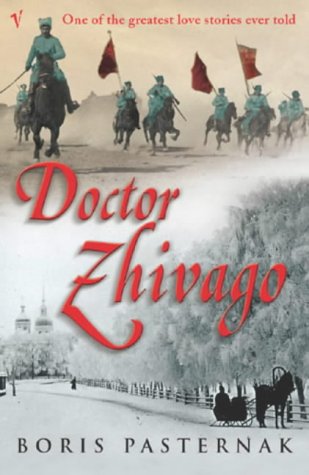
I have to admit that before I started reading this book I had absolutely no idea what it was about, though I think I must have had the impression it was a romantic historical epic set against a backdrop of beautiful snowy landscapes. Although I’ve never actually watched any of the film or television adaptations of this book it seems that they have chosen to focus more on the love story aspect, which is probably why I had this misconception of what the book would be like. This particular edition of the book does nothing to dispel that idea, with the claim on the cover that this is “one of the greatest love stories ever told”. It isn’t. Not in my opinion, anyway. After reaching the end of the book it seemed to me that the romance had only formed a minor part of the story, taking second place to the Russian history and politics, though whether this is a good thing or a bad thing depends on your personal preference, of course!

Doctor Zhivago was originally written in Russian and the translators of this edition are Max Hayward and Manya Harari. I hadn’t looked into which other translations are available – I just picked the book up on a whim when I noticed it on the library shelf because I’ve been interested in reading it for a while. Maybe there are other translations that are better, but I didn’t have any problems with this one; I thought the writing flowed well and was easy enough to read (although the story itself is disjointed, almost episodic). There are some beautiful, moving passages, and yes, some wonderful descriptions of snowy Russian landscapes too. But what did make this book very challenging for me was my complete lack of knowledge of most of the history involved: the February and October Revolutions, for example, and the Civil War between the Reds and the Whites. If you’re planning to read Doctor Zhivago and know nothing about the historical context I would strongly recommend doing some background reading first – I wish I had as I’m sure it would have made the story a lot easier to understand and follow!

The parts of the book that I did enjoy were excellent – I particularly loved the penultimate chapter, Again Varykino, and its atmospheric descriptions of a deserted town surrounded by howling wolves – but I was disappointed that I never managed to form any kind of emotional connection with any of the characters. Although Yuri, Lara and Tonya found themselves in situations that I could sympathise with, I thought their characters felt underdeveloped. They never felt like real people to me, so their stories didn’t affect me as much as they should have done.

I wish I had been able to write a more intelligent, articulate review but I think I’ll have to leave that to other people as I’m aware that a lot of the political and philosophical aspects of the story just went over my head. To fully appreciate this book I would have to read it again and I don’t think that’s something I’ll ever want to do! I do usually like Russian literature in general – I loved Mikhail Bulgakov’s The Master and Margarita, I enjoyed Anna Karenina and am currently taking part in a group read of War and Peace – so I have to conclude that Pasternak and Doctor Zhivago are just not for me.

Caprice and Rondo by Dorothy Dunnett

Caprice and Rondo The seventh in the House of Niccolò series and another one I enjoyed, although it was actually one of my least favourites so far. I know other readers will disagree, but in an eight-volume series it’s inevitable that there are going to be some that I don’t love as much as others and this was one of them. Before I try to explain why, I’ll repeat my usual warning that if you have not read the previous six Niccolò novels, you will encounter some spoilers below – it’s impossible to avoid them at this stage in the series!

*

At the beginning of Caprice and Rondo, we find Nicholas in exile following the revelations at the end of the previous book, To Lie with Lions. After allowing his rivalry with his wife, Gelis, to cause financial problems for his bank and almost destroy the nation of Scotland, it seems that his friends and colleagues may not be able to forgive him this time. Spending the winter drinking with the pirate Paúel Benecke in Danzig, Poland, Nicholas appears to be without aim and direction, until the opportunity arises for him to travel to Caffa on the Black Sea in the company of the mysterious Anna von Hanseyck. He is also still searching for the African gold that was stolen from his ship in Scales of Gold, as well as trying to protect Gelis and their son, Jodi, from their numerous enemies who include the former Vatachino agent, David de Salmeton.

I think part of the problem I had with this book was that we are taken to such a lot of different geographical locations and yet none of them really came to life for me as vividly as the settings in the previous books. I realise the cold, subdued atmosphere of the Danzig chapters was probably intended to match Nicholas’s mood and the state of mind he had found himself in, rather as the frozen landscapes of Russia matched Lymond’s in The Ringed Castle, but for me, this was probably the least successful of all the settings in any of the Dunnett novels I’ve read. Caffa is beautifully described, but I couldn’t help thinking the whole section of the book that took place in the Crimea felt a bit irrelevant, though maybe that’s partly because I was finding it difficult to really get interested in the intricacies of Tartar politics. I was much more interested in the other main thread of the story which involved Gelis, with the help of Tobie, visiting Thibault de Fleury and trying to unearth the truth about Nicholas’s parentage. I found myself liking Gelis again in this book after being so frustrated and confused by her since the end of Scales of Gold. I had never doubted that she and Nicholas loved each other and it’s so sad that they had wasted all those years when they could have been together as a family.

We also get a new villain in this book: Julius’s wife, Anna. I was suspicious of Anna from the beginning having learned not to trust characters who seem too good to be true, though I hadn’t guessed who she really was (or not until Adelina’s background was discussed, after which it was quite easy to make the connection) so that was a surprise. I was a bit disappointed though that our established villains, Jordan de Ribérac and Simon de St Pol, never appeared in this book.

While some new questions were raised – the identities of the six children, for example – it also felt as though a lot of things were being tied up in this book in preparation for the final one, such as the death of Nicholai Giorgio de’ Acciajuoli and the end of the mercenary company led by Astorre (I thought Astorre’s death at Nancy was one of the most moving scenes in the book). And of course, the Duchy of Burgundy itself was thrown into disarray with the Duke also losing his life in the battle of Nancy. I also, like Nicholas, finally began to have a better understanding of Ludovico da Bologna who seems to have popped up all over the place in whichever obscure corner of the world Nicholas has been visiting.

“Josaphat Barbaro, speaking of him in Persia, had said, ‘One meets him everywhere, does one not, as one might expect to see the ubiquitous God? But what one meets is not God, but one’s own conscience’.”

Although I started this post by saying this was one of my least favourite Niccolo books, ironically I also found it one of the quickest and easiest to read and I flew through it in a few days over Christmas. I’m reading Gemini now and can’t wait to see how the series concludes!

The Conductor by Sarah Quigley

It’s 1941 and Russia is now at war with Germany. As the Nazis surround Leningrad with the aim of starving the city into submission, the composer Dmitri Shostakovich begins work on his Seventh Symphony. While other important musicians are being evacuated, Shostakovich insists on remaining to help defend his city. To his wife, Nina, the real reason he doesn’t want to leave is because he doesn’t want to be disturbed while writing his symphony and it seems to her that he is putting his music before the welfare of his family.

During the siege, the government orders that the Seventh Symphony be performed to raise the morale of the Soviet troops at the front. Since the members of Leningrad’s famous Philharmonic Orchestra and their conductor Mravinsky have already been removed from the city, the job of performing the Seventh Symphony falls to another, less highly regarded conductor, Karl Eliasberg and the second-rate Radio Orchestra. Eliasberg finally has the chance to do something great, but it’s not going to be easy…of the musicians who have stayed in Leningrad through the long, cold Russian winter some of them are dead and the others barely have the strength to lift their instruments.

Alongside the stories of Shostakovich and Eliasberg is the story of a third man, Nikolai Nikolayev, and his beloved nine-year-old daughter, Sonya. Nikolai must make the heartbreaking decision of whether to risk sending Sonya out of Leningrad on her own while he stays behind to continue his work as violinist in the orchestra.

The Siege of Leningrad was surely one of the most horrific episodes of the Second World War. This book was maybe not quite as emotional as other novels I’ve read on the same subject (The Bronze Horseman by Paullina Simons, for example) but it was still very moving. The idea of people being so hungry they’re driven to boiling down leather briefcases for protein or mixing water and hair oil to make soup, while watching as their family and friends die one by one of starvation or cold, is horrible to think about. And yet the story is not too bleak or depressing because it’s not just about war and suffering – it’s also about the power of art and music and how something good can come from even the worst circumstances imaginable.

The characters Sarah Quigley has chosen to focus on in this novel are all interesting, three-dimensional people who each have their own set of problems and obstacles to overcome during the siege. My favourite was Karl Eliasberg, the conductor of the book’s title. Based on a real person but one who we don’t know much about, the author imagines him as a shy, awkward man with low self-esteem, desperate to have his talents recognised and to be accepted by the cultural elite. Shostakovich is his idol but every time he comes face to face with him he finds himself saying the wrong things and failing to give the impression he was hoping to give. Eliasberg’s character is so well-written and believable I felt I could really understand him and empathise with him.

Despite Shostakovich being one of the central characters and the story revolving around one of his compositions, you don’t need any knowledge of classical music to enjoy this novel. However, I would highly recommend listening to the Seventh Symphony after finishing the book – it’s definitely worth it and it really adds to the reading experience. I loved this book and I have a feeling that when I make my list of favourite books of the year in December this might be one of them.