Written in My Own Heart’s Blood by Diana Gabaldon

Written in my Own Heart's Blood Diana Gabaldon seems to polarise readers like no other author. It’s rare to find anyone who has read one of her novels and didn’t feel strongly about it one way or the other! I do completely understand the reasons why people would dislike her writing, but I admit that I’ve always loved her Outlander series, at least until the last couple of books. I think I was about eighteen when I read Gabaldon’s first novel – Cross Stitch as it was called here in the UK, and I immediately went on to read the next three books (there were only four in the series then). Since then I’ve read each new book as it was published. The seventh volume, An Echo in the Bone (which happens to be the very first book I reviewed on this blog in 2009), left me feeling a bit disappointed, but sadly this new one has disappointed me even more, especially after a five year wait.

In some respects I think Gabaldon has improved as a writer over the course of the series, but the later books just don’t compare to the earlier ones in any of the other ways that matter to me – in plot, structure, characterisation or emotional impact. I’m not sure whether it’s just that my tastes have changed over the years, but I think the shift in narrative structure from being mainly narrated by one character in the first person to being told from multiple perspectives might also have something to do with it. And then there’s the fact that while the earlier novels are set mostly in Scotland during the 1745 Jacobite Rising and its aftermath, the later ones are set during the American Revolution, a period I’m not as interested in. Whatever the reason, these books are starting to lose their appeal for me. I’ll still be following the series to its end, though – I’ve invested far too much time in it to stop now!

Anyway, on with my thoughts on Written in My Own Heart’s Blood. This review is as spoiler-free as I could make it but as it refers to the eighth book in a series you may prefer not to read any further until you’ve caught up with the first seven books. At this point I should say that if you’re not already familiar with this series, then you really need to start at the beginning or you’ll get hopelessly confused!

If you remember, the previous book, An Echo in the Bone, ended on more than one cliffhanger and thankfully Written in My Own Heart’s Blood picks up immediately where Echo left off. There are two main threads to the novel. First, we follow Jamie, Claire and their assorted friends and family members who are all now based in Philadelphia. The year is 1778 and we are in the middle of the Revolution, with all the dangers and complications that brings. In the novel’s other strand, we return to Lallybroch in Scotland to catch up with Brianna and Roger who are having some exciting adventures of their own.

I really wanted to love this book but unfortunately I experienced a lot of the same problems with this one that I had with Echo. Both books seem to be dominated by characters and storylines from Gabaldon’s spin-off Lord John series – and I gave up on that series after two books. Ideally, I would have preferred the Lord John characters to stay in the Lord John books and the main Outlander series to concentrate on Jamie, Claire and the other characters we already know and love, such as Fergus and Marsali and their children or Ian Murray and Jenny. It seemed strange to me, for example, that we see so little in this book of Jenny interacting with Ian, the son she hasn’t seen for years, yet so much time is devoted to a search for Lord John’s nephew, Ben, a character who I can’t even remember being mentioned in previous books.

I don’t want to sound completely negative, because the good parts of Written in My Own Heart’s Blood are very good, but overall I thought the book lacked focus and because there are so many different storylines all running parallel with each other, it was inevitable that I would struggle to care about them all, particularly the ones dealing with characters I don’t really like. Many of the things that happen in the book feel superfluous and seem to have no real purpose other than to make a very long book even longer: a storyline involving two young girls William takes under his protection, an operation Claire performs on a slave with an unpleasant medical condition, and the death of a character which I found totally unnecessary.

The military aspect of the book was another problem for me, but I’ll admit that my lack of knowledge of this period of American history is probably to blame. I couldn’t keep track of the various Generals and Colonels and which side they were on, and whenever Claire met a presumably famous historical figure of the period I didn’t feel the excitement I was obviously intended to feel. My fault, though, not the author’s.

On the other hand, I thought Roger and Brianna’s parts of the book were fantastic! It was great to meet characters I’d never expected to meet again. These sections were much more compelling than the rest of the book, something I never thought I would say! While I’ve always liked Roger I could never quite warm to Bree and have often been impatient with the amount of time devoted to them in some of the previous books – but not this time. I was disappointed that only two out of the novel’s nine parts follow Roger and Bree and their children…I didn’t want their story to come to an end.

So, I’ve been left with very mixed feelings about this book and am sorry I’ve had to post a less than glowing review of a book by an author I used to consider one of my favourites. I did love the final few pages, though, because what I had been desperately hoping would happen did happen! If I didn’t already know that there’s going to be a book nine I think I would have been happy for this to have been the end of the series, even though there are still some storylines left unresolved. Based on past experience, I suspect we’ll have to wait four or five years to read the ninth, and probably final, book. I’m sure I’ll be reading it, despite my problems with this one, and am hoping for a satisfying conclusion to the series.
Insurrection by Robyn Young

Insurrection - Robyn Young Insurrection is the first in a trilogy telling the story of Robert the Bruce, who was King of Scotland in the 14th century. The second book, Renegade is available now and the third, Kingdom, will be out this summer. In this first novel, beginning in 1286, we meet Robert as a young boy in a Scotland torn apart by the sudden and unexpected death of King Alexander III. The King has died without a male heir, leaving the succession to the throne undecided. The Bruces believe they have a strong claim, but they face competition from their enemies, John Balliol and the Comyns.

In England, meanwhile, King Edward I is forming his own plans for Scotland. Beginning a search for four ancient relics that will enable Merlin’s Last Prophecy to be fulfilled, Edward enlists the help of a group of young noblemen known as the Knights of the Dragon. When Robert, sent to England to restore his family’s reputation, is approached by the Knights, he must decide exactly where his loyalties and ambitions lie.

Insurrection is exactly the sort of historical fiction I love. As someone who reads a lot of historical novels I often find that they either focus too much on romance and court intrigue or are too action-packed with one long battle scene after another. I had neither problem with this book; I found it to be a fascinating, atmospheric tale of kings and knights, witches and soldiers, treachery, murder and war. The descriptive writing is wonderful and the battles (yes, there are a few) are well written and easy to follow. I admit that my heart sank when I discovered this was yet another book with an ‘ancient prophecy’ storyline, but I needn’t have worried because it is only one small part of the plot and I thought it actually felt quite plausible as it’s true that Edward I really did have a fascination with Arthurian legend.

Robert the Bruce is a name I’ve always been intrigued by without really knowing much about him. I have a memory from years ago of going out with my parents one Sunday afternoon on what my dad always called ‘an aimless drive’ and ending up in Dumfries and Galloway in Scotland where we noticed a sign pointing to ‘Robert the Bruce’s Cave’ – the cave where Robert supposedly went into hiding from Edward I in 1306 and was famously inspired by a spider weaving its web. Not one of the most exciting places I’ve ever visited (there wasn’t even a spider in sight when we went to look inside the cave), but it has stayed in my mind all these years later!

Because I knew so little about Robert and this period of history, I felt that I was really learning a lot from Insurrection. Everything felt accurate and thoroughly researched and although I had to concentrate to keep track of the complex politics and relationships between the characters, I was never bored. At the end of the book there’s a character list, glossary of medieval terms and a chart showing the order of succession to the Scottish throne, all of which I found useful.

Of course, this is a work of fiction rather than non-fiction so there are times when the author doesn’t stick exactly to the known facts. For example, the deaths of Alexander III and his granddaughter Margaret, Maid of Norway may have had more innocent causes than those described in the book. The Knights of the Dragon is also a fictional order, although the men who belong to it really existed. Robyn Young explains some of her choices in her author’s note so that we can see where she has used her imagination to fill in some gaps and provide motivations for the actions of her characters.

I know this book will not suit all tastes in historical fiction (some readers might dislike the inclusion of prophecies and witchcraft or will be disappointed by the lack of significant female characters and the fact that Robert himself is not always easy to like) but I absolutely loved it. I’m looking forward to reading Renegade and Kingdom and also exploring Robyn Young’s earlier trilogy on the Knights Templar.

After Flodden by Rosemary Goring

After FloddenThe Battle of Flodden in 1513 was the largest and bloodiest battle fought between England and Scotland. The battle was fought near Branxton, Northumberland, in the north of England and despite the Scots having the biggest army in numbers, the result was a decisive victory for the English. It is estimated that while there were between 1,000-4,000 losses on the English side, there may have been over 10,000 Scottish casualties, including King James IV of Scotland.

After Flodden is a fictional account of the battle and its aftermath. Among the men who went to Flodden and never came back is Louise Brenier’s brother, Benoit. Since coming to Scotland from France several years earlier, the Brenier family have had more than their fair share of troubles, including the death of Louise’s sister, a mistress of James IV. Unwilling to accept that her brother could also be dead, Louise decides to search for him – but finding out the fate of one man among thousands is not going to be easy.

Accompanied by her faithful dog, ‘the vixen’, Louise leaves her home in Edinburgh behind and heads for the dangerous, lawless English/Scottish Borders. She is joined on her journey by two very different men: Gabriel Torrance, a nobleman from the court of King James, and Adam Crozier, leader of one of the Border clans. When both men offer to help look for Benoit, Louise must decide which of them she can trust.

After Flodden is Rosemary Goring’s first novel, published in 2013 to coincide with the 500th anniversary of the battle and having seen some very positive reviews of it last year I was looking forward to reading it myself. Now that I’ve read it, my feelings are mixed. After a slow start I did find myself enjoying the story but I didn’t think it was anything special – though maybe I was just expecting too much from it.

One thing I did love about this book was the choice of subject. Flodden has been mentioned briefly in other books I’ve read, but I have never come across a whole novel devoted to it until now. So many historical fiction novels are the ‘sweeping epic’ sort, covering several decades of history and spanning continents, so it was refreshing to see a book that was so tightly focused on one specific historical event. Reading After Flodden has helped me understand the reasons for the battle and why it was a disaster for the Scots.

In addition to the plot I’ve outlined above, other aspects of the battle and its consequences are also explored. The descriptions of the military preparations for the battle and the weapons and tactics involved are balanced by the more personal, human side. As well as seeing how Louise and her mother react to what has happened, we also meet a young boy who has carried his dying father from the battlefield. Some of the most emotional parts of the book are from the perspective of Patrick Paniter, secretary to James IV, who was one of the men advising the King before the battle and who feels responsible for the disastrous outcome.

I also found the sections of the book describing Louise’s journey south and her encounters with the Border clans very interesting as I only live around 60 miles from the border myself (on the English side). The history of this region is fascinating and I’m surprised it isn’t a more popular choice for historical fiction authors (The Disorderly Knights by Dorothy Dunnett features a feud between two rival Border families, the Scotts and the Kerrs, but I can’t think of many other books that I’ve read that even touch on this subject).

Dialogue is a difficult thing to get right in historical fiction but Goring’s attempt is reasonably good; it doesn’t sound too modern and she uses some Scottish dialect, but not too much. I was less convinced by the way she drops the occasional French word into Madame Brenier’s speech – it didn’t feel natural at all. A bigger problem, for me, is that the story is not told in chronological order but jumps around in time, which I found very confusing. It seemed unnecessary and made it difficult to follow the order of events.

The story was also too predictable, which is not always a bad thing, but when part of the plot revolves around the identity of a traitor it’s disappointing that it’s so easy to guess who that traitor is. It would have been nice to have been kept in suspense until Louise worked out the truth! On the plus side, the book included some useful character lists and a map so that readers can trace Louise’s journey through the Borders. I had to laugh at a misprint listing the members of the ‘Sottish Court’ (though knowing what some of these sixteenth century courts were like, maybe that was an accurate description!)

Although I didn’t enjoy this book as much as I’d hoped to, it was good to have the opportunity to learn more about this important battle.

The Firebird by Susanna Kearsley

The Firebird Nicola Marter has a special talent, but it’s one that she doesn’t like to admit to – by touching an object she is able to see the history of the other people who have held that same object in the past. When a woman brings a wooden carving of a Russian firebird into the art gallery where Nicola works, asking for a valuation, Nicola is faced with a dilemma. The woman claims that the firebird was given to one of her ancestors by Empress Catherine of Russia and when Nicola holds the carving in her hands she knows that this is the truth, but unless she can find a way to prove it the carving is worth nothing.

Nicola decides to find out all she can about the history of the firebird but as her own psychic abilities are not strong enough, she enlists the help of an old boyfriend, Rob McMorran. Rob shares her special gift of psychometry, but while Nicola tries to keep hers a secret, Rob is happy for everyone to know about his powers. This difference in attitude is the reason they ended their relationship several years earlier, but Nicola knows that Rob is the only person who can help her now. Together they trace the path of the firebird from Slains Castle in Scotland to a convent in Belgium and finally to eighteenth century St Petersburg, and along the way they unravel the story of a young girl called Anna and learn how the Empress’s wooden firebird came to be in her possession.

This book surprised me because based solely on the synopsis, I’d expected to be learning about Russian history, but instead the focus is on Scottish history, particularly the Jacobites (the supporters of the deposed King James VII of Scotland – and II of England – and his heirs). I’ve read other historical fiction novels about the Jacobite Risings and always find it a sad subject to read about; the Jacobites were so devoted to their cause and so hopeful of success, but we know that all their efforts would only end in tragic failure. Yet somehow, in all my previous reading about the Jacobites, I had missed the fact that as well as looking to France and Spain for support, there was also a community of Jacobites working in Russia. It was interesting to read the author’s note at the end of the book and find out a bit more about the historical aspects of the story, including which of the eighteenth century characters really existed and which were fictional.

I often see Susanna Kearsley compared to Mary Stewart and in this book, the telepathic connection between Nicola and Rob reminded me of the one between Bryony and her secret lover in Stewart’s Touch Not the Cat, who could also read each other’s minds and communicate without words – though of course Nicola and Rob have the additional ability of being able to see into the past and watch the actions of people who lived many years ago. I loved following Anna’s story (especially in the earlier chapters set in Scotland and Ypres) but I also enjoyed the contemporary storyline and the interactions between Rob and Nicola. The transitions from one time period to another were smooth and natural and I thought the balance between the two felt right.

The Firebird is a sequel to Sophia’s Secret (or The Winter Sea depending on which country you’re in) and the character of Rob has also appeared in another Kearsley book, The Shadowy Horses. I haven’t read either of those two books yet, though that didn’t seem to be a problem as we are given all the background information we need early in the novel. I’m still looking forward to going back and reading them both, even if I’ve done things in the wrong order!

Stormy Petrel by Mary Stewart

Stormy Petrel It’s hard to believe it’s only been two years since I discovered Mary Stewart! I read the brilliant Nine Coaches Waiting in November 2011 and since then I’ve read seven of her other books and loved most of them. When I first started to think about what I wanted to read for Anbolyn’s Mary Stewart Reading Week, Stormy Petrel wasn’t a title that came to mind, but I decided to see what the library could offer and this was the only one they had that I hadn’t already read. Knowing that this was one of her later books (published in 1991) and not considered to be one of her best, I was careful not to go into it with my expectations too high.

Stormy Petrel is narrated by Rose Fenemore, a poet and writer of science fiction novels. Due to her busy schedule as a tutor of English at Cambridge, Rose doesn’t have as much time to write as she would like, so she decides to take a break and spend two weeks at a cottage on the Hebridean island of Moila. Her brother Crispin, a doctor, agrees to meet her there as he is a keen wildlife photographer and is looking forward to taking pictures of the rare birds that nest on the island.

Rose arrives several days before Crispin and begins to settle into the cottage, but on her first night the island is hit by a storm and she wakes up to find a strange man in the kitchen. His name is Ewen Mackay and he tells her that his foster parents used to live in the cottage and he has come to visit them unaware that they had moved away. As Rose listens to Ewen’s story, another man arrives at the door. Introducing himself as John Parsons, he explains that he was camping and his tent has blown away in the wind so he is looking for somewhere to shelter from the storm. Rose lets them both stay until morning but over the next few days she learns more about both men and discovers that neither of them has been completely honest with her. How can she decide who to trust?

This was not one of my favourite Mary Stewart books and slightly disappointing compared with some of her earlier ones, but I still liked it and rate it above Rose Cottage, which was her final book, published several years after this one (I didn’t dislike Rose Cottage either, but it was a bit too gentle for me). The problem with Stormy Petrel is that as a ‘romantic suspense’ novel the romance is only hinted at and there’s not much suspense either. After one or two surprises near the beginning of the book the rest of the story is predictable, the villain is not really all that villainous and I never felt that Rose was in any danger.

Something I did love about this book was the wonderful Scottish setting. Every time I read a Mary Stewart novel I find myself enthusing over her beautiful descriptions of the area in which the story is set, and Stormy Petrel is no exception:

The Isle of Moila is the first stop past Tobermory. It is not a large island, perhaps nine miles by five, with formidable cliffs to the north-west that face the weather like the prow of a ship. From the steep sheep-bitten turf at the head of these cliffs the land slopes gently down towards a glen where the island’s only sizeable river runs seawards out of a loch cupped in a shallow basin among low hills. Presumably the loch – lochan, rather, for it is not large – is fed by springs eternally replenished by the rain, for nothing flows into it except small burns seeping through rush and bog myrtle, which spread after storms into sodden quagmires of moss. But the outflow is perennially full, white water pouring down to where the moor cleaves open and lets it fall to the sea.

Moila doesn’t really exist but the descriptions are so vivid I’m sure it must be based on a real Hebridean island. Stewart’s love for the landscape and the wildlife are obvious and throughout the story she explores the importance of preserving the beauty of nature. If you don’t already know what the title ‘stormy petrel’ refers to, she explains that too.

At just over 200 pages, this is a quick read and perfect for those times when you just want to relax with a book that’s not too complex or demanding!

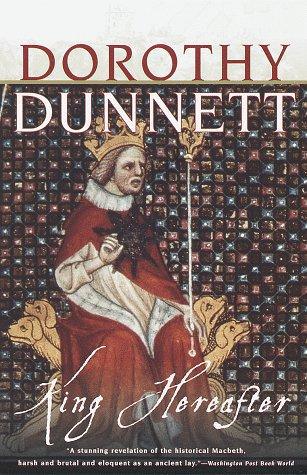
King Hereafter by Dorothy Dunnett

King Hereafter “Then she said, ‘Thorfinn!’ quickly, and moved to him; but had hardly got to his side before he loosed his fingers and thumbs and plunged them down to the mattress like spear-points.
‘No! Macbeth. Macbeth. Macbeth!’ The name reached her like sling-shot.
Groa said, ‘They are the same man. I should know. I married both.’”

I couldn’t wait to read this book having loved Dorothy Dunnett’s Lymond Chronicles and House of Niccolo series so much when I read them last year. King Hereafter, her only standalone historical novel, is set in eleventh-century Orkney and Scotland (known at that time as Alba) and is based around the idea that Macbeth, the historical King of Alba, and Thorfinn, Earl of Orkney, were the same person – Macbeth being Thorfinn’s baptismal name. Whether that might be true or not, the case she puts forward in this book is very convincing and obviously the result of an enormous amount of research. The novel follows Thorfinn throughout his entire life and along the way there are battles, both on land and at sea, fires, storms, births, deaths, political intrigue and even a race across the oars of a longboat. We also meet other historical figures of the time including King Canute and Lady Godiva – but at the heart of the story, for me, is Thorfinn’s love for his wife, Groa.

I loved this book, although the combination of unfamiliar history, complex politics and intricate relationships between the characters meant that it required a huge amount of concentration and a lot of referring to the centre pages of the book which contained three maps of Orkney, Alba and England, and two family trees. I would have been completely lost without these maps and charts; I found myself consulting them constantly – and even then there were some relationships that still weren’t quite clear to me. Added to the fact that my edition of the book had 880 pages (not the same as the one pictured here, by the way), it seemed to take me nearly as long to read this one book as it did to read the entire Lymond Chronicles! That’s not necessarily a bad thing, though, when a book is as good as this one is.

Before I go any further I should point out that King Hereafter is not a retelling of Shakespeare’s Macbeth and there is really very little resemblance between Dunnett’s story and Shakespeare’s, although she does quote from the play in the section headings and there are some references to events that are also in the play, such as ‘Birnam Wood coming to Dunsinane’. Some of the basic plot points are the same – yes, Thorfinn/Macbeth becomes King of Alba after the death of King Duncan, for example, but the circumstances surrounding Duncan’s death are very different from the murder Shakespeare describes. And thankfully, Groa is a far more likeable character than Lady Macbeth. The three witches don’t appear either, though instead we have Groa’s son, Lulach, and his prophecies (I suspect that to really be able to make any sense of most of Lulach’s cryptic comments you need to know how the rest of the story is going to play out and to be familiar with some of the historical sources too).

I loved Thorfinn from his very first appearance. I could see some similarities between Thorfinn and Dunnett’s other heroes, Lymond and Nicholas, but in other ways he is quite different. This is the moment we meet him for the first time as a child, seen through the eyes of his foster father, Thorkel Fostri:

“Not the complaining Earl Brusi. Not the lovely young Rognvald his son. But a scowling juvenile, thin as a half-knotted thong, with a monstrous brow topped by a whisk of black hair over two watering eyes, thick as acorns.
It raised one arm and called. Its voice had not even started to break.

‘Thorfinn,’ said Thorkel, and the word itself was a groan. Here in Norway, here in Nídarós, here on King Olaf’s jetty was the child-Earl of Caithness and Orkney. His foster-son.”

We soon see that Thorfinn’s unattractive exterior hides a shrewd brain, great physical ability, wit, courage and, although we are told that he never laughs, a wry sense of humour too. He is capable of all the plotting, scheming and negotiating that is necessary to keep up with the ever-changing rivalries and alliances between various leaders, while also dealing with the threats from England, Norway and Denmark and trying to do what is best for his people of Orkney, Caithness, Moray and the rest of Alba. As with Lymond and Nicholas we are rarely given the privilege of getting inside Thorfinn’s head; instead we see him mostly from the perspective of the people around him, which can be either insightful or misleading depending on how well these viewpoint characters understand him.

Groa is a great character too and is now one of my favourite female characters in all of Dunnett’s novels. The story of how she and Thorfinn come to love and understand each other is beautifully written and it was wonderful to watch their relationship develop over the course of the novel. Apart from the relationship between Thorfinn and Groa, the other one I found particularly fascinating and complex was the relationship between Thorfinn and his nephew, Rognvald. The encounters between the two of them throughout the first half of the book provided what, for me, were some of the most dramatic and exciting scenes in the book.

Thorfinn does have a lot of ambition, but unlike Shakespeare’s Macbeth, it’s not because he’s looking for personal glory or has been encouraged by his ruthless Lady; his ambition is to improve life in his lands and give his people a strong ruler, uniting the disparate, diverse tribes of Orkney and Alba under a common religion and common laws. On the subject of religion, I did get very confused somewhere in Part 3, where Thorfinn visits Pope Leo in Rome. Actually, a lot of the religious aspects of the story in general confused me and that’s something I would attempt to understand better on a re-read. I tried not to worry too much about the things I couldn’t understand on this first read and instead concentrated on getting to know Thorfinn, Groa and the other characters, and enjoying the beautiful writing. The descriptions of the landscapes of Orkney and Alba are so vivid and evocative. This is one that I particularly loved:

They entered Loch Bracadale with the sunrise, rose-coloured oars laying darkling folds on the rose-tinted pool of the fjord. A dusting of guillemots, asleep on the water, roused and dived with almost no sound, leaving pink and verdigris rings on the surface. A charcoal rock needled with cormorants became suddenly bare, and from the shore came the scalloped cry of an oyster-catcher, joined after a moment by others. Then the longships slid past, and the sounds died away.

Although the Lymond Chronicles are still my favourites, I can definitely see why some people would consider this Dorothy Dunnett’s best book. It’s amazingly detailed and well-researched, as well as being a very powerful and emotional story. The only problem with reading a book like this is that when you know there can only be one outcome to the story and that there’s no chance of a happy ending, it makes the build-up to the conclusion difficult to read. The end of Thorfinn’s story was inevitable but still heartbreakingly sad.

I’m sorry I don’t have any more of Dunnett’s historical novels to look forward to, but I will try her Johnson Johnson mystery series at some point – and like all of Dunnett’s books I’m sure re-reading King Hereafter in the future will also be a rewarding experience!

The Forgotten Queen by D.L. Bogdan

The Forgotten Queen Of all the royal women of the Tudor period, one we tend not to hear much about is Margaret, the elder sister of King Henry VIII and grandmother of Mary, Queen of Scots. And yet Margaret was not only a princess of England, but she also became a queen at the age of thirteen when she married King James IV of Scotland. In this historical fiction novel aptly titled The Forgotten Queen, D.L. Bogdan tells Margaret Tudor’s story.

James IV is much older than Margaret and given that this was a marriage made for political reasons, she is fortunate that James proves to be a kind and gentle husband – although not a very faithful one. In time Margaret comes to love him and is devastated when he is killed at the Battle of Flodden in 1513. Their young son succeeds to the throne and is crowned James V, but as he is not yet old enough to reign on his own, Scotland is ruled by a series of regents. Margaret marries again, this time to a man of her own choice, but as she learns more about her second husband – Archibald Douglas, the Earl of Angus – she begins to wonder if she has made a terrible mistake.

With her ties to both England and Scotland, it’s inevitable that eventually Margaret will have to choose between the country of her birth and her adopted country and must decide where her allegiances lie. It’s often unclear to the reader and even to Margaret herself what her true loyalties are, but the one thing that is obvious is that she wants whatever is best for the young James V, who is in a vulnerable position at the mercy of the various advisors, regents and noblemen who surround him. And while she fights to secure her son’s throne, Margaret never forgets her father Henry VII’s dream that through her Scotland and England could one day be united.

I knew absolutely nothing about Margaret Tudor before reading this book so, for me, she really is ‘the forgotten Queen’. It made a nice change to read a book set during the Tudor period that chooses to focus on somebody other than Henry VIII and his six wives and I did learn a lot about Margaret’s life. Unfortunately though, Margaret herself comes across as a very unsympathetic character: immature, selfish and stubborn. She makes some very bad decisions, often failing to take advice from other people, and she expects more from her friends than she is prepared to give in return. However, there were still times when I could feel some compassion for her, as she did seem to have a very difficult and tragic life. Only two of her children survived past infancy – James and her daughter with Angus, Margaret Douglas – and her second and third marriages were both very unhappy (although having said that, I felt that Margaret did nothing to make them any happier).

In addition to learning about Margaret’s life I enjoyed learning more about this period of Scottish history in general, for example the aftermath of Flodden, but I found the author’s attempt at handling Scottish dialect very irritating. To indicate that a character is Scottish she substitutes the words ‘dinna’ and ‘canna’ for don’t and can’t but doesn’t make any real effort to use any other Scottish words. This made the dialogue feel very unconvincing and artificial. Also, as the book covers such a long period of time, it would have been helpful if dates had been provided in the chapter headings or whenever the story jumps forward by a few years. It was hard to tell how much time had passed between one chapter and the next, or sometimes even between one paragraph and the next. Just a small thing but it would have made the story so much easier to follow!

This was a fairly light read, as you can probably tell from the title and cover. I think if I had been looking for a more in-depth book about Margaret Tudor I would have been disappointed, but as an introduction to her story it was enjoyable enough and has left me wanting to know more about this forgotten queen.